
- Release Year: 2003
- Platforms: Browser, Windows
- Publisher: Jetacer Interactive LLC
- Developer: Jetacer Interactive LLC
- Genre: Puzzle, Strategy, Tactics
- Perspective: Top-down
- Game Mode: Single-player
- Gameplay: Tile matching puzzle, Turn-based
- Average Score: 83/100
Description
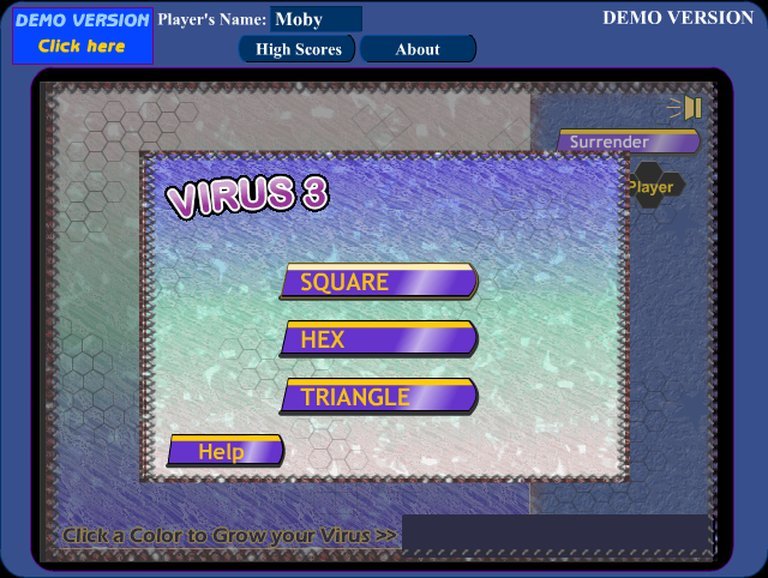
Virus 3 is a strategic puzzle game where players spread a ‘virus’ across a grid of colored cells, starting from a single cell in the top-left corner. In single-player mode, the goal is to conquer the entire board within a decreasing move limit, earning points for efficiency. The two-player mode pits opponents against each other to claim more territory, with the game ending when the board is fully occupied. The game features multiple cell shapes, board layouts, and color schemes, offering a mix of challenge and replayability.
Virus 3 Free Download
PC
Virus 3 Guides & Walkthroughs
Virus 3 Reviews & Reception
flashmuseum.org (100/100): Virus 3 is a truely intriguing game of strategy and skill
mobygames.com (66/100): Average score: 3.3 out of 5
Virus 3 Cheats & Codes
PC
Press [Keypad Enter] followed by P to enable cheat mode. Then, hold [Keypad Enter] and press one of the following keys to activate the corresponding cheat function.
| Code | Effect |
|---|---|
| F | Refuel |
| L | Extra life |
| C | Toggle special effects |
| N | Return to the game |
Virus 3: A Strategic Puzzle Masterpiece of the Early 2000s
Introduction: The Legacy of a Forgotten Gem
In the vast ocean of early 2000s browser games, Virus 3 (2003) stands as a quiet but brilliant testament to the enduring appeal of strategic puzzle design. Developed by Jetacer Interactive LLC, this turn-based tile-matching game refined the Filler concept into a deceptively simple yet deeply engaging experience. While it may not have achieved the mainstream recognition of contemporaries like Bejeweled or Tetris, Virus 3 carved out a niche for itself among puzzle enthusiasts, offering a unique blend of territorial expansion, color-based strategy, and competitive multiplayer dynamics. This review explores why Virus 3 remains a fascinating artifact of its era—a game that, despite its minimalist presentation, delivered a level of strategic depth rarely seen in browser-based puzzlers.
Development History & Context: The Rise of Browser-Based Strategy
The Studio and the Vision
Jetacer Interactive LLC, the developer behind Virus 3, was a small but ambitious studio operating in the early 2000s, a time when the internet was rapidly becoming a viable platform for gaming. The studio’s vision for Virus 3 was to create a puzzle game that combined the accessibility of browser-based play with the strategic depth of board games. The Filler concept, which had been explored in earlier games like 7 Colors (1991), provided the perfect foundation—a simple ruleset that could be expanded into a competitive and addictive experience.
Technological Constraints and Innovations
Released in November 2003, Virus 3 was constrained by the technological limitations of the era. Browser games were typically built using Flash or Java, and Virus 3 was no exception. The game’s top-down, fixed/flip-screen perspective and turn-based mechanics were optimized for low-bandwidth environments, ensuring smooth performance even on dial-up connections. Despite these constraints, Jetacer Interactive managed to pack a surprising amount of variety into the game, including:
– Three distinct cell shapes (square, hexagon, triangle)
– Multiple board layouts
– Variable color schemes
The browser version served as a “limited teaser” for a full retail Windows release, which included additional features like a two-player mode—a rarity for browser games at the time.
The Gaming Landscape of 2003
The early 2000s were a transitional period for gaming. While AAA titles like Half-Life 2 and The Sims dominated the retail market, browser games were gaining traction as a form of casual entertainment. Virus 3 emerged alongside other Flash-based puzzlers like Bubble Shooter and Zuma, but it distinguished itself by emphasizing strategy over reflexes. The game’s turn-based nature and competitive multiplayer mode made it a standout in a genre often dominated by fast-paced, single-player experiences.
Narrative & Thematic Deep Dive: The Metaphor of Infection
The Premise: A Game of Territorial Domination
Virus 3 is, at its core, a game about expansion and control. The player begins with a single cell in the top-left corner of a grid, representing the “virus.” The objective is to spread this virus across the entire board by selecting colors that border the player’s territory. Each move consumes a color, and all adjacent cells of that color are absorbed into the player’s domain. The metaphor of infection is central to the game’s identity, framing the player’s actions as a relentless, strategic spread of a digital pathogen.
Themes of Strategy and Adaptation
While Virus 3 lacks a traditional narrative, its gameplay mechanics convey themes of adaptation and resource management. The decreasing move limit in single-player mode forces players to think several steps ahead, weighing the risks of aggressive expansion against the need for efficiency. The two-player mode, meanwhile, introduces a layer of psychological strategy, as players must anticipate their opponent’s moves while maximizing their own territorial gains.
The Absence of Story: A Strength or a Weakness?
Unlike many modern puzzle games, Virus 3 does not attempt to wrap its mechanics in a narrative shell. There are no characters, no dialogue, and no overarching plot. Instead, the game relies entirely on its core gameplay loop to engage players. This minimalist approach is both a strength and a limitation:
– Strength: The lack of narrative allows the game to focus entirely on its strategic depth, making it accessible to players who prefer pure gameplay over storytelling.
– Weakness: Without a compelling story or characters, Virus 3 struggles to create an emotional connection with players, which may explain its relatively modest reception compared to more narrative-driven puzzlers.
Gameplay Mechanics & Systems: The Art of Territorial Expansion
Core Gameplay Loop: Simple Rules, Complex Strategy
The gameplay of Virus 3 is elegantly simple:
1. The player starts with a single cell.
2. On each turn, the player selects a color.
3. All cells of that color adjacent to the player’s territory are absorbed.
4. The goal is to cover the entire board within a limited number of moves.
This simplicity belies the game’s strategic depth. Players must carefully consider:
– Color distribution: Which colors are most abundant and where?
– Border expansion: How can they maximize the number of cells absorbed per move?
– Move efficiency: How can they minimize wasted moves to stay within the limit?
Single-Player Mode: A Test of Precision
In single-player mode, Virus 3 becomes a race against the move limit. Each level reduces the number of allowed moves by one, creating a escalating challenge that rewards foresight and adaptability. The scoring system incentivizes both speed and efficiency:
– Conquering cells grants points.
– Completing a level with leftover moves awards bonus points.
This creates a risk-reward dynamic where players must balance aggressive expansion with careful planning.
Two-Player Mode: Competitive Territorial Warfare
The two-player mode transforms Virus 3 into a head-to-head battle of wits. Players start from opposite corners of the board and compete to control the majority of cells. The game ends when the entire board is filled, and the player with the most territory wins. This mode introduces several strategic layers:
– Blockade tactics: Players can attempt to cut off their opponent’s expansion routes.
– Color denial: By absorbing key colors, players can limit their opponent’s options.
– Psychological play: Bluffing and misdirection become crucial, as players try to predict and counter each other’s moves.
Innovative Systems: Cell Shapes and Board Variety
Virus 3 distinguishes itself from other Filler-style games through its variety of cell shapes and board layouts:
– Square grids: The most straightforward, offering predictable expansion patterns.
– Hexagonal grids: Introduce diagonal adjacency, complicating strategic planning.
– Triangular grids: The most challenging, with irregular borders and unpredictable expansion paths.
This variety ensures that Virus 3 remains fresh and engaging, even after extended play sessions.
UI and Accessibility
The game’s user interface is functional but unremarkable, reflecting the technological constraints of the era. The mouse-driven controls are intuitive, allowing players to select colors and observe the results of their moves with minimal friction. However, the lack of visual feedback for potential moves—a feature that would become standard in later puzzle games—can make the game feel somewhat opaque to newcomers.
World-Building, Art & Sound: Minimalism in Design
Visual Design: Functional Aesthetics
Virus 3 adopts a minimalist visual style, with simple geometric shapes and a limited color palette. The game’s art direction is purely functional, prioritizing clarity and readability over artistic flair. The top-down perspective and fixed/flip-screen visuals ensure that the player’s focus remains on the strategic elements of the game, rather than on elaborate animations or detailed environments.
Sound Design: The Silence of Strategy
The game’s sound design is equally sparse. There are no musical scores, no voice acting, and no ambient sounds. The only auditory feedback comes from the subtle clicks and chimes that accompany each move, serving as a minimalist reinforcement of the player’s actions. While this lack of audio immersion may feel jarring to modern players, it aligns with the game’s focus on pure strategy.
Atmosphere: A Digital Battleground
Despite its minimalist presentation, Virus 3 creates a distinct atmosphere of digital warfare. The abstract nature of the gameplay—spreading a “virus” across a grid—evokes the feeling of a cybernetic conflict, where territory is measured in pixels and strategy is the only weapon. This atmosphere is reinforced by the game’s cold, clinical aesthetic, which strips away all distractions and forces the player to engage with the mechanics on a purely intellectual level.
Reception & Legacy: A Cult Classic in the Making
Critical and Commercial Reception
Virus 3 received limited critical attention upon its release, reflecting the niche status of browser-based puzzle games in 2003. The game’s MobyGames score is listed as “n/a,” indicating a lack of formal reviews, though it holds an average player rating of 3.3 out of 5. This modest reception is somewhat misleading, as Virus 3 developed a dedicated following among puzzle enthusiasts who appreciated its strategic depth and competitive multiplayer mode.
Evolution of the Filler Genre
Virus 3 is part of a broader lineage of Filler-style games, which includes titles like 7 Colors (1991), SameGame (1985), and Chain Shot! (1995). While it did not revolutionize the genre, Virus 3 refined its mechanics and introduced innovations like hexagonal and triangular grids, which would later influence other puzzle games. Its two-player mode, in particular, was ahead of its time, foreshadowing the competitive puzzle games that would emerge in the late 2000s and early 2010s.
Influence on Later Games
The legacy of Virus 3 can be seen in several later titles:
– Competitive puzzle games: Games like Puyo Puyo Tetris (2014) and Battleship Craft (2012) adopted similar head-to-head mechanics, where players compete to outmaneuver each other in a shared space.
– Territorial expansion games: The Civilization series and Risk-style board games owe a debt to Virus 3’s emphasis on strategic expansion and resource management.
– Browser-based strategy games: Virus 3 helped pave the way for more complex browser games, proving that deep strategy could thrive in a casual, accessible format.
Preservation and Modern Accessibility
Today, Virus 3 is preserved on platforms like the Internet Archive and Flash Museum, where it can be played in its original Flash format. While the game’s technology is outdated, its core mechanics remain as engaging as ever, offering a glimpse into the early days of browser-based strategy gaming.
Conclusion: A Strategic Puzzle Worth Remembering
Virus 3 is a game that defies easy categorization. It is neither a blockbuster hit nor a forgotten relic, but rather a quiet masterpiece of strategic puzzle design. Its minimalist presentation and lack of narrative may have limited its mainstream appeal, but these same qualities allow its gameplay to shine. By stripping away all distractions and focusing solely on the mechanics of territorial expansion, Virus 3 offers a pure, unadulterated strategic experience that remains compelling even two decades after its release.
In the pantheon of puzzle games, Virus 3 occupies a unique niche—a bridge between the simplicity of early arcade puzzlers and the complexity of modern strategy games. It is a testament to the power of elegant design, proving that even the most straightforward concepts can yield deep, rewarding gameplay. For fans of strategic puzzles, Virus 3 is a hidden gem well worth rediscovering.
Final Verdict: A brilliant but underappreciated strategic puzzle game that deserves a place in the history of browser-based gaming. 8.5/10