
- Release Year: 1998
- Platforms: Windows
- Publisher: Interplay Productions, Inc.
- Developer: VR Sports
- Genre: Sports
- Perspective: 3rd-person
- Game Mode: Single-player
- Gameplay: Baseball simulation, Home Run Derby, Season mode
- Setting: Sports stadium
- Average Score: 66/100
Description
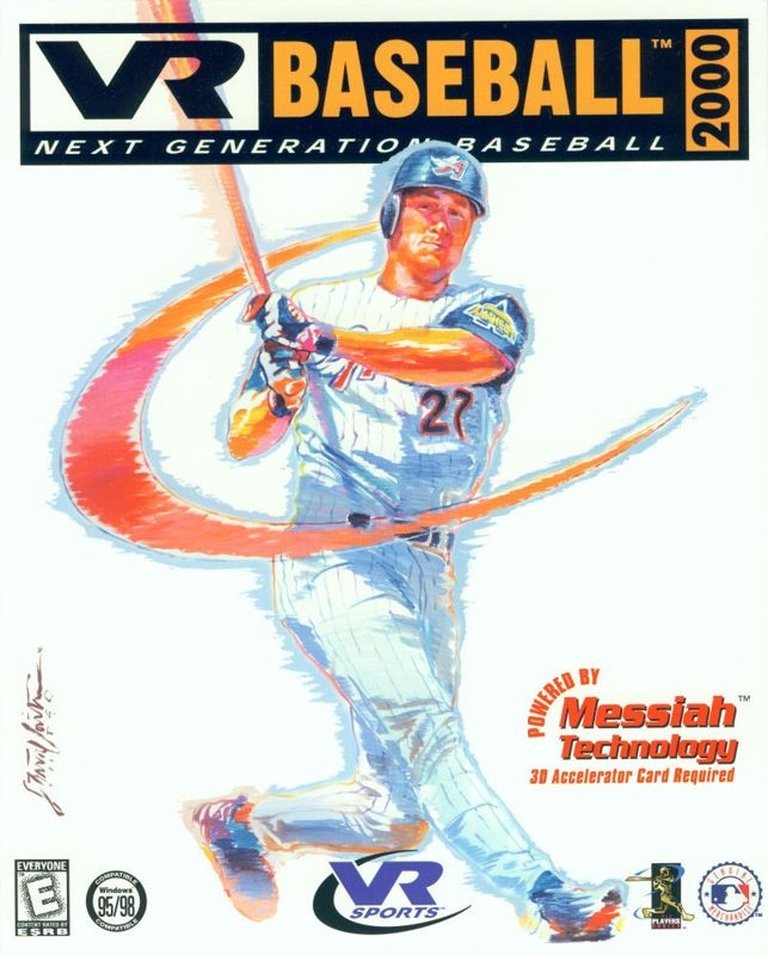
VR Baseball 2000 is an officially licensed MLB baseball simulation game released in 1998, featuring the 1999 season’s teams, rosters, and stadiums. Players can engage in full seasons, single matches, or the Home Run Derby, with over 750 players and 30 teams modeled after their real-life counterparts. Built on Shiny Entertainment’s Messiah engine, the game offers intuitive controls, solid gameplay, and above-average graphics for its time, though it lacks deep management features.
Gameplay Videos
VR Baseball 2000 Reviews & Reception
en.wikipedia.org (67/100): Considering the fact that Interplay was working with an untested engine this year, VR Baseball 2000 is pretty promising, but in many ways it’s still not quite there yet.
ign.com (60/100): A worthy pitcher-batter face-off is the saving grace of this threadbare outing.
espn.com (75/100): VR Baseball 2000 is a decent game but one that does not hold a clear edge over any of the others in the genre.
retrogek.com : Although it might not be as widely remembered as some blockbuster titles, it provided a solid representation of baseball for fans of the genre during the late 90s.
VR Baseball 2000: A Swing and a Miss in the Golden Age of Sports Simulations
Introduction
In the late 1990s, the baseball video game genre was a battleground of innovation, with developers vying to capture the magic of America’s pastime in digital form. Amidst this competitive landscape, VR Baseball 2000 emerged as a curious artifact—a game that promised next-generation visuals and deep simulation mechanics but ultimately fell short of its lofty ambitions. Developed by VR Sports and published by Interplay in 1998, VR Baseball 2000 was the third installment in the VR Baseball series, leveraging the much-hyped Messiah engine from Shiny Entertainment. Yet, despite its technical pedigree and MLB licensing, the game struggled to carve out a lasting legacy. This review explores VR Baseball 2000 in exhaustive detail, examining its development, gameplay, reception, and the reasons it remains a fascinating footnote in the history of sports gaming.
Development History & Context
The Studio and the Vision
VR Sports, a subsidiary of Interplay, was tasked with creating a baseball simulation that could compete with industry heavyweights like Triple Play and All-Star Baseball. The studio’s vision was ambitious: to deliver a game that combined realistic gameplay with cutting-edge graphics, powered by the Messiah engine—a technology touted for its ability to render over 100,000 polygons at high frame rates. The Messiah engine was a significant selling point, prominently featured on the game’s box art, and was intended to set VR Baseball 2000 apart from its contemporaries.
However, the development process was fraught with challenges. Interplay, the game’s publisher, was experiencing financial difficulties at the time, which likely impacted the game’s production. The Messiah engine, while powerful, was untested in the sports genre, and its integration into a baseball simulation proved more complex than anticipated. The result was a game that, while technically impressive in some areas, felt rushed and incomplete in others.
The Gaming Landscape of 1998
The late 1990s were a golden era for sports simulations. Games like Triple Play 99 and High Heat Baseball were setting new standards for realism, depth, and presentation. VR Baseball 2000 entered this competitive market with the goal of offering a unique blend of arcade accessibility and simulation depth. Its release in October 1998 placed it alongside other major titles, but it struggled to stand out in a crowded field.
The game’s use of the Messiah engine was a double-edged sword. While it allowed for fluid character animations and detailed player models, the engine’s strengths were not fully utilized. The stadiums, crowds, and overall presentation lacked the polish of competing titles, leaving VR Baseball 2000 feeling like a missed opportunity.
Narrative & Thematic Deep Dive
The Illusion of Realism
VR Baseball 2000 was marketed as a realistic baseball simulation, complete with official MLB rosters, stadiums, and player models. The game included 30 teams and 750 players, with a handful of star athletes modeled after their real-life counterparts. This attention to detail was intended to immerse players in the world of professional baseball, offering a sense of authenticity that was highly prized in sports simulations.
However, the game’s narrative and thematic execution fell short of its ambitions. While the inclusion of real-world teams and players added a layer of realism, the lack of a career mode or deep management features undermined the game’s potential as a true simulation. Players could engage in single games, full seasons, or the Home Run Derby, but the absence of a franchise mode or player development system left the experience feeling shallow.
Themes of Competition and Strategy
At its core, VR Baseball 2000 was about the strategic duel between pitcher and batter. The game’s pitching mechanics were particularly well-regarded, offering players a high degree of control over pitch selection, speed, and location. This focus on strategy was a strength, but it was not enough to elevate the game above its competitors.
The game’s themes of competition and strategy were further diluted by its presentation. The lack of dynamic camera angles, play-by-play commentary, and crowd reactions made the experience feel sterile. While the game captured the mechanics of baseball, it failed to convey the drama and excitement of the sport.
Gameplay Mechanics & Systems
Core Gameplay Loops
VR Baseball 2000 offered a straightforward baseball experience, with players taking on the roles of pitcher, batter, and fielder. The game’s controls were designed to be accessible, with a simple two-click system for batting and intuitive pitching mechanics. However, the simplicity of the controls came at the cost of depth, particularly in the batting and fielding systems.
Pitching: A Standout Feature
The pitching mechanics in VR Baseball 2000 were widely praised as the game’s strongest feature. Players could select from a variety of pitch types, adjust their speed, and target specific locations on the plate. The game also included a stamina system and a detailed scouting graph that tracked pitch locations and types. This level of control and feedback made pitching a strategic and engaging experience.
Batting: A Missed Opportunity
In contrast, the batting mechanics were criticized for their lack of depth. Players could choose between a normal swing, a home run swing, and a bunt, but there was no ability to aim the ball or adjust the batter’s stance. This oversimplification made batting feel less nuanced than in competing titles, where players had more control over the direction and trajectory of their hits.
Fielding: A Flawed System
Fielding was another area where VR Baseball 2000 struggled. The game lacked an auto-field option, requiring players to manually control their fielders. However, the camera system made it difficult to track the ball and determine which fielder was under the player’s control. This led to frustrating moments where fielders would fail to react to balls in play, undermining the game’s realism.
User Interface and Accessibility
The game’s user interface was functional but uninspired. Menus were straightforward, but the lack of depth in the game’s modes and features made the experience feel limited. The absence of a career mode or player management system was a significant oversight, particularly for fans of deep sports simulations.
World-Building, Art & Sound
Visual Presentation: A Mixed Bag
VR Baseball 2000’s visuals were a product of its time, leveraging the Messiah engine to deliver fluid animations and detailed player models. However, the game’s presentation was inconsistent. While the player models were well-rendered, the stadiums and crowds lacked detail, often appearing flat and lifeless. The game’s textures were also criticized for their low resolution, which detracted from the overall immersion.
The Messiah engine’s capabilities were not fully realized in VR Baseball 2000. While it allowed for high polygon counts and smooth animations, the game’s environments and crowd reactions felt underdeveloped. This disparity between the engine’s potential and the game’s execution was a recurring theme in reviews.
Sound Design: A Lack of Atmosphere
The game’s sound design was another area where VR Baseball 2000 fell short. While the crack of the bat and the roar of the crowd were present, the lack of play-by-play commentary and dynamic audio cues made the experience feel hollow. The crowd reactions were often misaligned with the on-field action, further detracting from the game’s immersion.
The absence of a commentator was particularly notable. While some games of the era featured robust commentary systems, VR Baseball 2000 relied on generic stadium announcements and umpire calls. This lack of personality made the game feel less engaging than its competitors.
Reception & Legacy
Critical Reception: A Divisive Release
VR Baseball 2000 received mixed reviews upon its release, with critics praising its pitching mechanics but criticizing its lack of depth and polish. The game’s aggregate score on GameRankings was 67%, reflecting its status as a middling entry in the genre.
Praise for Pitching, Criticism for Everything Else
Critics universally praised the game’s pitching mechanics, which were seen as a standout feature. However, the game’s batting, fielding, and presentation were widely criticized. Reviewers noted the lack of depth in the game’s modes, the underwhelming visuals, and the absence of features like a career mode or player management system.
A Game That Felt Unfinished
Many reviewers speculated that VR Baseball 2000 had been rushed to market, with some suggesting that Interplay’s financial troubles had impacted the game’s development. The game’s lack of polish and incomplete features led to a consensus that it was a missed opportunity—a game with potential that had not been fully realized.
Commercial Performance and Legacy
VR Baseball 2000 did not achieve significant commercial success, and it is largely forgotten today. The game’s legacy is one of unfulfilled promise, a title that could have been a contender but ultimately fell short of its ambitions.
The game’s use of the Messiah engine was a notable aspect of its development, but the engine’s potential was not fully exploited. Later titles, such as VR Football, would attempt to build on the lessons learned from VR Baseball 2000, but the series never achieved the same level of success as its competitors.
Conclusion: A Game of What-Ifs
VR Baseball 2000 is a fascinating case study in the challenges of game development. It was a game with ambitious goals, leveraging cutting-edge technology and a strong license, but it ultimately failed to deliver on its promise. The game’s pitching mechanics were a highlight, offering a level of depth and control that was praised by critics. However, the lack of polish in other areas—batting, fielding, presentation, and features—left the game feeling incomplete.
In the pantheon of baseball simulations, VR Baseball 2000 is a footnote—a game that could have been great but instead serves as a reminder of the importance of execution in game design. For fans of the genre, it is a curious artifact, a glimpse into what might have been had the development process been smoother and the game’s ambitions more fully realized.
Final Verdict: 6.5/10
VR Baseball 2000 is a game of contrasts—a title with standout pitching mechanics but lacking in depth and polish. While it offers a functional baseball experience, it is ultimately overshadowed by its contemporaries. For collectors and historians, it is a fascinating relic of the late 1990s sports gaming scene, but for most players, it is a game best remembered for its potential rather than its execution.