
- Release Year: 2000
- Platforms: PlayStation, Windows
- Publisher: Infogrames Europe SA, Infogrames France S.A.S., Infogrames Hudson K.K., Infogrames, Inc.
- Developer: Appaloosa Interactive Corporation
- Genre: Driving, Racing
- Perspective: Behind view
- Game Mode: Single-player
- Gameplay: Power-ups, Recordable replays, Weapons
- Setting: Cartoon
- Average Score: 80/100
Description
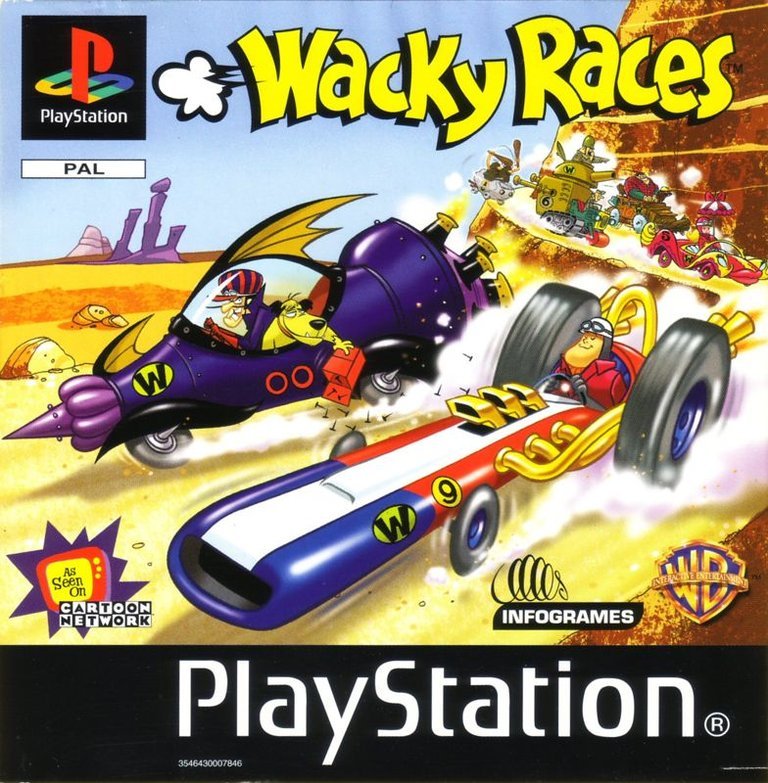
Wacky Races is a racing video game based on the classic Hanna-Barbera cartoon series. Players compete as iconic characters like Dick Dastardly, Muttley, Peter Perfect, and Penelope Pitstop, each with their unique vehicles, navigating through vibrant, cartoon-inspired tracks. The objective is to finish first to unlock new courses, while using an array of weapons to sabotage opponents and enhance progression.
Gameplay Videos
Wacky Races Free Download
Wacky Races Guides & Walkthroughs
Wacky Races Reviews & Reception
themediamanblog.com : the game is still a tonne of fun to play
imdb.com (80/100): Graphics are excellent and character voices are dead on!!
Wacky Races Cheats & Codes
PlayStation 2
Select the ‘Cheats’ option at the main menu and enter the code.
| Code | Effect |
|---|---|
| CHIMPGIVEAWAY | Unlocks all tracks |
| MONKEYSPOILERS | Unlocks all cars |
| GADGETDEAROUT | Unlocks all gadgets |
| THOSEWACKYKIDS | Enables Kid Mode |
| FASTCARSAGOGO | Sets Dastardly difficulty setting |
PlayStation
Select the ‘Cheats’ option at the main menu and enter the code.
| Code | Effect |
|---|---|
| CHIMPGIVEAWAY | Unlocks all tracks |
| GADGETCLEAROUT | Unlocks all gadgets |
| MONKEYSPOILERS | Unlocks all cars |
| THOSEWACKYKIDS | Enables Kid Mode |
| FASTCARSAGOGO | Sets Dastardly difficulty setting |
Dreamcast
For in-game codes, select ‘Cheats’ at main menu. For button sequences, use in specific modes. CodeBreaker codes require a cheat device.
| Code | Effect |
|---|---|
| WACKYGIVEAWAY | Unlocks all tracks and bosses |
| WACKYSPOILERS | Unlocks all cars |
| BARGAINBASEMENT | Unlocks all vehicle abilities |
| CRACKEDNAILS | Enables Hard as nails mode |
| Start + Select + A + B | Achieves zero lap time in trial mode |
| Start + Select + A + B | Finishes in first place in championship mode when in first position |
| 0119C5F0 000003FF | Unlimited Muttleys (CodeBreaker) |
| 0113678C 0000000A | Player 1 Unlimited Tokens in Battle Arena (CodeBreaker) |
| 001A78A9 00000005 | Unlimited Retries in Wacky Cup (CodeBreaker) |
Game Boy Color
Enter password ‘MUTTLEY’ or use button combinations during gameplay.
| Code | Effect |
|---|---|
| MUTTLEY | Unlocks all racers, tracks, and Crazy Cup |
| Start + Select | Ends championship level with points based on current position (Level Skip) |
| Start + Select + A + B | Achieves zero second lap time in trial mode |
Wacky Races (2000): A Cartoon Kart Racer’s Faltering Leap into the Third Dimension
Introduction: The Wackiest Race of All?
For a generation raised on Saturday morning cartoons, the sight of Dick Dastardly’s Mean Machine, Penelope Pitstop’s Compact Pussycat, and the Slag Brothers’ Boulder-Mobile careening through impossible landscapes is indelible. The 1968 Hanna-Barbera series Wacky Races was a masterclass in structured chaos, a premise so simple—eleven bizarre vehicles in a no-holds-barred cross-country rally—that it became a timeless template for competition comedy. Thus, when the kart racing boom of the late 1990s, ignited by Mario Kart 64 and solidified by Crash Team Racing, demanded more licensed mascots, a Wacky Races video game seemed not just logical, but inevitable. Released in 2000 by Infogrames across PlayStation, PC, and Game Boy Color (with a notably different, better-received Dreamcast/PS2 version following shortly after), this adaptation arrived with a specific mandate: to faithfully translate the slapstick spirit of the cartoon into an interactive format. My thesis is that Wacky Races (2000) is a fascinating, deeply flawed historical artifact—a game that captures the aesthetic and character of its source material with commendable gusto but stumbles critically in the translation of its essence into polished, engaging gameplay mechanics. It stands as a case study in the perils of rushing a licensed title into a saturated genre, where passion for the IP is visibly undermined by uneven execution, technical limitations, and a failure to grasp what made the original concept so dynamically fun.
Development History & Context: Infogrames’ Hanna-Barbera Gold Rush
The early 2000s were a period of aggressive expansion for French publisher Infogrames, which had acquired the Alone in the Dark and Rayman franchises and was aggressively pursuing licensed properties to bolster its family-friendly portfolio. The 1996 Time Warner acquisition of Turner Broadcasting had consolidated the vast Hanna-Barbera library under one corporate roof, making licenses like Wacky Races theoretically more accessible. Infogrames, having already collaborated with Warner on titles like Looney Tunes: Space Race, saw an opportunity to tap into the deep nostalgia for classic cartoons.
Development fell primarily to Appaloosa Interactive (formerly Novotrade), a Hungarian studio with a pedigree in licensed games and 3D tech (Duke Nukem: Total Meltdown, Penumbra: Overture years later). For the PlayStation and Windows versions, they aimed for a fully 3D, cel-shaded aesthetic to mimic the original cartoon’s hand-drawn look—a technically ambitious choice for the time that placed them alongside pioneers like Jet Set Radio (2000). The Game Boy Color version, developed by Velez & Dubail, was a separate, 2D project tailored to the handheld’s constraints, and it would ultimately receive significantly better reviews.
The creative vision, as outlined in press materials, was straightforward: replicate the “prank-pulling” and “character-driven” chaos of the TV show. However, this vision existed within stark technological and market constraints. The PlayStation was aging, struggling with texture-heavy 3D graphics, while the PC market was dominated by increasingly sophisticated racing sims and the juggernaut Crash Team Racing. The team’s solution—using cel-shading and a token-based gadget system—was conceptually sound but hampered by implementation issues. Reports from developers (via MobyGames credits) hint at a tight schedule; the game’s release was staggered (GBC in June 2000, PS1/PC in September 2000 EU/November 2000 NA), and the subsequent Dreamcast version, developed by Infogrames Sheffield House and released just months later, was widely perceived as a more complete, polished product. This suggests the PS1/PC version may have been the initial, rushed launch, with the Sheffield team refining the formula for Sega’s more powerful hardware. The result is a game that feels like a proof-of-concept that arrived at retail prematurely.
Narrative & Thematic Deep Dive: Capturing the Cartoon’s Soul, Missing its Spine
The genius of the original Wacky Races lay in its lack of traditional narrative. There was no overarching plot, just the relentless, episodic pursuit of victory through insane vehicles and even more insane sabotage. The 2000 game understands this “No Plot? No Problem!” ethos perfectly, a fact celebrated by its marketing and opening cinematics. The game presents itself as pure event: a series of races across surreal, themed environments. The only semblance of a story is a flimsy framing device: Dick Dastardly, in a pre-race cinematic, smugly offers the player a chance to drive his Mean Machine and win for him, a promise that is inevitably subverted when the player unlocks and steals the car. This moment, animated in full CGI (a stark contrast to the in-game graphics), perfectly encapsulates the cartoon’s dynamic where Dastardly’s schemes always backfire.
Where the game’s thematic execution becomes fascinating is in its Adaptational Badass treatment of Dick Dastardly. In the cartoon, Dastardly’s cheating was constant, elaborate, and invariably self-defeating; he never won. In the game, as noted by TV Tropes, he becomes a “serious competitor easily capable of winning races under his own power.” His boss races are brutally difficult, and his special ability—starting on “3” during the countdown—is a form of illegitimate advantage the AI uses relentlessly. The ultimate unlock, playing as Dastardly, is framed as a cosmic anomaly: the narrator’s voice drips with disgust or shock if you win, and Dastardly himself is gleefully surprised. This isn’t just a gameplay reward; it’s a meta-commentary on the cartoon’s central joke, finally allowing the cheater to triumph and breaking the fourth wall of the series’ own rules. It’s a clever, if somewhat cynical, interpretation that respects the spirit of the character while satisfying player power fantasies.
Conversely, the game’s treatment of the other characters is largely superficial. Penelope Pitstop remains the “damsel in distress” with a vehicle that can deploy a pancake flipper or a homing heart, but there’s no engagement with her series, The Perils of Penelope Pitstop. The Slag Brothers’ ability to pound each other (and their car) to tune it up is present, but their caveman simplicity is just a gameplay quirk. The thematic dissonance lies in the mismatch between the cartoon’s focus on creative sabotage and the game’s reliance on generic kart-racing power-ups (bubble gum, land mines, rocket launchers). While vehicle-specific gadgets like the Ant Hill Mob’s shutter shield or the Convert-a-Car’s transformations are conceptually strong, they often feel like variations on a theme rather than unique expressions of character. The world itself is just a series of racetracks (Canyon Craze, Silly Hills, Chilly Thrills, Down & Town), lacking the episodic, location-specific hazards of the original series (e.g., a race through a giant’s kitchen, an ocean crossing on a raft). The game has the who and the what of the cartoon, but misses the where and why that gave the original its idiosyncratic charm.
Gameplay Mechanics & Systems: A Token System in a Kart-Racing World
Gameplay is structured around a familiar mascot-racer template: choose a vehicle with unique stats (speed, acceleration, handling), race on circuits, collect power-ups, and use them to attack or defend. The game’s central, defining mechanic is the Wacky Token system. Instead of random power-up boxes, pink coin-like tokens float on the track. Collecting them fills a gauge that allows you to select from your vehicle’s pre-chosen set of three gadgets. This is a significant departure from Mario Kart, where items are random and often game-changing. Here, strategy is shifted to pre-race loadout and resource management during the race. Do you prioritize your primary attack (like the Creepy Coupe’s dragon fire) or your flight/defense ability? The tokens themselves are abundant, but using a gadget ejects the token back onto the track for others to grab, creating a tense, cyclical economy.
Vehicle Diversity & The Unlockable Hierarchy: The roster is a critical point of contention. The base game offers eight of the iconic eleven racers. The missing trio—the Ant Hill Mob (Bullet Proof Bomb), Professor Pat Pending (Convert-a-Car), and Rufus Ruffcut (Buzz Wagon)—are relegated to boss roles. This is a significant omission that dilutes the “all-stars” appeal, a fact heavily noted by critics like those at Absolute PlayStation who called it a “shocking game for such a massive franchise.” Unlocking the three boss vehicles (Red Max’s Crimson Haybailer, Pat Pending’s Convert-a-Car, and Dastardly’s Mean Machine) requires completing specific “Boss Challenges,” which are essentially elimination races. The Mean Machine is the ultimate prize, boasting randomized, powerful gadgets and superior stats. This progression loop—win championships to unlock bosses, beat bosses to unlock their cars—is sound in theory but undermined by the game’s shallow championship content.
Modes & Structure: The four modes—Time Trial, Championship, Multiplayer (split-screen), and Super Gadgets (an encyclopedia of abilities)—are standard for the genre. The Championship mode is the core single-player experience, but it is startlingly brief. Across four “themed” environments (Canyon, Forest, City, Snow), there are only 16 tracks, with an additional “Dick’s Revenge” championship unlocked after getting Dastardly. This pales in comparison to contemporaries. A “Golden Muttley Cup” variant adds a collectible requirement (find 10 trophies on the track and win), a clever twist that the PC Zone review highlighted as a rare moment of ingenuity.
Flawed Systems & “Cheap” Design: The game’s most damning critiques revolve around its AI and balance. The “Computer Is a Cheating Bastard” trope is in full effect, especially against bosses who have unlimited token access and can spam gadgets. More insidiously, as user reviewer “Jack the Critic” observed, the AI’s prowess is an illusion; once you learn the tracks and exploit the game-breaking shortcuts (present on many circuits, like the “big wheel” shortcut in Canyon Craze 2), races become trivial. This destroys competitive longevity. The handling physics are also inconsistent. While most cars have a distinct feel, the Turbo Terrific is notoriously awful, with a turning radius so wide it’s nearly undrivable—a glaring design flaw that a studio like Appaloosa should have caught. The lack of a difficulty slider means the experience is static, and the rubber-banding AI (where opponents magically catch up) is non-existent; instead, the race order can become absurdly static once a leader establishes a lead, making a 6th-to-1st surge impossible unless the leader crashes.
World-Building, Art & Sound: A Mixed Bag of Cel-Shaded Ambition
Visually, the game attempts a direct translation of the 2D cartoon into 3D via cel-shading. This is its most celebrated and most criticized aspect. On one hand, when it works, it works beautifully. The vehicle models are exceptionally faithful, capturing the exaggerated proportions and Patchwork designs of the originals. The mean Machine’s jagged edges, the Creepy Coupe’s spooky castle turret, the Boulder-Mobile’s literal boulders—all are rendered with a charming, toy-like quality. The environments, while simplistic, use bold, flat colors and lack realistic texture mapping, which actually helps maintain the cartoon illusion. A track like Down & Town or Wood Stockage (for Red Max) evokes the show’s background art style.
On the other hand, the execution is often poor. Across all platforms, but especially on the base PlayStation (which Video Games (German) savaged for “pixel clipping”), the cel-shading is inconsistently applied. Outline thickness flickers, and textures are often blurry, low-resolution messes that resemble “painted-on” decals rather than cohesive surfaces. The character models are the biggest letdown. Drivers are static, minimally animated figures glued into their cockpits. Dick Dastardly and Muttley in the Mean Machine aren’t even given arms! This isn’t a hardware limitation; it’s a resource allocation failure—the studios clearly prioritized the cars over the characters, a cardinal sin for a character-driven franchise. The few 2D-animated cutscenes (like Dastardly’s offer) are a highlight, using authentic-looking animation drawn in the show’s style, but they are few and far between.
Sound design and voice acting are a relative bright spot. Infogrames secured original and legacy voice talent: Janet Waldo (Penelope Pitstop) and John Stephenson (the Narrator) reprised their roles. Jim Cummings, the iconic voice of Darkwing Duck and many Disney characters, took over as Dick Dastardly, capturing Paul Winchell’s wheedling, scheming cadence perfectly. Billy West voiced Muttley. The sound effects—boings, crashes, whistle sounds—are lifted directly from the cartoon’s library, creating an aurally authentic experience. The soundtrack, however, is generic early-2000s rock/pop loops that do nothing to enhance the atmosphere. The disconnect is palpable: you hear the genuine cartoon, but see a muddy 3D approximation.
Reception & Legacy: A Tale of Two (or Three) Versions
The critical reception for Wacky Races (2000) was overwhelmingly mixed to negative, but it must be parsed by platform.
-
PlayStation / PC (Appaloosa version): These fared disastrously. On Metacritic, the PC version holds a 64/100 (based on 4 reviews), but individual scores were brutal: Absolute PlayStation (34/100), CVG (40%), NowGamer (44%). The aggregate GameRankings scores are telling: PC 51%, PS1 32%. Criticisms were universal: shallow gameplay, terrible AI, lack of content, poor graphics on PS1, and the cardinal sin of not including all 11 racers. As IGN’s Vincent Lopez summarized, it was a “simplistic, cute looking, but overall shallow experience.” It was seen as a cheap, rushed knock-off in an era where Crash Team Racing (88 Metascore) and Mario Kart 64 had set a high standard. It was, in the words of one critic, “a missed chance.”
-
Game Boy Color (Velez & Dubail version): This port was a shockingly positive outlier. With a MobyScore of 7.9 and a GameRankings aggregate of 78%, it was praised by IGN (8/10) and GameSpot (8.6/10) for its tight controls, enjoyable sense of speed, and smart adaptation to the handheld’s limits. By trimming the roster to a manageable number and focusing on clean 2D gameplay, it avoided the 3D pitfalls of its siblings. It’s a classic case of a portable game understanding its constraints and succeeding within them.
-
Dreamcast / PlayStation 2 (Infogrames Sheffield House version – Wacky Races: Starring Dastardly and Muttley): This is the version the game is known for among hardcore fans. Released within a year, it was a near-total overhaul. It featured true cel-shading (a visual landmark), a new city area (“The Big Apricot”), improved physics, four-player support, and a more robust “Adventure” mode with gold stars and Wacky Trial clocks. It was critically acclaimed (Dreamcast 84% on GR, PS2 70%) and is remembered as a solid, fun kart racer. The existence of this superior version hung over the PS1/PC releases, making them look like cynical cash-ins.
Legacy: The 2000 Appaloosa version has largely been erased from the cultural memory. It is not the version celebrated in retrospectives, nor is it the one that influenced later games. Its legacy is one of caution: a warning about the dangers of misjudged licensed adaptations. The real legacy of the Wacky Races name in gaming belongs to the Sheffield House version and the later Mad Motors (2007). The PS1/PC game is a footnote—a “what not to do” example where a powerful license was squandered by uneven development, missing content, and a failure to distinguish itself in a crowded field. Its only lasting impact may be as a curator’s piece for Hanna-Barbera completionists, a painful reminder that even the most beloved IPs are not immune to the brutal realities of game development.
Conclusion: The Checkered Flag of Compromise
Wacky Races (2000) for PlayStation and PC is a game of profound contradictions. It is a love letter to Hanna-Barbera’s classic rendered with a sincere attempt at visual innovation (cel-shading), yet its core gameplay is hollow and its character representation is incomplete. It understands the iconography of the cartoon—the cars, the sounds, the villains—but fundamentally misunderstands the dynamics. The cartoon’s humor came from the unpredictable, physics-defying application of each vehicle’s unique gimmick within a race. The game reduces this to a repetitive token-collecting exercise with generic weapon effects, stripping away the contextual creativity.
Its place in video game history is that of a failed transitional product. It arrived at the tail end of the PS1’s life cycle, attempting to bridge a classic 2D cartoon property with the then-novelty of 3D mascot racing. Its technical ambition was not matched by technical proficiency or design depth. Compared to the polished, joyful experience of the Dreamcast version that followed, or the tight, focused GBC version, it feels like an early beta. For journalists and historians, it serves as a crucial case study in license management (the decision to omit key racers is baffling), platform-specific development pitfalls (the PS1 was not the机器 for cel-shading), and the critical importance of gameplay feel over cosmetic fidelity.
In the pantheon of licensed kart racers, Wacky Races (2000) does not stand alongside the greats. It is neither a forgotten gem nor a so-bad-it’s-good curiosity. It is, quite simply, a mediocre, flawed adaptation that failed to leverage its unparalleled source material. Its ultimate verdict is that of the cartoon’s own narrator: it tried to win, but in the end, it was “foiled again” by its own shortcomings. The race was wacky, but the game was just plain sloppy.