
- Release Year: 1996
- Platforms: Windows
- Publisher: New World Computing, Inc.
- Developer: Random Games, Inc.
- Genre: Strategy, Tactics
- Perspective: Isometric
- Game Mode: Single-player
- Gameplay: Mercenary management, Squad management, Tactical simulation, Turn-based combat
- Setting: 2000s, Near-future
- Average Score: 73/100
Description
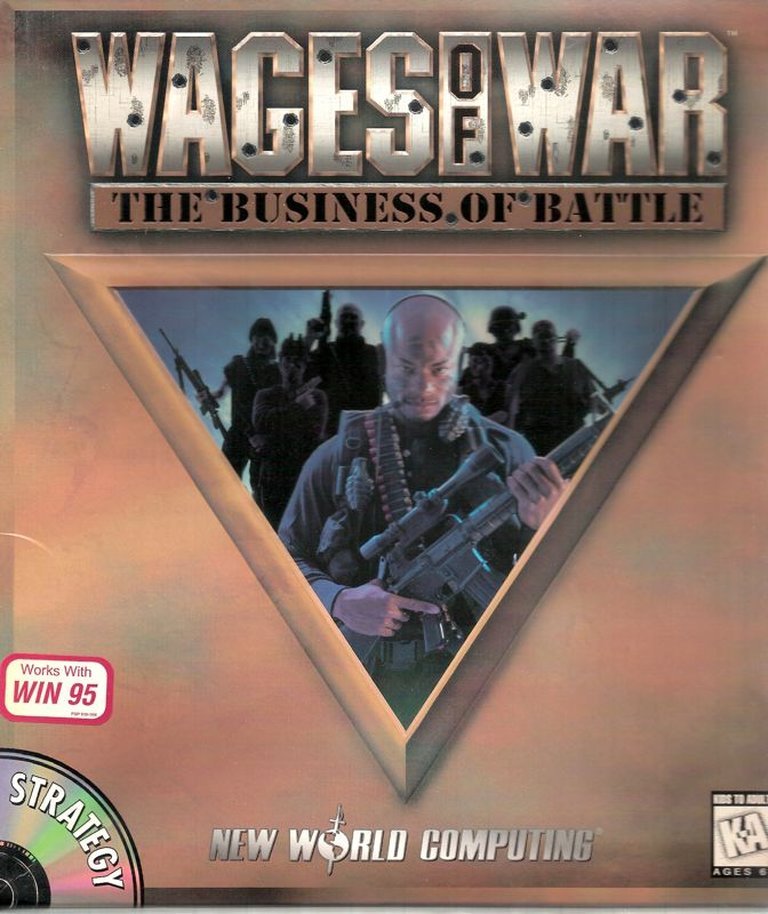
Wages of War: The Business of Battle is a turn-based tactical simulation where you command a mercenary company in the year 2001. The goal is to maximize profits by successfully completing missions while managing resources and minimizing casualties, competing against both enemy forces and rival mercenary groups.
Gameplay Videos
Wages of War: The Business of Battle Free Download
Wages of War: The Business of Battle Patches & Updates
Wages of War: The Business of Battle Mods
Wages of War: The Business of Battle Reviews & Reception
gamespot.com (82/100): Kick ass, take names, and collect your paychecks! Wages of War is outstanding – when it doesn’t crash.
Wages of War: The Business of Battle Cheats & Codes
PC
Type ‘blood money’ to enable cheat mode, then enter one of the following codes to activate the corresponding cheat function.
| Code | Effect |
|---|---|
| ADJECTIVES | Max out all mercs |
| BILL | Max out current merc |
| VERB | Extra ammo |
| LIBERTY | All weapons and max stats |
| FILL MAGAZINE | Abdul’s magazine gets two of everything |
| ELBOW ROOM | 999 action points |
| NOUN | Max health |
| DEADMAN | Kill all enemies |
| SMOKE | 25 smoke grenades |
| TIMERS | 10 satchel charges and 10 timers |
| 911 | 10 first aid kits |
| STATS | Max stats |
| MORTAL | Average stats |
| HOUR | Add one hour to game time |
| MMIN | Add five minutes to mission time |
| SET MINE | Place mine at current merc |
| OH DARN | 100 random mortar rounds launched |
| BANG | Activate all damage links |
| EXPLODE | Activate all destroy links |
| SEND IN THE CLOWNS | Clown theme |
| OH BOYS | Turn clowns off |
Wages of War: The Business of Battle: Review
Introduction
In the late 1990s, as the tactical strategy genre blazed a trail into complex simulations of warfare, few titles dared to dissect conflict through the cold lens of capital. Wages of War: The Business of Battle (1996), an isometric turn-based strategy developed by Random Games and published by New World Computing, stands as a bold, if flawed, artifact of this era. It eschewed the heroism of mainstream war games to instead cast players as CEOs of a mercenary empire, where victory was measured not in captured flags, but in profit margins and market dominance. This review deconstructs Wages of War as a product of its time—a game that married ruthless realism with ambitious systems, yet faltered under the weight of clunky interfaces and technical instability. Its legacy lies not as a landmark title, but as a fascinating bridge between X-COM’s tactical depth and Jagged Alliance’s narrative grit, offering a starkly cynical vision of war as a ledger sheet.
Development History & Context
Emerging in 1996—an year saturated with tactical titans like X-COM: Terror from the Deep and Jagged Alliance 2—Wages of War was the brainchild of Random Games, a small studio with no prior major releases. Its publisher, New World Computing (fresh off the Might & Magic franchise), injected resources and credibility, yet the project’s ambition outpaced its execution.
The game was built for Windows 95, leveraging CD-ROM media to deliver SVGA graphics and digitized voice acting—a technological step up from DOS-era contemporaries. However, the era’s constraints are palpable: the isometric view, while crisp, lacked true 3D height modeling, and the “Random Games 1996-2000 Strategy Engine” struggled with stability, leading to frequent crashes (a bane noted by critics). The gaming landscape demanded polish, but Wages of War arrived with a niche focus. While titles like Command & Conquer thrived on accessible real-time action, Wages of War doubled down on grim simulation, aiming to satiate hardcore strategists seeking “a true focus on realism” that X-COM only hinted at. Its near-future setting (year 2001) was prescient in its dystopian leanings, predating modern anxieties about privatized warfare and corporate geopolitics.
Narrative & Thematic Deep Dive
Wages of War’s narrative is a tapestry of corporate cynicism and geopolitical decay. Set in a post-apocalyptic 2001, the premise hinges on a Middle Eastern conflict that annihilates global oil reserves, collapsing superpowers and empowering terrorist syndicates and drug cartels. The player assumes the role of the CEO of “Mercs, Inc.,” a mercenary company headquartered in Australia, where governments offer $500,000 grants to entrepreneurs in this fractured world. There are no grand heroes here; players negotiate contracts via fax with shadowy clients—from governments to corporations—while competing against rival mercenary firms.
The plot unfolds through 16 linear missions, framed as profit-driven errands: infiltrate a warlord’s stronghold, protect a convoy, or recover stolen biotech data. Dialogue is sparse and utilitarian, with mercenaries responding to commands via generic radio static (“Copy that” or “Under fire!”). Character development is nearly nonexistent; the 60 recruitable mercenaries boast attributes like Experience and Will but lack the idiosyncratic personalities of Jagged Alliance’s IMPs. The narrative’s strength lies in its thematic grit. War is not glory but a ledger: “Winning missions is not enough,” the game insists. “The player must win each mission while making the greatest profit possible.” This extends to systems like leasing weapons (“in the future, it’s a no-no to own weapons of war”) and hiring intelligence brokers, where information costs directly impact mission viability. The game’s bleak worldview is underscored by its absence of moral choices; every contract is a transaction, and collateral damage is just a line item on a balance sheet.
Gameplay Mechanics & Systems
Wages of War’s core loop bifurcates into two phases: theOffice Interface (logistics) and the Mission Interface (combat), each with distinct mechanics and flaws.
Office Interface (The “Fax Dance”):
Pre-mission preparation is a meticulous, if tedious, process. Players negotiate contracts—haggling over payment, deadlines, and objectives via a simulated fax machine. This is followed by selecting intelligence agencies, leasing weapons from black-market brokers, arranging travel logistics, and training mercenaries. The interface, however, is a masterclass in frustration. Each phase involves repetitive “phone-and-fax” exchanges, with no visual feedback beyond text. As one review lamented, it’s “the fax dance again,” where players cycle through menus with little efficiency. Resource management is punishing: weapon failures (jammed rifles, dud grenades) and cost overruns can bankrupt a company, forcing players to balance risk and reward in every decision.
Mission Interface (Tactical Combat):
Combat unfolds on an isometric grid using an innovative initiative system. Unlike standard turn-based mechanics, all combatants (player and AI) act in order of their initiative score—a composite of Experience and Will attributes. This creates dynamic, tension-filled sequences where a elite merc might interrupt an enemy’s move, but a rookie’s hesitation could prove fatal. Action points govern movement, firing, and abilities, with suppression fire reducing enemy APs—a realistic touch that rewards tactical positioning.
The system’s depth, however, is undermined by a clunky UI. Commanding mercenaries requires navigating unintuitive menus, and the lack of a tactical map or clear line-of-sight indicators hinders planning. Weapon variety is impressive: from Uzis and M-60s to mortars and crossbows, but their lease-based nature adds financial pressure. Environmental factors like rain (slowing movement) and wind (affecting grenade trajectories) add realism but also complexity. Ultimately, the combat is methodical and unforgiving, demanding patience over pyrotechnics.
Progression & Content:
Mercenaries gain experience and skills, but with no persistent narrative hooks, their growth feels mechanical. The absence of multiplayer, a scenario editor, and a campaign beyond 16 missions cripples replayability—a stunning omission for a genre thriving on user-generated content.
World-Building, Art & Sound
Wages of War’s world-building is its strongest asset. The near-future setting is richly detailed: maps span war-torn cities, jungles, and drug-cartel strongholds, each reflecting the game’s geopolitical lore. The manual expands on the post-oil-collapse world, with factions like the unified “New Americas” and privatized armies, creating a believable, if grim, tapestry.
Artistically, the game excels for its era. SVGA graphics render detailed soldiers, vehicles, and environments with crisp clarity. The isometric perspective effectively conveys 3D space without true elevation modeling, though destructible scenery is disappointingly sparse. Character designs are functional, with mercenaries differentiated solely by gear rather than visual identity.
Sound design is a mixed bag. Weapon fire, explosions, and ricochets are impressively realistic, immersing players in the chaos of battle. Voice acting, however, is the game’s nadir: mercenaries deliver lines with flat monotony, while cutscenes feature cheesy inflections (“We’re going in hot!”). The soundtrack is minimal, relying on ambient tension over melodic cues, which underscores the game’s sterile, corporate tone.
Reception & Legacy
At launch, Wages of War polarized critics, earning a middling 65% average on MobyGames. Praise was reserved for its ambition: GameSpot awarded it 82%, calling it “outstanding—when it doesn’t crash,” while Power Play (81%) lauded its “X-COM-like, spannungsgeladenes Flair” (tense atmosphere). However, the consensus underscored its flaws. Computer Gaming World (60%) deemed its mercenaries “lacking personality,” and PC Player (40%) noted that “every excitement is stifled by the heavy interface.” Players rated it 3.9/5, with retrospectives criticizing its “lack of replayability” and “frustrating quirks.”
Commercially, the game was a niche hit, overshadowed by genre giants. Its legacy is one of “what could have been.” It influenced later tactical titles by emphasizing simulation over spectacle, but failed to innovate beyond its core ideas. Modern preservationists debate its merits: while MyAbandonware users lament its unavailability (“It’s not on sale! Not anywhere!”), modders praise its moddable .dat files, allowing enthusiasts to tweak weapons and scenarios. Its true impact lies as a historical artifact—a precursor to games like Shadow Tactics that blend tactics with economic systems, albeit with far greater polish.
Conclusion
Wages of War: The Business of Battle is a time capsule of tactical gaming’s experimental phase. Its vision of war as a soulless enterprise was ahead of its time, presaging modern debates about military privatization. Yet, groundbreaking ideas—an initiative-based combat system, mercenary leasing, and profit-driven objectives—are shackled to archaic design. The “fax dance” management and clunky UI make it a chore to play, while its static campaign and lack of personality ensure it never reaches the heights of Jagged Alliance.
For historians, it’s a fascinating, flawed document of 90s ambition. For players, it’s a curio best approached with patience and a DOSBox. In the pantheon of tactical strategy, Wages of War never ascended to greatness, but its unflinching lens on the business of battle ensures it remains a uniquely cynical, and compelling, relic of an era when war games dared to ask: what if the real prize wasn’t victory, but the bottom line?