
- Release Year: 1995
- Platforms: Arcade, Nintendo 64, PlayStation, Windows
- Publisher: GT Interactive Software Corp., Midway Home Entertainment, Inc., Midway Manufacturing Company
- Developer: Midway Manufacturing Company
- Genre: Action
- Perspective: Third-person
- Game Mode: Single-player
- Gameplay: Arcade, Fighting
- Setting: Ancient Civilizations
- Average Score: 39/100
- Adult Content: Yes
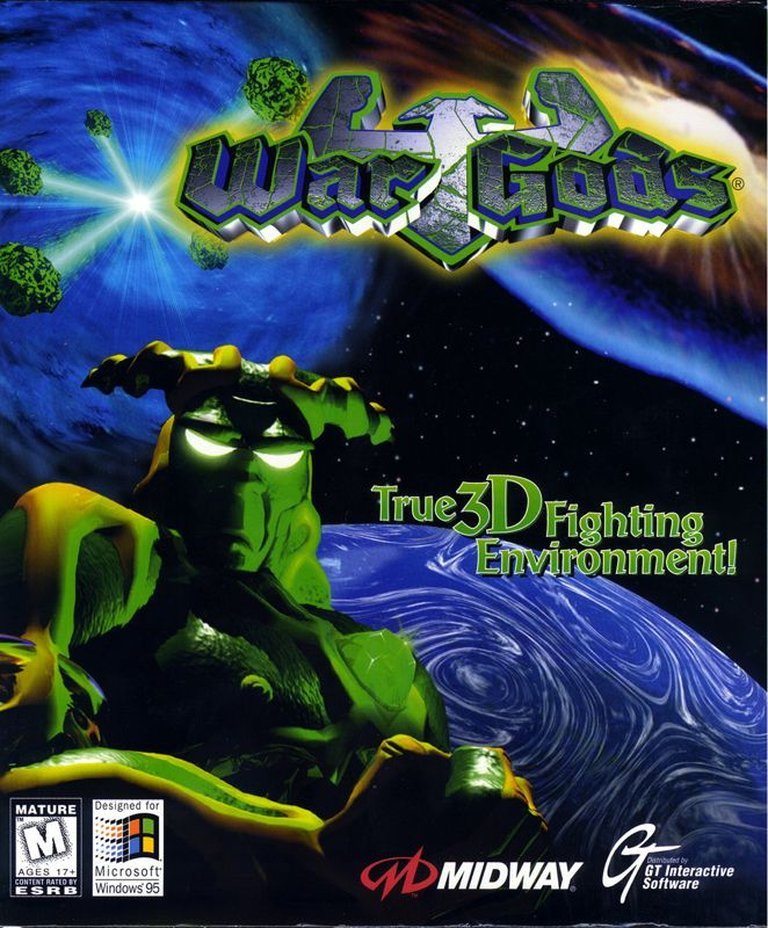
Description
War Gods is a one-on-one 3D fighting game where players battle across diverse environments with fighters inspired by ancient civilizations. Featuring a combo system and gruesome finishing moves, the game offers intense arcade-style combat. Its standout graphical style uses texture-mapped 3D models layered with digitized photos, creating a semi-realistic visual aesthetic. With 10 unique characters, each representing different mythological or historical themes, the game blends fast-paced action with strategic move combinations.
Gameplay Videos
War Gods Free Download
War Gods Guides & Walkthroughs
War Gods Reviews & Reception
gamepressure.com (39/100): A brutal 3D fighting game, in which beings endowed with incredible powers stand to fight to the death.
War Gods Cheats & Codes
Nintendo 64 (N64)
Enter button sequences at the title screen or character selection screen.
| Code | Effect |
|---|---|
| Right, Right, Right, B, B, A, A | Unlock Cheat Menu |
| Left, Down, Down, Right, Left, Up, Left, Up, Right, Down | Play As Exor |
| Down, Right, Left, Left, Up, Down, Right, Up, Left, Left | Play As Grox |
| C-Left, C-Left, Right, A, B, C-Up, C-Right | Infinite Credits |
| Up + Start | Random Character Select |
PlayStation (PSX/PS1)
Enter four-digit passwords at the options screen or select codes at the character select screen.
| Code | Effect |
|---|---|
| 2358 | Invincibility for Player One |
| 1224 | Invincibility for Player Two |
| 7879 | Power-up Player One |
| 3961 | Power-up Player Two |
| 7453 | Enable Fatalities |
| 0322 | Enable Easy Fatalities (HP + LK) |
| 4258 | Quick Game |
| 0705 | Infinite Credits / Freeplay |
| 6969 | Play As Grox |
| 2791 | Play As Exor |
| 5550 | Level Select (Level 1) |
| 5551 | Level Select (Level 2) |
| 5552 | Level Select (Level 3) |
| 5553 | Level Select (Level 4) |
| 5554 | Level Select (Level 5) |
| 5555 | Level Select (Level 6) |
| 5557 | Level Select (Secret Level) |
| Up + Start | Random Character Select |
PC
Enter four-digit codes in the cheat box at the top right of the ‘Advanced’ page under ‘Properties’.
| Code | Effect |
|---|---|
| 1971 | Player 1 Invincible |
| 1515 | Player 2 Invincible |
| 0708 | Player 1 Does More Damage |
| 3366 | Player 2 Does More Damage |
| 3871 | Player 1 can play as Grox |
| 9021 | Player 2 can play as Exor |
| 1037 | Press HP-LK to do Fatality Moves |
| 2509 | Brings up Freeplay in options menu |
| 4774 | Ends game after defeating one opponent |
| 9997 | Play on Secret Arena |
| 5721 | Displays frame rate |
| 9990 | Level Select (Level 1) |
| 9991 | Level Select (Level 2) |
| 9992 | Level Select (Level 3) |
| 9993 | Level Select (Level 4) |
| 9994 | Level Select (Level 5) |
| 9995 | Level Select (Level 6) |
| 9996 | Disable Level Selection |
War Gods: Forgotten Battleground of Midway’s 3D Ambitions
Introduction
When arcades dominated gaming culture, Midway Manufacturing etched its name in history with Mortal Kombat’s bone-cracking brutality. In 1996, amid the industry’s shift to 3D, Midway gambled on War Gods—a fighter promising mythic spectacle and dimensional innovation. But what arrived was a janky, disjointed brawler that struggled beneath technical constraints, derivative design, and the weight of its own ambition. This review dissects War Gods’ rise and fall: a cautionary tale of transitional-era experimentation, where digitized gore clashed with polygonal growing pains, cementing its fate as a footnote rather than a phoenix.
Development History & Context
Midway’s Identity Crisis
By the mid-90s, Midway faced pressure to evolve beyond Mortal Kombat’s 2D dominance. With Tekken and Virtua Fighter redefining 3D combat, War Gods emerged as a proving ground for the studio’s “Zeus” engine—later retooled for Mortal Kombat 4. Developed by a secondary team led by Joe Linhoff (system design) and George Petro (gameplay), the project began as a tech demo hybridizing Cruis’n USA’s hardware with a 100MB hard drive for asset storage.
Digital Skin: Innovation Meets Limitation
The game’s “digital skin” technology—mapping photographs of live actors onto rudimentary 3D models—aimed for realism but faltered under hardware constraints. Motion capture, performed by just two actors, resulted in stiff animations reused across the roster. Delays plagued development; previewed at trade shows in early 1996, War Gods’ arcade launch was pushed to Q3 after testers criticized unbalanced mechanics.
A Crowded Arena
War Gods debuted in a fractured market: Sega’s Virtua Fighter 3 dazzled with fluidity, while Tekken 2 refined 3D combat depth. Midway’s own Mortal Kombat Trilogy (1996) dominated sales, leaving War Gods stranded between legacy expectations and next-gen aspirations. Ports to N64, PlayStation, and Windows in 1997—handled by Eurocom—added minor tweaks (like reduced difficulty) but failed to address core flaws, dooming its commercial viability.
Narrative & Thematic Deep Dive
A Melting Pot of Missteps
War Gods’ premise drips with 90s edginess: an alien ore crash-lands on Earth, granting ten mortals godlike powers, who then battle for supremacy. Characters span global myths—Egyptian grave robber Anubis, Norse valkyrie Vallah, Aztec priest Ahau Kin—yet their backstories drown in cliché. CY-5, a cyborg from 2096, and Tak, a living stone idol, hint at creativity, but their dialogue (e.g., Exor’s taunt: “You cannot defeat me!”) is boilerplate arcade fare, lacking Mortal Kombat’s dark charisma.
Thematic Bankruptcy
Beneath the lore lies a vacuous core. The ore’s corrupting influence—a metaphor for power’s allure—is underexplored. Each fighter’s ending repeats the same generic victory text, undermining narrative stakes. Unlike MK’s realm-hopping epic, War Gods feels like a tournament stripped of consequence, reducing its gods to hollow avatars for procedural violence.
Gameplay Mechanics & Systems
A Mortal Kombat Clone in 3D Clothing
War Gods replicates MK’s control scheme: high/low punches, kicks, blocks, and a dedicated “3D” button for sidestepping. Yet this added axis feels half-baked; holding the button triggers pre-scripted dodges rather than true spatial control. Combos—advertised as intricate—often devolve into button mashing, with trap moves (like Pagan’s lightning spheres) breaking flow.
Technical Faceplants
- AI: Opponents oscillate between brain-dead predictability (on “Very Easy”) and relentless, frame-perfect assaults (on harder settings).
- Progression: Arcade mode offers no unlocks beyond boss fights (Grox, Exor), while home ports omit training or versus options, echoing MobyGames’ critique: “bare bones… no reason to replay.”
- Fatalities: Gruesome finishers—Pagan’s Medusa-head petrification, Warhead’s nuclear detonation—lack MK’s tactile satisfaction due to clunky inputs and choppy animations.
The Ports’ Downfall
Nintendo 64’s cartridge limits exacerbated compromises; textures blurred, framerates dipped to 20 FPS, and the controller’s analog stick clashed with digital inputs. PC players battled installation bugs, while PlayStation’s load times tested patience. Eurocom’s ports, though faithful, amplified the arcade original’s flaws.
World-Building, Art & Sound
Digital Skins, Plastic Souls
War Gods’ aesthetic is a study in dissonance. “Digital skin” textures—meant to blend realism with fantasy—created uncanny, jagged models (IGN’s Matt Casamassina likened them to “ugly mannequins”). Egyptian pyramids and samurai dojos rotate dynamically but feel sterile, lacking interactive elements beyond cosmetic hazards (e.g., Warhead’s missile silo).
Sound: A Silver Lining
Vincent Pontarelli’s score mixes orchestral bombast with synth eeriness—Anubis’ desert stage channels Middle Eastern motifs, while Exor’s lair throbs with alien dread. Jeff Morrow’s announcer barks (“Finish him!”) inject urgency, and punch effects land with crunchy satisfaction. It’s a fleeting triumph in a视听 landscape otherwise marred by repetitive groans and forgettable ambiance.
Reception & Legacy
Critical Backlash
- Consensus: Averaging 52% on MobyGames, critics lambasted shallow mechanics (“Mortal Kombat with none of the charm” —IGN) and lazy design (“characters as exciting as dirt” —Game Revolution).
- Commercial Flop: Arcade cabinets saw limited distribution; N64 and PlayStation ports sold ~200K combined—paltry next to Mortal Kombat Trilogy’s millions.
- Censorship: Germany’s BPjS indexed it in 1997 for violence, curtailing its European reach.
A Faint Echo in Gaming History
War Gods’ legacy is paradoxical: a commercial failure that indirectly shaped Mortal Kombat 4’s 3D transition. Its “digital skin” tech, while flawed, informed NetherRealm’s later work. Today, it’s a cult curiosity—preserved in MAME emulation and YouTube retrospectives celebrating its so-bad-it’s-good jank—but remains a stark reminder of how not to innovate in a genre crossroads.
Conclusion
War Gods is gaming archaeology: a relic of an industry scrambling to adapt to 3D. Midway’s ambition—to marry MK’s brutality with polygonal spectacle—buckled under rushed development, technical myopia, and a roaster of forgettable combatants. While its sound design hints at untapped potential and its digital skin tech paved modest ground, the game crumbles under dated systems and uninspired design. In the pantheon of fighters, War Gods isn’t a deity—it’s a cautionary mortal, remembered not for glory, but for the hubris of its fall. For historians, it’s a fascinating artifact; for players, it’s a battle best left in the past.