
- Release Year: 2008
- Platforms: Windows
- Publisher: Atari Europe S.A.S.U., TGC – The Games Company GmbH
- Developer: Enigma Software Productions, S.L.
- Genre: Strategy, Tactics
- Perspective: Diagonal-down
- Game Mode: Single-player
- Gameplay: Diplomacy, Environmental interactions, Real-time, Research, Resource Management, Tactical Combat, Turn-based, Unit formations
- Setting: World War II
- Average Score: 67/100
Description
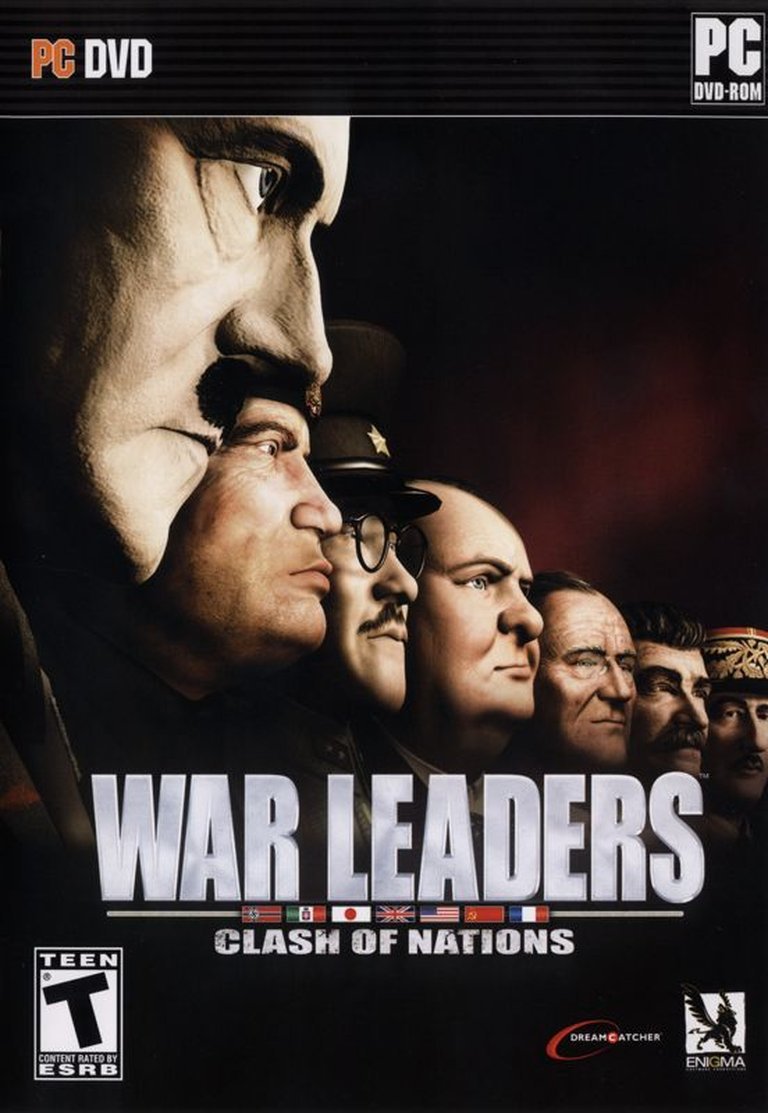
War Leaders: Clash of Nations is a strategic game blending turn-based and real-time elements, set during World War II. Players manage nations by recruiting armies, conducting diplomacy, and researching advancements in a turn-based mode, while battles unfold in real-time with tactical depth, including unit formations, environmental advantages, and the influence of special ‘war leaders’ who boost local loyalty. The game features 175 provinces and seven playable nations, offering a mix of automated or hands-on combat resolution.
Gameplay Videos
War Leaders: Clash of Nations Cracks & Fixes
War Leaders: Clash of Nations Patches & Updates
War Leaders: Clash of Nations Guides & Walkthroughs
War Leaders: Clash of Nations Reviews & Reception
metacritic.com (55/100): Lengthy load times, dated visuals, and obtuse interface and an unnecessarily decentralized recruitment system.
gamepressure.com (85/100): War Leaders: Clash of Nations aims to be one of the most complete WWII games ever, by allowing you to assume the role of one of the 7 most important characters of World War II.
mobygames.com (62/100): War Leaders: Clash of Nations is a mix between turn-based and real-time strategy game which follows the basic formula known from the Total War series.
gamewatcher.com : War Leaders casts you in the boots of one of the World’s greatest historical figures primed for the second greatest tragedy to strike humanity.
War Leaders: Clash of Nations Cheats & Codes
PC
Enter the following codes during gameplay.
| Code | Effect |
|---|---|
| [Alt] + M | $1,000 |
| [Alt] + B | Fast building |
| [Alt] + O | Oil |
| [Alt] + I | Complete all research |
War Leaders: Clash of Nations: A Flawed but Ambitious WWII Strategy Game
Introduction
War Leaders: Clash of Nations (2008) is a turn-based and real-time strategy hybrid that dared to challenge the dominance of the Total War series by transplanting its core mechanics into the tumultuous theater of World War II. Developed by Spain’s Enigma Software Productions and published by Atari Europe and DreamCatcher Interactive, the game promised players the chance to rewrite history as one of seven iconic war leaders—Churchill, Stalin, Hitler, Roosevelt, and others—commanding armies, negotiating alliances, and engaging in tactical battles across a global map. Yet, despite its ambitious scope and innovative features, War Leaders emerged as a cautionary tale of unfulfilled potential, marred by technical instability, uneven design, and a rushed release that left critics and players alike frustrated.
This review delves deep into the game’s development, mechanics, narrative ambitions, and legacy, exploring why it remains a fascinating footnote in the history of WWII strategy games rather than a celebrated classic.
Development History & Context
The Studio and the Vision
Enigma Software Productions, a Spanish developer with a modest portfolio, took on the monumental task of creating War Leaders: Clash of Nations as a direct competitor to Total War. The studio’s previous work included titles like Legends of War: Patton’s Campaign and The Experiment, but none approached the scale or ambition of War Leaders. The project was led by Alberto Domínguez Aguilar, who served as both project lead and designer, alongside a team of 65 developers.
The vision was clear: create a Total War-style experience set in WWII, blending turn-based grand strategy with real-time tactical battles. The game’s unique selling point was its focus on “war leaders”—charismatic figures like Churchill and Hitler—who served as both narrative anchors and gameplay mechanics, influencing loyalty and morale in occupied territories.
Technological Constraints and the Gaming Landscape
Released in March 2008, War Leaders arrived during a transitional period for strategy games. The Total War series was at its peak with Medieval II: Total War (2006) and Empire: Total War (2009) on the horizon. Meanwhile, real-time strategy games like Company of Heroes (2006) had redefined tactical WWII combat with unprecedented realism and destructibility.
Enigma’s challenge was to merge these two paradigms into a cohesive experience. The game’s engine, while capable of rendering large-scale battles, struggled with performance issues, particularly during the real-time combat phases. The hardware requirements—recommending a Pentium 4 2.4 GHz, 1 GB RAM, and a GeForce 7600—were modest by 2008 standards, but the game’s optimization left much to be desired, leading to long load times and frequent crashes.
A Rushed Release and Post-Launch Struggles
War Leaders was released in a notoriously unstable state. Critics and players alike reported game-breaking bugs, AI inconsistencies, and balance issues. The absence of a multiplayer mode at launch—later patched in—further alienated potential fans. Enigma responded with a series of patches (notably v1.2 and v1.3), which addressed some of the most egregious issues, but the damage to the game’s reputation was already done.
The game’s publisher, Virgin Play (later V.2 Play), was itself in financial turmoil, filing for liquidation in September 2009. This instability likely contributed to the game’s lack of post-launch support and marketing, leaving War Leaders to languish in obscurity despite its ambitious design.
Narrative & Thematic Deep Dive
The Plot: Rewriting History
War Leaders offers players the chance to rewrite WWII history through its “historical accuracy” settings:
– Low Accuracy: A sandbox mode where alliances are fluid, and players can forge unlikely partnerships (e.g., Nazi Germany allying with the USSR).
– Medium Accuracy: Follows the historical Axis/Allies divide but allows for some flexibility in timing and strategy.
– High Accuracy: A rigid, historically grounded experience where major events (e.g., Germany’s invasion of Poland) unfold as they did in reality.
The campaign mode casts players as one of seven war leaders, each with unique traits and bonuses:
– Franklin D. Roosevelt (USA)
– Winston Churchill (UK)
– Adolf Hitler (Germany)
– Joseph Stalin (USSR)
– Benito Mussolini (Italy)
– Hideki Tōjō (Japan)
– Charles de Gaulle (France)
Victory conditions vary by mode. In Low Accuracy, players can win by conquering 80% of the world’s territories or defeating all other nations. In Medium and High Accuracy, victory requires defeating all enemy nations by 1950, with the added challenge of protecting your war leader—losing them results in an automatic defeat.
Characters and Dialogue
The game’s narrative is thin but serviceable, relying heavily on the historical weight of its war leaders. Each leader is represented as a unique unit on the battlefield, with their presence boosting morale and loyalty in occupied regions. The dialogue, however, is sparse and often generic, with unit voice lines lacking the authenticity of contemporaries like Company of Heroes. Japanese soldiers barking American phrases (“Let’s go!”) and other anachronisms undermine the game’s attempts at historical immersion.
Themes: Power, War, and Alternate History
War Leaders grapples with themes of power, leadership, and the moral ambiguities of war. The ability to rewrite history—such as preventing the Holocaust or enabling Axis victory—invites players to confront the ethical implications of their decisions. However, the game’s shallow diplomacy and lack of narrative depth prevent these themes from resonating as powerfully as they might in a more story-driven experience.
The game’s focus on war leaders as both strategic assets and symbolic figures reflects a fascination with the “Great Man” theory of history, where individual leaders shape the course of events. This approach, while engaging, oversimplifies the complex socio-political forces that drove WWII, reducing the conflict to a series of tactical and territorial struggles.
Gameplay Mechanics & Systems
The Hybrid Strategy Model
War Leaders follows the Total War blueprint, dividing gameplay into two phases:
1. Turn-Based Grand Strategy: Players manage economies, research technologies, conduct diplomacy, and move armies across a global map divided into 175 provinces.
2. Real-Time Tactical Battles: When armies clash, players can resolve battles automatically or take direct control in a real-time tactics mode.
Turn-Based Grand Strategy
The turn-based layer is where War Leaders stumbles most. While functional, it lacks the depth and polish of its inspirations:
– Economy and Resource Management: Players must balance tax rates, resource production (oil, steel, tungsten, etc.), and infrastructure development. However, the system is overly simplistic, with resources often feeling arbitrary rather than meaningful.
– Diplomacy: Diplomatic interactions are rudimentary, with alliances and declarations of war feeling mechanical rather than dynamic. The AI’s diplomatic behavior is unpredictable, often leading to illogical conflicts (e.g., Japan being attacked by Germany and the USSR simultaneously).
– Research and Technology: The tech tree is extensive but poorly explained, with many technologies offering vague or underwhelming benefits. Research feels like a chore rather than a strategic priority.
Real-Time Tactical Battles
The real-time battles are the game’s strongest feature, offering a mix of tactical depth and spectacle:
– Unit Variety: Players command infantry, tanks, artillery, aircraft, and naval units, each with distinct strengths and weaknesses. Special units, such as commandos and elite troops, add variety to engagements.
– Formations and Tactics: Units can adopt three formations (march, defense, offense), each conferring bonuses to speed, accuracy, or damage. Infantry can crouch or go prone, while tanks and artillery can fortify in buildings or behind cover.
– Generals and Heroes: Generals (e.g., Patton, Rommel) can be assigned to lead units, automating their behavior based on broad orders. Heroes, earned through heroic victories, provide temporary morale boosts.
– Environmental Interaction: Battles take place across diverse terrains, from urban streets to snowy fields. Buildings can be occupied for defensive bonuses, and environmental hazards (e.g., rivers, cliffs) play a role in tactics.
Despite these strengths, the real-time battles suffer from technical issues:
– Performance Problems: Frame rate drops and stuttering are common, particularly in large engagements.
– AI Limitations: Enemy AI is inconsistent, with units often behaving erratically or failing to exploit tactical advantages.
– Balance Issues: Air units are overpowered, capable of decimating ground forces with little counterplay. Naval combat is underdeveloped, feeling tacked-on rather than integral.
Innovative but Flawed Systems
War Leaders introduces several innovative mechanics that set it apart from its peers:
– War Leaders as Units: The inclusion of war leaders as deployable units is a novel idea, tying narrative and gameplay together. Their presence on the battlefield boosts morale, but losing them results in defeat.
– Automated Battle Resolution: Players can choose to auto-resolve battles, a welcome feature for those who prefer grand strategy over tactical micromanagement. However, the auto-resolve system is opaque, with outcomes often feeling arbitrary.
– Multiplayer Mode: Added post-launch, the multiplayer mode supports competitive and cooperative play, though its small player base and technical issues limit its appeal.
However, these innovations are undermined by poor execution:
– Lack of Tutorials: The game’s steep learning curve is exacerbated by the absence of interactive tutorials. While video tutorials are included, they are passive and fail to adequately prepare players for the game’s complexities.
– UI and UX Issues: The user interface is clunky and unintuitive, with critical information buried in menus. The lack of tooltips and clear feedback makes managing empires needlessly cumbersome.
– Save System Problems: The game’s save system is unreliable, with crashes often corrupting save files. The absence of quicksave functionality further frustrates players.
World-Building, Art & Sound
Setting and Atmosphere
War Leaders attempts to capture the global scale of WWII, with a map spanning 175 provinces across Europe, Asia, Africa, and the Americas. The game’s art style is functional but uninspired, with a late-2000s aesthetic that prioritizes readability over immersion. Provinces are color-coded by faction, and unit models are detailed enough to distinguish at a glance but lack the polish of contemporaries like Company of Heroes.
The game’s atmosphere is undermined by its technical limitations. While the turn-based map is clear and functional, the real-time battles suffer from bland textures, repetitive animations, and a lack of environmental detail. Urban battles, in particular, feel sterile, with generic buildings and little sense of place.
Visual Direction
The visual design of War Leaders is a mixed bag:
– Unit Models: Infantry, tanks, and aircraft are adequately detailed, with distinct silhouettes that aid in quick identification. However, animations are stiff, and unit variety is limited, with many factions sharing identical models.
– Terrain and Maps: Battlefields are procedurally generated, leading to repetitive layouts. While terrain types (e.g., forests, deserts) affect gameplay, they lack visual distinctiveness.
– UI Design: The user interface is functional but dated, with a cluttered layout that obscures critical information. The lack of customization options further hampers usability.
Sound Design
The audio design in War Leaders is one of its weaker aspects:
– Music: The soundtrack is forgettable, with generic orchestral pieces that fail to evoke the grandeur or tension of WWII. The lack of dynamic music—where tracks shift based on battlefield events—further diminishes immersion.
– Sound Effects: Unit voice lines are repetitive and often anachronistic, with soldiers speaking in accented English regardless of faction. Weapon sounds and explosions are serviceable but lack impact.
– Ambient Audio: The game’s ambient sounds—such as distant gunfire or aircraft engines—are sparse and fail to create a sense of atmosphere.
Reception & Legacy
Critical Reception
War Leaders: Clash of Nations received mixed-to-negative reviews upon release, with critics praising its ambition but condemning its execution. Aggregate scores reflect this divide:
– MobyGames: 6.5/10 (based on 13 critic reviews)
– Metacritic: No metascore (insufficient reviews), but user scores average 5.8/10.
– GameWatcher: 6/10, calling it “a good effort from team Enigma, not great but it doesn’t stink up the desktop either.”
Common criticisms included:
– Technical Instability: Frequent crashes, long load times, and performance issues plagued the experience.
– Shallow Grand Strategy: The turn-based layer lacked depth, with diplomacy and economy systems feeling underdeveloped.
– AI and Balance Problems: The AI’s erratic behavior and overpowered air units frustrated players.
– Lack of Polish: The game’s rough edges—from clunky UI to repetitive voice lines—undermined its potential.
Positive aspects noted by reviewers:
– Innovative Hybrid Gameplay: The blend of turn-based and real-time strategy was praised for its ambition.
– Unit Variety and Tactics: The real-time battles offered satisfying tactical depth, with formations and environmental interactions adding complexity.
– Alternate History Potential: The ability to rewrite WWII history appealed to fans of sandbox strategy games.
Commercial Performance and Player Reception
War Leaders underperformed commercially, failing to carve out a niche in the crowded strategy market. Its technical issues and lack of post-launch support further hindered its longevity. Player reception was similarly lukewarm, with many expressing disappointment at the game’s unfulfilled potential.
On platforms like Reddit and gaming forums, War Leaders is often remembered as a “what could have been” title—a game with bold ideas but flawed execution. Some players, however, developed a cult appreciation for its unique mechanics, particularly its focus on war leaders and alternate history scenarios.
Influence and Legacy
War Leaders had little direct influence on the strategy genre, but its hybrid gameplay model foreshadowed later titles like Conflict of Nations: Modern War (2018), which adopted a similar turn-based/real-time structure. Its emphasis on historical leaders as gameplay mechanics also prefigured later games like Hearts of Iron IV, where political figures play a central role in diplomacy and warfare.
Despite its flaws, War Leaders remains a fascinating case study in the challenges of competing with established franchises. Its development and reception highlight the importance of polish, stability, and post-launch support in the strategy genre—a lesson that later titles, such as Total War: Rome II (2013), would also learn the hard way.
Conclusion: A Flawed Gem with Untapped Potential
War Leaders: Clash of Nations is a game of contradictions: ambitious yet unfinished, innovative yet flawed, and bold yet underwhelming. Its hybrid gameplay model and alternate history premise are compelling, but its technical instability, shallow grand strategy, and lack of polish prevent it from achieving greatness.
For strategy enthusiasts willing to overlook its rough edges, War Leaders offers a unique and occasionally rewarding experience. Its real-time battles, in particular, provide moments of tactical brilliance, while its alternate history scenarios invite creative experimentation. However, for most players, the game’s frustrations—crashes, long load times, and AI quirks—will outweigh its strengths.
In the pantheon of WWII strategy games, War Leaders occupies a modest niche: not a classic, but not a failure either. It is a testament to the risks and rewards of innovation, a game that dared to challenge the Total War formula but ultimately fell short of its ambitions. For historians of the genre, it remains a fascinating artifact—a reminder of what might have been had Enigma Software been given the time and resources to refine its vision.
Final Verdict: 6/10 – A bold but flawed experiment that strategy fans may appreciate for its ambition, despite its many shortcomings.