
- Release Year: 2002
- Platforms: Windows
- Publisher: ASYLUM Games
- Developer: ASYLUM Games
- Genre: Action
- Perspective: Third-person
- Game Mode: Single-player
- Gameplay: Arcade, Shooter, Train, Vehicular
- Setting: World War II
- Average Score: 53/100
Description
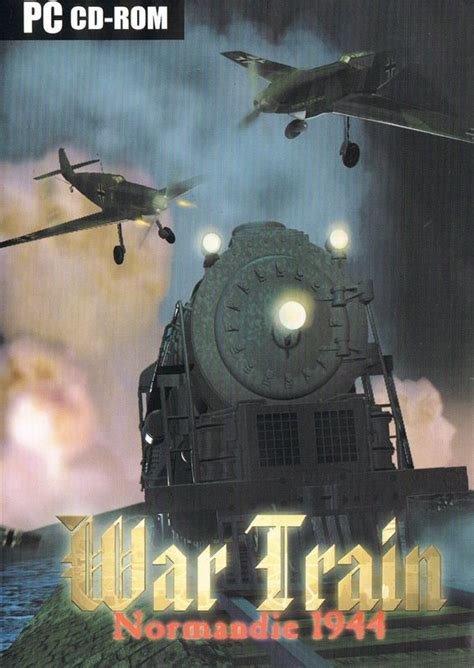
War Train: Normandie 1944 is a World War II-themed third-person action game developed by ASYLUM Games, released in 2002. Players assume the role of Allied agent Steven Miller, who must defend a fleeing train in Normandy against enemy forces using mounted weaponry. The game challenges you to combat attackers including tanks, infantry, and aircraft while navigating through the wartime setting.
Gameplay Videos
War Train: Normandie 1944 Free Download
War Train: Normandie 1944 Reviews & Reception
mobygames.com (50/100): Average score: 2.5 out of 5
myabandonware.com (80/100): 4 / 5 – 5 votes
gamefaqs.gamespot.com (30/100): 1 users have rated this game (average: 1.5 / 5)
War Train: Normandie 1944: Review
Introduction
In the vast archive of World War II games, few titles evoke the peculiar charm—and frustration—of War Train: Normandie 1944. Released in 2002 by German developer ASYLUM Games, this budget-grade third-person rail shooter casts players as Allied agent Steven Miller, fleeing Nazi forces aboard a fortified train in Normandy. Ostensibly a blend of arcade action and vehicular simulation, the game promised tension, strategy, and historical immersion. Yet, two decades later, it lingers as a relic of ambition hampered by technical limitations and derivative design. This review excavates War Train’s uneven legacy, arguing that while its premise intrigues, its execution falters under the weight of clunky mechanics and missed opportunities.
Development History & Context
ASYLUM Games, a studio synonymous with low-budget WWII-themed titles (Airborne Hero: D-Day Frontline 1944, Ardennes Offensive), positioned War Train as a modest but novel entry in the early 2000s’ saturation of war games. The era saw AAA giants like Medal of Honor and Call of Duty redefine first-person shooters, while ASYLUM catered to niche audiences with straightforward action experiences. Developed for Windows, War Train emerged amid technological constraints: limited 3D rendering capabilities, rudimentary AI, and a market flooded with WWII clichés. The game’s focus on train-based combat was atypical yet underdeveloped, a symptom of its rushed production and budgetary confines. In a landscape dominated by infantry combat and flight simulators, War Train’s locomotive-centric premise was bold but ultimately half-baked.
Narrative & Thematic Deep Dive
The plot is threadbare even by early 2000s standards: Agent Miller steals blueprints for a Nazi “miracle weapon” and escapes via train, battling waves of enemies across Normandy. Miller lacks characterization beyond his title, and the story unfolds through sparse text in the “How to Play” section—a far cry from the cinematic storytelling of contemporaries. Thematically, War Train gestures toward desperation and resistance, mirroring real-life Allied struggles, but these ideas remain superficial. There are no moral dilemmas, no emotional stakes—just a linear escape punctuated by gunfire. Dialog is nonexistent, and the narrative serves merely as scaffolding for the action. In this regard, War Train feels less like a crafted experience and more like a justification for its gameplay loop.
Gameplay Mechanics & Systems
War Train’s core loop oscillates between turret-based shooting and train management. Players control Miller from a first-person perspective (described inaccurately as “third-person” in some sources), manning a roof-mounted gun to destroy tanks, planes, and infantry. Combat is arcade-style, with enemies spawning predictably along the track. The shooting mechanics are functional yet imprecise, hampered by stiff controls and a lack of feedback.
The game’s sole innovation—train upkeep—adds complexity but frustrates more than it engages. A panel accessed via right-click lets players shovel coal, adjust water levels, and extinguish fires. Neglecting these tasks slows the train or triggers catastrophic damage, forcing players to multitask amid enemy assaults. While conceptually intriguing, this system feels underdeveloped. The UI is clunky, interruptions break combat flow, and failure often leads to abrupt game-over screens without checkpoints.
Levels are linear and repetitive, spanning five missions with identical objectives: survive until the next station. There’s no progression system, though high scores and a basic leaderboard nod to arcade traditions. The absence of saves or difficulty options amplifies the trial-and-error tedium, cementing War Train as a relic of unforgiving design.
World-Building, Art & Sound
Visually, War Train embodies early 2000s austerity. Normandy’s landscapes are rendered in low-poly gloom, with muddy textures, blocky structures, and monotonous terrain (Old-Games.ru’s review aptly notes a “garbage-болотные тона” palette). Weather effects like lightning flashes briefly alleviate the drabness but can’t mask the technical shortcomings. Enemy models lack detail, and animations are robotic, undermining any sense of immersion.
Sound design is equally spare. The soundtrack features a surprisingly dramatic orchestral theme in menus but devolves into repetitive industrial noise during gameplay—clanking rails, engine roar, and generic gunfire dominate. There’s no voice acting, and ambient sounds fail to evoke the chaos of war. Together, these elements create an atmosphere that’s more tedious than tense, a far cry from the immersive battlefields of Medal of Honor or Brothers in Arms.
Reception & Legacy
Upon release, War Train garnered minimal attention. It holds a 2.5/5 average from two user ratings on MobyGames, with no critic reviews archived. Player feedback (scattered across forums and retrospectives) cites “frustrating” mechanics, “ugly” visuals, and “repetitive” action. Its commercial impact was negligible, and ASYLUM Games folded shortly after, leaving War Train as a footnote in their catalogue of budget curiosities.
The game’s legacy lies in its oddball premise rather than its execution. While rail shooters like Panzer Dragoon or Rez achieved cult status, War Train’s blend of turret combat and train management found no successors. Today, it’s preserved only in abandonware circles and archival sites—a curiosity for historians examining the era’s lesser-known experiments.
Conclusion
War Train: Normandie 1944 exemplifies the pitfalls of ambition outstripping resources. Its premise—a WW2 escape aboard a weaponized train—holds narrative and mechanical promise, but tedious execution, technical limitations, and a lack of polish doom it to obscurity. While ASYLUM Games’ attempt to fuse arcade shooting with simulation deserves acknowledgment, the result is a game that frustrates more than it fascinates. For collectors of oddball war games, it’s a fascinating artifact; for most players, it’s a relic best left in the past. Final verdict: A misfire in the annals of WW2 gaming, notable only as a cautionary tale of unrealized potential.
Score: 2/5
(A conceptually intriguing but mechanically flawed relic of early 2000s budget game design.)