
- Release Year: 2012
- Platforms: Linux, Macintosh, Windows
- Publisher: Eugen Systems, Focus Home Interactive SAS
- Developer: Eugen Systems
- Genre: Strategy, Tactics
- Perspective: Diagonal-down
- Game Mode: Online PVP, Single-player
- Gameplay: Experience points, Line of sight, Morale, Real-time strategy, Supply lines, Unit management
- Setting: Cold War, Europe
- Average Score: 77/100
Description
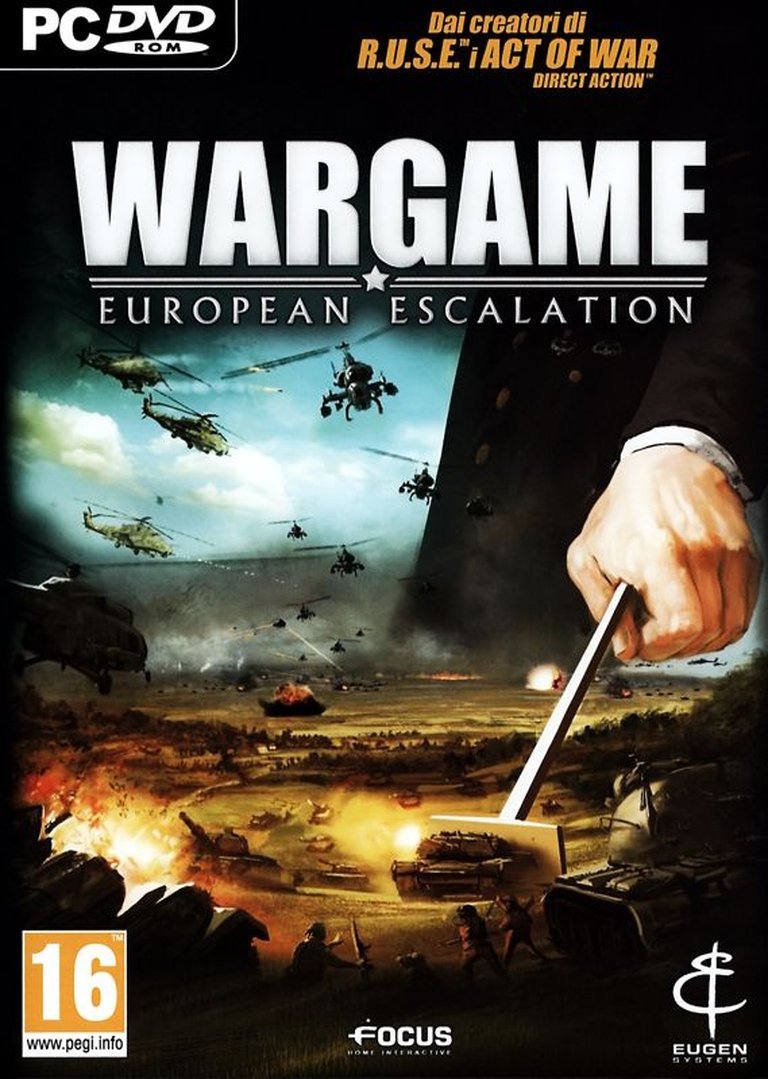
Wargame: European Escalation is a real-time strategy game set in an alternate Cold War scenario where World War III erupts in 1975 across Europe. Players command diverse military units including ground forces and helicopters (excluding airplanes), managing tactical elements like supply lines, line of sight, and morale while earning command stars to unlock new units and deployment points for reinforcements. The campaign features loosely linked missions with shifting player-controlled war parties, and utilizes seamless zoom technology for strategic oversight, with units gaining experience to enhance combat effectiveness.
Gameplay Videos
Where to Buy Wargame: European Escalation
PC
Wargame: European Escalation Cracks & Fixes
Wargame: European Escalation Patches & Updates
Wargame: European Escalation Mods
Wargame: European Escalation Guides & Walkthroughs
Wargame: European Escalation Reviews & Reception
metacritic.com (81/100): It’s a scope and scale that can be daunting, but it allows for an unparalleled level of player agency within an RTS.
ign.com : A straight-forward RTS for straight-forward players.
elder-geek.com : the game does a good job in forcing players to choose wisely when planning the makeup of their forces.
gizmogames.co.uk (70/100): A strategic Cold War duel with sharp flavour and deep systems, its demanding but rewarding when you finally crack the front.
monstercritic.com (81/100): It’s a scope and scale that can be daunting, but it allows for an unparalleled level of player agency within an RTS.
Wargame: European Escalation: Review
Introduction
In the shadow-laden twilight of the Cold War, where the line between peace and nuclear annihilation was razor-thin, Wargame: European Escalation thrust players into a harrowing alternate reality: a 1975 World War III erupting between NATO and the Warsaw Pact. Developed by French studio Eugen Systems and published by Focus Home Interactive, this 2012 real-time tactics (RTT) masterpiece redefined the genre by merging the meticulous depth of traditional wargames with the visceral intensity of real-time strategy. Its legacy lies in its unflinching commitment to realism, its breathtaking scale, and its ability to challenge players to think like true battlefield commanders. Yet, its formidable learning curve and systemic quirks prevent it from achieving perfection. This review dissects Wargame: European Escalation as both a landmark in tactical simulation and a flawed but revolutionary experience that continues to influence modern warfare games.
Development History & Context
Eugen Systems, the architect behind the acclaimed R.U.S.E. (2009), entered 2012 with a clear vision: to create an RTT stripped of base-building and resource gathering, focusing instead on pure tactical combat. Inspired by historical “what-if” scenarios of the Cold War, the team sought to answer the question: What would a conventional war between NATO and the Warsaw Pact have looked like? Technologically, the game leveraged the second iteration of the proprietary IrisZoom engine, a remarkable achievement for its time. This engine enabled seamless zooming from a bird’s-eye view of 60-square-mile maps down to the treads of individual tanks, rendering thousands of units without performance hitches—a feat that made Wargame feel like a “living war room,” as Eurogamer noted.
The gaming landscape of 2012 was dominated by titles like StarCraft II and Total War, emphasizing accessibility and spectacle. Wargame, however, defied trends by targeting a niche audience of “grognards” (hardcore wargamers) and military enthusiasts. Its refusal to dumb down mechanics—such as logistics, morale, and unit-specific counters—was both its greatest strength and greatest hurdle. As PC PowerPlay Australia observed, “Simple controls don’t mean a simple game,” positioning Wargame as a “fiendishly complex battle” for the dedicated few.
Narrative & Thematic Deep Dive
Wargame: European Escalation’s single-player campaigns eschew a traditional linear narrative in favor of four “Operations,” each a standalone vignette exploring Cold War flashpoints that nearly ignited global conflict. These scenarios are steeped in historical authenticity:
– “Brüder gegen Brüder” (1975): Unfolds after an East German soldier defects to the West, killing border guards and triggering a fratricidal war between the two Germanies.
– “Dabrowski’s Mazurka” (1981): Casts players as a Soviet commander quelling a Polish uprising inspired by Solidarność, with Czechoslovakia’s defection to NATO escalating the crisis.
– “ABLE ARCHER” (1983): Explores the real-world NATO exercise that nearly triggered Soviet pre-emptive strikes, framed as a Warsaw Pact invasion of the Fulda Gap.
– “Wasteland” (1984): A post-nuclear odyssey where a rogue Soviet commander unites survivors from both sides in vengeance, blurring ideological lines after mutual destruction.
The narratives are thematically rich, emphasizing the fragility of diplomacy and the absurdity of ideological warfare. Dialogue is sparse and utilitarian—radio chatter in native languages (e.g., Czech, Polish, German) adds immersion but lacks character development. The standout theme is the futility of nuclear brinkmanship, crystallized in “Wasteland”’s bleak, irradiated landscapes. As Destructoid noted, the game lets players “create personal stories through tactical prowess,” from ambushes with Spetsnaz troops to pincer maneuvers against armored columns, underscoring how war transcends ideology.
Gameplay Mechanics & Systems
Wargame’s core gameplay revolves around two pillars: deck-building and real-time tactical execution. Before battle, players craft a “deck” of 25 units from NATO (USA, UK, France, West Germany) or Warsaw Pact (USSR, Poland, East Germany, Czechoslovakia) sub-factions, using Command Stars earned in single-player or multiplayer. This system—unlocking 361 historically accurate units, from the M1 Abrams to the T-80—fosters deep customization but suffers from a clunky UI that hinders comparison of unit stats, as IGN criticized.
In combat, deployment points (earned by controlling map sectors) fund reinforcements, while supply lines dictate unit sustainability. Fuel, ammunition, and morale are critical; a tank stuck in mud or an infantry squad routed by flamethrowers can turn the tide. Combat favors realism:
– Unit counters are rock-paper-scissors (e.g., ATGMs devastate tanks but are vulnerable to infantry).
– Terrain matters: Forests provide cover, while elevation enhances line of sight.
– Morale effects: Units routing become liabilities, breaking formation and exposing flanks.
Multiplayer (up to 8 players) shines with asymmetric team play—e.g., one player controlling tanks, another helicopters—and victory points based on unit destruction. Yet, the game’s AI is inconsistent, often resorting to predictable rushes, and its pace can feel frantic without pause options. “The lack of a scenario editor limits long-term enjoyment,” lamented Gamers’ Temple, while Eurogamer.de noted the “sterile” campaign fails to emotionally engage.
World-Building, Art & Sound
The Cold War Europe setting is meticulously recreated, from the pine forests of the Fulda Gap to the urban sprawl of West Berlin. Maps, though sometimes repetitive, emphasize geographical realism, with terrain influencing tactics (e.g., hedgerows ambushes, rivers as chokepoints). The IrisZoom engine delivers visual splendor: tank treads flatten wheat fields, explosions illuminate smoke plumes, and zooming reveals minute details like tank crew animations. Helicopters buzz realistically, while infantry units trudge through mud—a testament to the engine’s scalability.
Sound design is equally immersive. Weapon reports are thunderous, and unit chatter in native languages (e.g., Russian orders, German reports) heightens authenticity. The score is understated, with no overpowering melodies—only the cacophony of battle and the occasional somber underscore to underscore the war’s gravity. As Elder-Geek.com observed, this “realistic soundscape” avoids “hard guitar riffs,” letting the combat speak for itself.
Reception & Legacy
Wargame: European Escalation launched to critical acclaim, holding an 80% average on MobyGames and 81 on Metacritic. Eurogamer awarded it 90%, praising its “unparalleled player agency” and “scope that can be daunting.” Critics lauded its depth: PC PowerPlay called it “a great game for those up for fiendishly complex battle,” while GameSpot noted it answered “life’s most important questions,” like how many T-34/85s a Challenger 1 could destroy. However, accessibility issues drew fire; IGN lamented the “horrifically bad interface,” and Eurogamer Germany scored it just 60%, citing the “sterile” campaign.
Commercially, the game found a loyal niche, selling enough to justify two sequels: AirLand Battle (2013, adding aircraft and Scandinavian theaters) and Red Dragon (2014, introducing naval forces). Its legacy endures as the blueprint for modern tactical RTS. The deck-building system influenced titles like Steel Division: Normandy 44 (2017), and its emphasis on realism birthed a dedicated subgenre. As Gizmos World of Games summarized, it remains “one of the most rewarding Cold War RTS experiences” for enthusiasts, despite its “steep entry barrier.”
Conclusion
Wargame: European Escalation is a flawed masterpiece that sacrifices accessibility for uncompromising tactical depth. Its deck-building system, realistic combat, and breathtaking scale set new standards for the genre, while its Cold War setting offers a haunting glimpse into a world that never was. Yet, its UI quirks, punishing learning curve, and inconsistent AI prevent it from reaching the pantheon of all-time greats. For the strategist who thrives on complexity, it remains an essential experience—one that rewards patience with moments of pure tactical brilliance. As Destructoid declared, “After two decades, Wargame finally does modern warfare right.” In the annals of military simulation, European Escalation stands not as a perfect game, but as a pivotal landmark that redefined what real-time tactics could be.
Final Verdict: A must-play for hardcore strategy enthusiasts, but newcomers should tread carefully. 8.5/10.