
- Release Year: 2005
- Platforms: Windows
- Publisher: SEGA Corporation, THQ Inc.
- Developer: Relic Entertainment
- Genre: Compilation
- Game Mode: LAN, Online PVP, Single-player
- Setting: 000, Warhammer 40
- Average Score: 74/100
Description
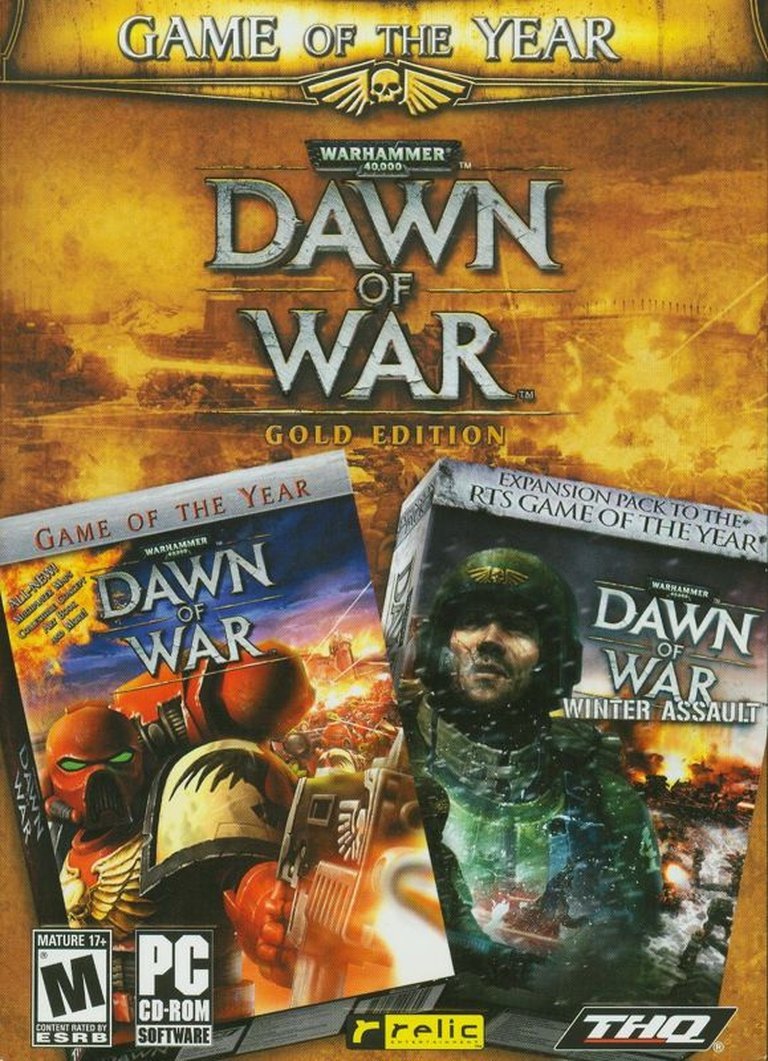
Warhammer 40,000: Dawn of War – Gold Edition is a real-time strategy compilation set in the dystopian Warhammer 40,000 universe, where humanity’s Imperium of Man wages eternal war against alien hordes like Orks and Eldar, as well as Chaos forces and heretics. This edition bundles the Game of the Year version of the base game—featuring the Blood Ravens Space Marines defending the besieged planet Tartarus from Ork invaders through resource-capturing battles and squad-based combat—and the Winter Assault expansion, expanding the campaign with new factions and multiplayer options in a grimdark galaxy-spanning conflict.
Warhammer 40,000: Dawn of War – Gold Edition Free Download
Warhammer 40,000: Dawn of War – Gold Edition Patches & Updates
Warhammer 40,000: Dawn of War – Gold Edition Mods
Warhammer 40,000: Dawn of War – Gold Edition Guides & Walkthroughs
Warhammer 40,000: Dawn of War – Gold Edition Reviews & Reception
ign.com : the battles are just so damn entertaining and the pace of the game fast enough that it’s hard not to have a good time.
metacritic.com (74/100): Mixed or Average
mgrgaming.com : Gold is the only way to go!
noobfeed.com : A classic RTS comes back with a modern touch (and some strange things).
reviewgraveyard.com : the first thing you get is a really quite impressive testosterone poisoned intro CGI, which should get you into the mood for the chaos to follow.
Warhammer 40,000: Dawn of War – Gold Edition Cheats & Codes
PC
Start the game with the -dev command line parameter. Then, press [Ctrl] + [Shift] + ~ during gameplay to display the console window. Note: v1.10 patch or higher required; some limited to skirmish mode with ‘Allow Cheats’ enabled in options. In some versions, use [Ctrl] + [Shift] + @.
| Code | Effect |
|---|---|
| cheat_killself | Suicide / kill self |
| cheat_requisition( [number] ) | Get indicated amount of requisition |
| cheat_power( [number] ) | Get indicated amount of power |
| cheat_revealall | Reveal all FOW (fog of war) |
| cls | Clear console window |
| taskbar_hide | Hide taskbar |
| taskbar_show | Show taskbar again |
| quit | Quit to Windows |
| render_togglerainbow() | Rainbow colors |
| render_togglexray() | See-through white textures |
| render_togglewireframe() | Colored wireframes |
| detail_toggle() | Toggle shaders |
| decal_toggle() | Toggle banners and badges |
| fog_toggle() | Toggle brown dust |
| terrlod_dist( [minimum, maximum] ) | Change the distance where models lose detail |
| terrlod_toggle() | Toggle model detail drop |
| staticdecal_dump() | Dump static decal stats to file |
| dynamicdecal_dump() | Dump dynamic decal stats to file |
| shadow_toggle | Toggle shadows |
| ingame_stats_mouseover_toggle | Toggle mouseover stat bars |
| ingame_stats_toggle | Toggle stat bars |
| ingame_select_ui_toggle | Remove selection boxes |
| simvis_cameranearclip( “[meters]” ) | Objects closer than this value not drawn |
| simvis_camerafarclip( “[meters]” ) | Hide objects further than this value; default is 200 |
| getsimrate() | Display current game speed |
| setsimrate( [number] ) | Set game speed |
| simvis_fx_refresh | Screen update while console is up |
| simvis_list | Reads data\art\ebps files and lists handler (channel) usage |
| simvis_toggle( “[channel name]” ) | Toggle subsystem visibility (e.g., TerrainOverlayHandler, EnviroHandler, etc.) |
| get=[item name] | Spawn item |
| sd_instant_build=1 | Instant construction |
| fow_revealall | Reveal all fog of war |
| fow_unrevealall | Restore fog of war |
| cursor_hide | Hide mouse cursor |
| cursor_show | Show mouse cursor |
| message_hide | Hide ingame message |
| message_show | Show ingame message |
| restart | Restart the mission |
| statgraph | Enable statgraph window |
| statgraph_channel(“fps”) | Send FPS data to statgraph |
Warhammer 40,000: Dawn of War – Gold Edition: Review
Introduction
In the grim darkness of the far future, there is only war—and Warhammer 40,000: Dawn of War – Gold Edition delivers it with unrelenting fury. Released in 2005 as a bundled package featuring the base game’s Game of the Year Edition (patched to v1.40 with four exclusive multiplayer maps) and the Winter Assault expansion, this compilation captures Relic Entertainment’s masterful adaptation of Games Workshop’s iconic tabletop wargame into a real-time strategy (RTS) powerhouse. Amid a 2004-2005 RTS landscape dominated by Warcraft III expansions and Command & Conquer: Generals – Zero Hour, Dawn of War stood out by emphasizing visceral, squad-based combat over traditional resource grinding, all set against the dystopian horror of the Warhammer 40k universe. Its legacy endures: the series has sold over 7 million copies, influencing squad-focused RTS design and spawning sequels up to Dawn of War IV (2026). Thesis: The Gold Edition isn’t just a value pack—it’s a definitive entry point to one of gaming’s most influential RTS titles, blending innovative mechanics, thematic depth, and replayable multiplayer into a blood-soaked symphony of grimdark warfare that remains essential two decades later.
Development History & Context
Relic Entertainment, fresh off Homeworld 2 (2003) and en route to Company of Heroes (2006), assembled a team of about 30 developers under director Alex Garden, lead designer Jay Wilson, producer Jonathan Dowdeswell, lead programmer Dominic Mathieu, art director Andy Lang, and composer Jeremy Soule (with additional music by Inon Zur). Development spanned over a year, constrained by early-2000s PC hardware limits like DirectX 8.1 and typical dual-core CPUs, yet Relic pushed boundaries with dynamic lighting, destructible environments, and squad animations that evoked the tactile feel of Games Workshop’s miniatures.
The gaming landscape was RTS-saturated but evolving: Blizzard’s hero-centric Warcraft III and Westwood’s base-rush Command & Conquer series emphasized macro-economy, while Relic drew from Homeworld‘s 3D battles and Ground Control‘s point-capture resources. Licensing Warhammer 40k—a gothic sci-fi universe of perpetual war since 1987—provided rich lore: humanity’s decaying Imperium versus xenos (Orks, Eldar) and Chaos heretics. THQ published amid a post-StarCraft drought for licensed RTS, releasing the base game on September 20, 2004 (NA), with the GOTY Edition following in 2005. Winter Assault (2005) addressed feedback on the base campaign’s brevity by adding the Imperial Guard faction and dual campaigns. Technological hurdles included pathfinding for squads amid debris-strewn maps and balancing asymmetric factions without “cheating” AI. Relic’s vision: translate tabletop dice-roll chaos into fluid, morale-driven combat, prioritizing infantry over tanks—a bold pivot that defined the Gold Edition’s tactical purity.
Narrative & Thematic Deep Dive
Base Game Campaign: Blood Ravens on Tartarus
The Gold Edition’s core narrative unfolds across 11 missions on Tartarus, an Imperial world besieged by Orks but manipulated by Alpha Legion Chaos Sorcerer Sindri Myr as a smokescreen for unearthing the Maledictum—a Khorne-tainted daemon prison. Players command the Blood Ravens 3rd Company Space Marines, led by the brooding Captain Gabriel Angelos (voice haunted by his homeworld Cyrene’s Exterminatus). Allies include Librarian Isador Akios (secretly corrupted), Colonel Brom’s 37th Tartarus PDF (Imperial Guard), and Inquisitor Mordecai Toth. Antagonists span Ork Warboss Orkamungus, Biel-Tan Farseer Macha, and Chaos Lord Bale/Sindri.
Plot Arc:
– Act 1 (Planetfall – Maw): Secure the spaceport, purge Orks, uncover Chaos markers. Toth demands evacuation amid a Warp Storm; Angelos defies him, haunted by Cyrene.
– Act 2 (Sacrifice – Chapel): Clash with Eldar in Lovvra Marr; destroy corrupted Guard; learn of Maledictum. Isador’s sabotage hints at betrayal.
– Act 3 (Unholy Ceremony – All Out War): Betrayals peak—Isador steals the artifact, Angelos executes him in a brutal duel (“Innocents must die so that humanity may live”). Allies assault Sindri’s Daemon Prince form; destroying the Maledictum unwittingly frees a Bloodthirster, revealing Tartarus as Khorne’s altar.
Themes probe Warhammer’s grimdark core: fanaticism vs. pragmatism (Angelos’ steel vs. Toth’s suspicion), corruption’s subtlety (Isador’s fall mirrors Horus Heresy lore), xenos arrogance (Eldar’s isolationism), and futility (every death empowers Chaos). Dialogue shines—Orks’ guttural WAAAGH! chants, Eldar’s ethereal prophecies—bolstered by Black Library novelizations (Dawn of War omnibus by C.S. Goto).
Winter Assault Campaigns: Titan Schism
Two five-mission arcs pit Order (Imperial Guard/Eldar) against Disorder (Chaos/Orks) for a stranded Imperial Titan. Order: Guard Colonel Brom defends against Ork raids; Eldar Farseer Taldeer invokes ancestral spirits. Disorder: Chaos Lord Eliphas summons daemons; Orks under Kaptin Bluddflagg hoard “trophies.” Shared finales adapt per faction (e.g., Guard’s Baneblade siege). Themes amplify ideological clash—faith vs. anarchy—tying into 40k’s religious zealotry.
Cutscenes, while engine-limited and clunky (stiff animations, variable voice acting), immerse via gothic narration. The Gold Edition’s narratives excel in escalation, foreshadowing sequels like Dawn of War II: Retribution.
Gameplay Mechanics & Systems
Core Loops: Resources, Building, Combat
Relic de-emphasized worker-harvesting: requisition accrues from HQ and captured strategic points (reinforceable via Listening Posts); power from generators (upgradable on slag deposits). Orks uniquely leverage WAAAGH! (population/banners scale tech tiers). Base-building unlocks tiers: e.g., Space Marine Fortress Monastery advances via Chapels, Machine Cults.
Combat Deconstruction:
– Squads: Infantry deploys as 4-man groups (reinforceable to 8-14), attachable with leaders (e.g., Space Marine Sergeant) or specials (plasma gun). Hard caps limit elites (1 Commander, 4 Apothecaries).
– Morale/Cover: Squad morale depletes under fire (zero = “broken,” reduced accuracy/speed); flamethrowers suppress. Cover tiers (light/heavy/negative) buff defense/damage.
– Melee/Ranged Duality: Fluid transitions; Synch Kills (e.g., Dreadnought crushing Orks) reward aggression.
– Vehicles/Walkers: Anti-infantry/vehicle loadouts; transports embark/disembark squads.
– Relics: Tier-4 super-units (Space Marine Terminators, Ork Squiggoth) dominate late-game.
– Stances/UI: Aggressive/Defensive/Cover modes; intuitive radial menus, hotkeys for micro.
Innovations/Flaws: Reinforce-anywhere prevents zerg-rushes; population/vehicle caps force composition. Pathfinding falters in clutter; AI cheats minimally but turtling exploits it. Victory variants (hold points 6 mins, annihilate HQs) promote aggression.
Faction Asymmetry & Winter Assault Additions
- Space Marines: Elite, balanced; high morale, Terminators.
- Orks: Swarm (morale immunity at mass); Squiggoths.
- Eldar: Fragile, mobile (Webway gates); Avatar.
- Chaos: Demoralizing psykers/daemons; Bloodthirster.
- Imperial Guard (WA): Cheap artillery (Baneblade); anti-Titan focus.
Skirmish (2-8 players, 200+ maps) and LAN/Internet multiplayer shine; Army Painter customizes schemes.
World-Building, Art & Sound
Tartarus evokes 40k’s grimdark aesthetic: blasted hives, fog-shrouded forests, warp-rifts. Visuals—high-fidelity 2004 models, ragdoll physics, gore—persist: Chaos buildings pulse with faces; Ork scrap fortresses spawn Gretchin. Gold Edition’s GOTY maps enhance replayability.
Atmosphere: Destructible terrain (craters form cover), particle effects (bolter muzzle flash), dynamic lighting build dread. Animations (finishing moves, pod drops) immerse; UI’s clean radial queues aid chaos.
Sound Design: Soule’s orchestral score swells epically; Jeremy Soule’s motifs underscore zealotry. VO icons 40k: Marines’ litanies (“For the Emperor!”), Orks’ slang. Weaponry roars—chainswords whine, lasguns crackle—amplifying melee thunder. Ambient warp-howls heighten horror, forging an auditory cathedral of war.
Reception & Legacy
Launch acclaim was stellar: Metacritic 86/100, GameRankings 87% (IGN/GameSpot 8.8/10 praised animations/UI; critiques: short campaign, unoriginality). Base game earned ELSPA Silver (100k+ UK sales); series hit 4M by 2009. Gold Edition averaged 4.6/5 (MobyGames players), lauded for value.
Evolution: Expansions iterated (Dark Crusade’s province map, Soulstorm’s nine factions); Definitive Edition (2025) remasters with 4K/64-bit. Influence: Squad morale/cover in Company of Heroes, Dawn of War II‘s RPG shift, 40k games (Space Marine 2). Mods (Ultimate Apocalypse) extend life; runner-up awards (GameSpot Best Strategy 2004, DICE noms) cement status.
Conclusion
Warhammer 40,000: Dawn of War – Gold Edition transcends its era, distilling 40k’s bloody theology into an RTS benchmark of tactical depth and spectacle. From Blood Ravens’ tragic purge to Titan sieges, its narratives probe faith’s cost; mechanics reward micro amid macro frenzy; atmosphere grips eternally. Flaws—dated pathing, linear campaigns—pale against innovations and replayability. Verdict: A pantheon entry in RTS history (9.5/10), essential for genre historians, 40k neophytes, and strategists craving meat-grinder warfare. In the 41st millennium, it endures—only war.