
- Release Year: 1988
- Platforms: Antstream, Atari ST, DOS, Windows, ZX Spectrum
- Publisher: Ocean Software Ltd., Piko Interactive LLC
- Developer: Denton Designs
- Genre: Action, Adventure
- Perspective: Diagonal-down
- Game Mode: Single-player
- Gameplay: Arcade, Puzzle elements
- Setting: Fantasy, Prehistoric
- Average Score: 73/100
Description
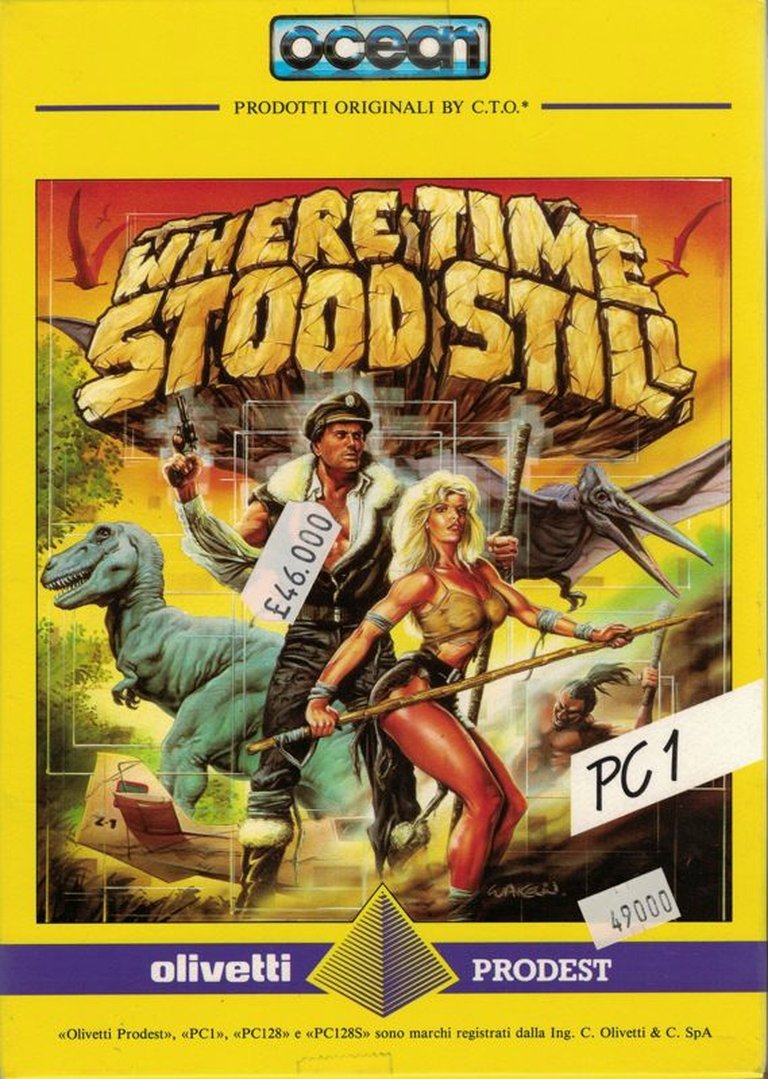
In ‘Where Time Stood Still’, players navigate a family of crash survivors through a prehistoric world where time has frozen, filled with dinosaurs, cavemen, and treacherous terrain. Using an isometric perspective, the game challenges players to guide each character—each with unique behaviors and needs—to safety while collecting essential items like weapons and first aid kits. The goal is to rescue all four family members, though the adventure continues as long as at least one survives.
Gameplay Videos
Where to Buy Where Time Stood Still
PC
Where Time Stood Still Free Download
Where Time Stood Still Guides & Walkthroughs
Where Time Stood Still Reviews & Reception
frgcb.blogspot.com (94/100): A triumphant return to form for the series.
hardcoregaming101.net : One of the most overlooked survival horror game titles of all time.
gamepressure.com (50/100): The graphic design is extremely clumsy.
amr.abime.net (76/100): A solid adventure with unique survival mechanics.
Where Time Stood Still: A Masterpiece of Survival and Strategy in the Lost World
Introduction: A Crash Landing into Legend
Few games capture the essence of survival, strategy, and sheer unpredictability as Where Time Stood Still (1988), a groundbreaking isometric action-adventure from Denton Designs and Ocean Software. Released for the ZX Spectrum 128K, Atari ST, and MS-DOS, this title remains a cult classic, celebrated for its innovative gameplay, atmospheric world-building, and pioneering use of procedural randomness. Often overshadowed by later survival horror titles like Alone in the Dark (1992), Where Time Stood Still deserves recognition as a trailblazer—a game that redefined what an adventure could be.
This review will dissect the game’s development, narrative depth, gameplay mechanics, and lasting influence, arguing that Where Time Stood Still is not just a product of its time but a timeless masterpiece of interactive storytelling and survival strategy.
Development History & Context: The Birth of a Survival Epic
The Studio and the Vision
Denton Designs, founded by ex-employees of the defunct Imagine Software, was no stranger to ambition. The studio had previously developed The Great Escape (1986), an isometric adventure that laid the groundwork for Where Time Stood Still. The latter was conceived as a spiritual successor, but with a radical shift in setting and mechanics. Inspired by Sir Arthur Conan Doyle’s The Lost World and Edgar Rice Burroughs’ The Land That Time Forgot, the game transported players to a prehistoric Himalayan plateau teeming with dinosaurs, cannibals, and environmental hazards.
Technological Constraints and Innovation
The game’s development was shaped by the limitations of 1980s hardware. The ZX Spectrum 128K version, in particular, pushed the boundaries of the platform, utilizing its expanded memory to create a vast, seamless map—a rarity for the era. The Atari ST and DOS versions followed, each adapting to their respective hardware constraints. The Spectrum and ST versions were monochrome, while the DOS version used four-color CGA, a limitation that paradoxically enhanced its retro aesthetic.
The Gaming Landscape of 1988
At the time of its release, the gaming industry was dominated by arcade-style action and linear adventures. Where Time Stood Still stood out by blending survival mechanics, character management, and procedural randomness—a combination that was revolutionary. Critics and players alike were captivated by its depth, with publications like Sinclair User and Crash! awarding it near-perfect scores.
Narrative & Thematic Deep Dive: Survival in the Lost World
Plot and Setting
The game begins with a plane crash in the Himalayas, stranding four survivors: Jarret (the pilot), Clive (a wealthy businessman), Gloria (his daughter), and Dirk (her fiancé). The plateau they find themselves on is a lost world where time has stood still, populated by dinosaurs, cannibals, and other prehistoric dangers. The goal is simple: guide the party to safety through a high mountain pass. However, the journey is fraught with peril, and the game’s narrative unfolds through the interactions between the characters and their environment.
Character Dynamics and Morale
What sets Where Time Stood Still apart is its emphasis on character dynamics. Each survivor has distinct traits:
– Clive: Overweight and perpetually hungry, he tires easily but can trade with natives.
– Gloria: Resilient but emotionally dependent on Dirk.
– Dirk: Athletic and multilingual, but devastated if Gloria dies.
– Jarret: The balanced leader, capable of handling most challenges.
The game’s morality system is ahead of its time. Characters complain when hungry, tired, or injured, and ignoring their needs can lead to abandonment or death. The relationships between characters—particularly Dirk and Gloria—add emotional weight, making their survival a personal investment for the player.
Themes of Survival and Randomness
The game’s core theme is survival against overwhelming odds. The plateau is a hostile environment where every decision matters. The procedural randomness—dinosaurs appearing unpredictably, bridges collapsing, or characters falling ill—creates a sense of constant tension. This randomness, while frustrating at times, reinforces the game’s survival horror elements, making each playthrough unique.
Gameplay Mechanics & Systems: A Survivalist’s Toolkit
Core Gameplay Loop
The gameplay revolves around exploration, resource management, and combat. Players must:
1. Navigate the Plateau: The isometric perspective, while visually striking, can be disorienting. The world is vast, with swamps, forests, and mountains to traverse.
2. Manage Resources: Food, weapons, and medical supplies are scattered across the map. Rationing is crucial, as overindulgence can deplete supplies quickly.
3. Combat and Avoidance: Dinosaurs and cannibals pose constant threats. Combat is simple but effective, with weapons like guns and spears available.
Character Control and AI
Players control one character at a time, switching between them if the leader dies. The AI-controlled characters are both a blessing and a curse—they can carry additional items but often get in the way or fall victim to environmental hazards. The menu system, while innovative, can be cumbersome, requiring precise cursor movements to pick up or use items.
Innovation and Flaws
The game’s most innovative feature is its procedural randomness, which keeps players on edge. However, this also leads to moments of frustration, such as a character dying instantly to a random dinosaur attack. The lack of a save feature (except in emulated versions) further amplifies the challenge, making Where Time Stood Still a test of endurance as much as skill.
World-Building, Art & Sound: Crafting a Prehistoric Nightmare
Visual Design
The game’s isometric perspective and monochrome (or limited-color) palette create a haunting, cinematic atmosphere. The Spectrum version, in particular, evokes the aesthetic of a 1950s sci-fi film, with its stark contrasts and detailed environments. The Atari ST version, with its clearer graphics, is the most visually impressive, while the DOS version’s CGA limitations give it a raw, retro charm.
Sound and Music
The Spectrum version stands out for its dual sound sources—the AY chip for music and the beeper for sound effects—creating a layered auditory experience. The Atari ST and DOS versions are more limited, with the latter lacking music entirely. Despite these constraints, the sound design enhances the game’s tension, from the eerie silence of the plateau to the sudden shrieks of attacking dinosaurs.
Reception & Legacy: A Cult Classic’s Journey
Critical and Commercial Reception
Upon release, Where Time Stood Still was met with widespread acclaim. Sinclair User called it “the most exciting game you’ve ever seen on the Spectrum,” while Crash! praised its “thoroughly engrossing arcade adventure.” The Atari ST and DOS versions received more mixed reviews, with critics noting their technical limitations but acknowledging the game’s depth.
Influence and Modern Reappraisal
While Where Time Stood Still never achieved mainstream fame, its influence is undeniable. It predates the survival horror genre’s formalization, introducing mechanics that would later define titles like Resident Evil and Alone in the Dark. Modern retrospectives, such as those from Hardcore Gaming 101, highlight its innovative use of randomness and character dynamics, arguing that it deserves a place in gaming history alongside its more famous successors.
Fan Preservation and Ports
The game’s legacy is preserved through fan efforts, including unofficial Amiga ports (2014) and modern re-releases on platforms like Steam. These efforts ensure that Where Time Stood Still remains accessible to new generations of players, cementing its status as a cult classic.
Conclusion: A Timeless Survival Epic
Where Time Stood Still is more than a relic of the 1980s—it is a masterclass in survival gameplay, character-driven storytelling, and atmospheric world-building. Its procedural randomness, while divisive, creates a sense of unpredictability that keeps players engaged. The game’s emphasis on resource management and character morale foreshadows modern survival titles, making it a pioneer in the genre.
While its technical limitations and lack of a save feature may deter some players, Where Time Stood Still rewards those who embrace its challenges. It is a game that demands patience, strategy, and adaptability—qualities that define the best survival experiences.
Final Verdict: Where Time Stood Still is a landmark title that deserves recognition as one of the most innovative and influential survival games of all time. Its blend of exploration, strategy, and survival mechanics makes it a timeless classic, and its legacy continues to inspire modern game design. For fans of survival horror and retro gaming, it is an essential experience.
Score: 9/10 – A masterpiece of survival and strategy, marred only by its technical limitations and lack of modern conveniences.