
- Release Year: 2013
- Platforms: PlayStation 3, Windows, Xbox 360
- Publisher: Koch Media GmbH (Austria)
- Developer: doublesix Video Games Ltd.
- Genre: Puzzle
- Game Mode: Single-player
- Gameplay: Game show, quiz, trivia
- Average Score: 67/100
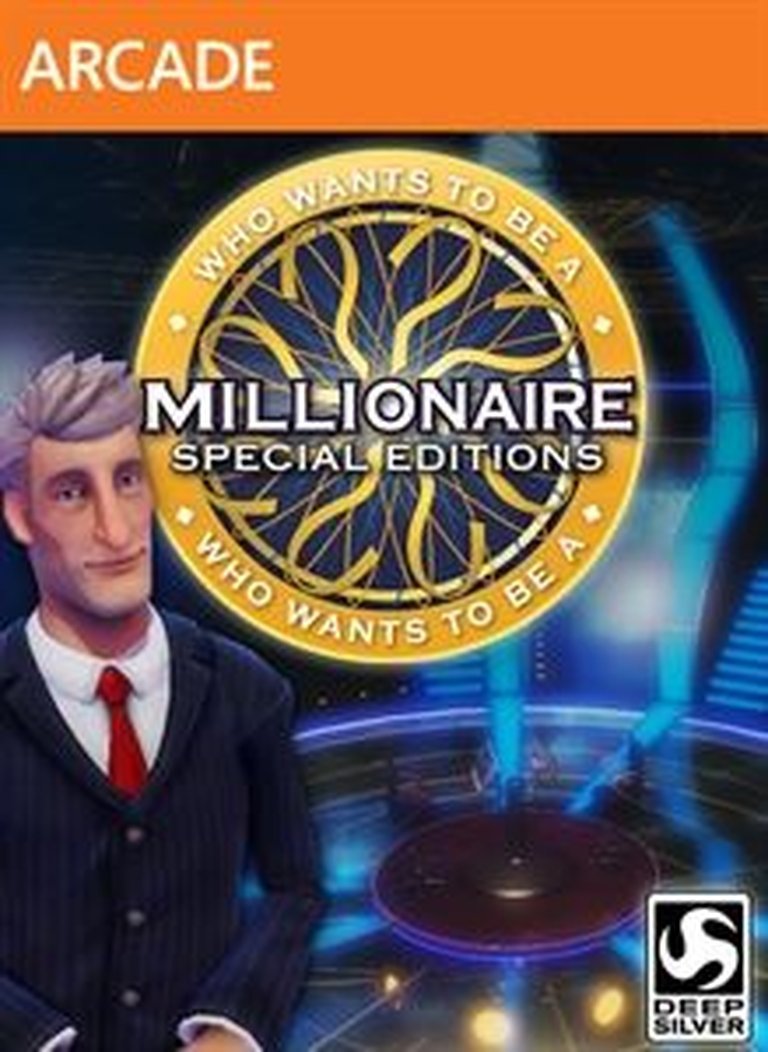
Description
Who Wants to Be a Millionaire: Special Editions is a video game adaptation of the popular TV quiz show, featuring the iconic music, sound bites, and set design from the UK versions of the 1990s and 2007. Players navigate through 15 multiple-choice questions to win 1,000,000 of their local currency, utilizing classic lifelines such as 50-50, Phone a Friend, and Ask the Audience. The game was released in 2013 for PlayStation 3, Xbox 360, and Windows, and includes various themed question packs for added variety.
Gameplay Videos
Who Wants to Be a Millionaire: Special Editions Free Download
Who Wants to Be a Millionaire: Special Editions Guides & Walkthroughs
Who Wants to Be a Millionaire: Special Editions Reviews & Reception
steambase.io (80/100): Who Wants To Be A Millionaire? Special Editions has earned a Player Score of 80 / 100.
metacritic.com (61/100): A surprisingly good effort.
steamcommunity.com : Never before in the arts has human emotion been expressed so delicately yet so courageously as it has been in Who Wants To Be A Millionaire: Special Editions.
gamefaqs.gamespot.com (61/100): A painfully slow and aged Millionaire quiz.
Who Wants to Be a Millionaire: Special Editions: Review
Introduction
For over two decades, Who Wants to Be a Millionaire has captivated global audiences with its high-stakes trivia theatrics. Special Editions (2013), developed by doublesix Games and published by Deep Silver, sought to transplant the show’s electric tension into interactive form, fusing nostalgic audiovisual fidelity with modular DLC content. Yet beneath its laser-focus on replicating the classic format lies a paradox: an experience simultaneously reverent and rudimentary, reflecting both the endurance of the franchise and the risks of licensing-driven design. This review interrogates how Special Editions balances authenticity with innovation—or lack thereof—in an era where trivia games like Buzz! and You Don’t Know Jack expanded the genre’s horizons.
Development History & Context
Doublesix Games—a now-defunct UK studio known for Burn Zombie Burn!—developed Special Editions using Unreal Engine 3, aiming to modernize the Millionaire formula after numerous predecessors (e.g., 2000’s Dreamcast iteration). Licensing constraints dictated much of the creative process: the game utilized Sony Pictures Television’s global rights (excluding North America, Canada, and Mexico) but lacked official branding for real-world hosts like Chris Tarrant. Regional publishing wrangles led to staggered releases—Europe and Australia in late 2011, North America in October 2013—and a fragmented DLC rollout.
The 2013 gaming landscape offered stiff competition. Social trivia apps like QuizUp were rising, while console titles like Buzz! Quiz TV (2008) leveraged dynamic multiplayer and pop-culture irreverence. Special Editions countered with hyper-focused authenticity, targeting franchise loyalists rather than casual audiences. Its delisting from digital storefronts by 2016—due to expiring licenses—cemented its status as a transient relic, though physical copies and some DLC (e.g., “Movies Pack”) linger.
Narrative & Thematic Deep Dive
As a trivia game, Special Editions lacks traditional narrative—yet its structure channels the show’s psychological drama. The sterile single-player mode frames players as anonymous contestants confronting escalating stakes (“Is that your final answer?”), while multiplayer local bouts stage knowledge as communal spectacle. Thematically, it interrogates hubris versus humility: lifelines like “Phone a Friend” parody human fallibility, while wrong answers trigger existential voice lines (“You’ve just lost £468,000…”).
The DLC packs—including Star Trek, South Park, and genre-specific sets—introduce subversive mini-narratives. The Star Trek edition, for instance, recasts the player as a Starfleet cadet tested by a Vulcan-esque host aboard the USS Enterprise. Such expansions flirt with satire yet remain shackled to rigid question-answer formats, missing opportunities to deepen lore or character dynamics.
Gameplay Mechanics & Systems
Core Loop & Progression
Faithful to the UK show’s 2007 iteration, gameplay involves answering 15 multiple-choice questions across tiers (£100 to £1,000,000), with no time limits. Players deploy three lifelines:
– 50:50 (eliminate two wrong answers)
– Phone a Friend (randomized “expert” suggestion)
– Ask the Audience (percentage-based poll)
Progression hinges on binary win/loss states—no saves mid-game—amplifying tension but limiting accessibility.
Innovation & Flaws
The game’s sole innovation was its modular DLC ecosystem, offering 1,200+ base questions and themed expansions (e.g., Millennium Millionaire, Football Millionaire). However, themed stages (e.g., Star Trek’s Enterprise bridge) were cosmetic, lacking gameplay differentiation. Critics lambasted the repetitive host dialogue (recorded by an anonymous VA), sluggish pacing (no timer), and unbalanced difficulty spikes. Local multiplayer supported four players in turn-based bouts but lacked online matchmaking, relying on leaderboards for competitive stakes.
UI/UX Design
Menus aped the show’s luminescent blue aesthetic, yet clunky navigation (e.g., cumbersome DLC management) clashed with Unreal Engine 3’s polished set renders. Lifeline usage felt tactile via controller inputs, though the omission of touch controls on PS Vita (despite cross-buy compatibility) was a missed opportunity.
World-Building, Art & Sound
Visual Design
Special Editions meticulously recreated the UK studio’s iconic set: glowingMoney Tree, tension-filled hot seat, and audience backdrops bathed in atmospheric gloom. Themed DLC expanded environments—most notably the Star Trek pack’s LCARS-styled UI and Enterprise bridge—offering visual novelty. Character models for contestants and hosts, however, betrayed budget constraints with stiff animations and generic designs.
Audio Atmosphere
Sound design mirrored the show’s 1990s–2007 eras, blending the classic “Final Answer” stinger with suspenseful basslines. While composer Keith Strachan’s themes elicited nostalgia, the lack of licensed tracks (e.g., The Jackpot Machine) and looping host quips (“Play… if you think you’re smart enough”) grated over time. Audience reactions—polite claps to shocked gasps—added authenticity but lacked dynamic range.
Reception & Legacy
Critical Response
Special Editions earned mixed reviews (Metascore: 61/100 on PS3). Praise focused on faithfulness (“Sweet!” — Games Master UK), while critics skewered repetitive audio and archaic design (“A painfully slow and aged Millionaire quiz” — Playstation Official Magazine UK). Steam user reviews leaned Positive (80/100), though anecdotes highlighted brutal question difficulty and DLC fragmentation.
Commercial Impact & Legacy
The game sold modestly but became invisible post-delisting. Its legacy resides in curatorial circles as a case study in licensed-game pitfalls—overzealous adherence to source material stifling innovation. Doublesix dissolved in 2014, and subsequent Millionaire games (e.g., 2020’s Switch version) abandoned Special Editions’ DLC model for unified content drops.
Conclusion
Who Wants to Be a Millionaire: Special Editions is a polarizing artifact: a lavish shrine to TV nostalgia hamstrung by mechanical timidity. Its commitment to replicating the show’s tension and aesthetics resonates with trivia purists, yet failures in pacing, audio diversity, and thematic DLC integration render it a secondary choice next to rivals like Buzz!. While not without charm, Special Editions remains a cautionary tale—of how reverence for legacy can eclipse ambition in licensed gaming. For historians, it’s essential; for casual players, an elephant graveyard of unrealized potential.
Final Verdict: ★★½☆☆ (2.5/5) — A technically competent but creatively cautious adaptation, best suited for completionists and Millionaire devotees.