
- Release Year: 2008
- Platforms: Windows
- Publisher: rondomedia Marketing & Vertriebs GmbH
- Developer: Contendo Media GmbH
- Genre: Puzzle
- Game Mode: Single-player
- Gameplay: Arcade, Tile matching puzzle
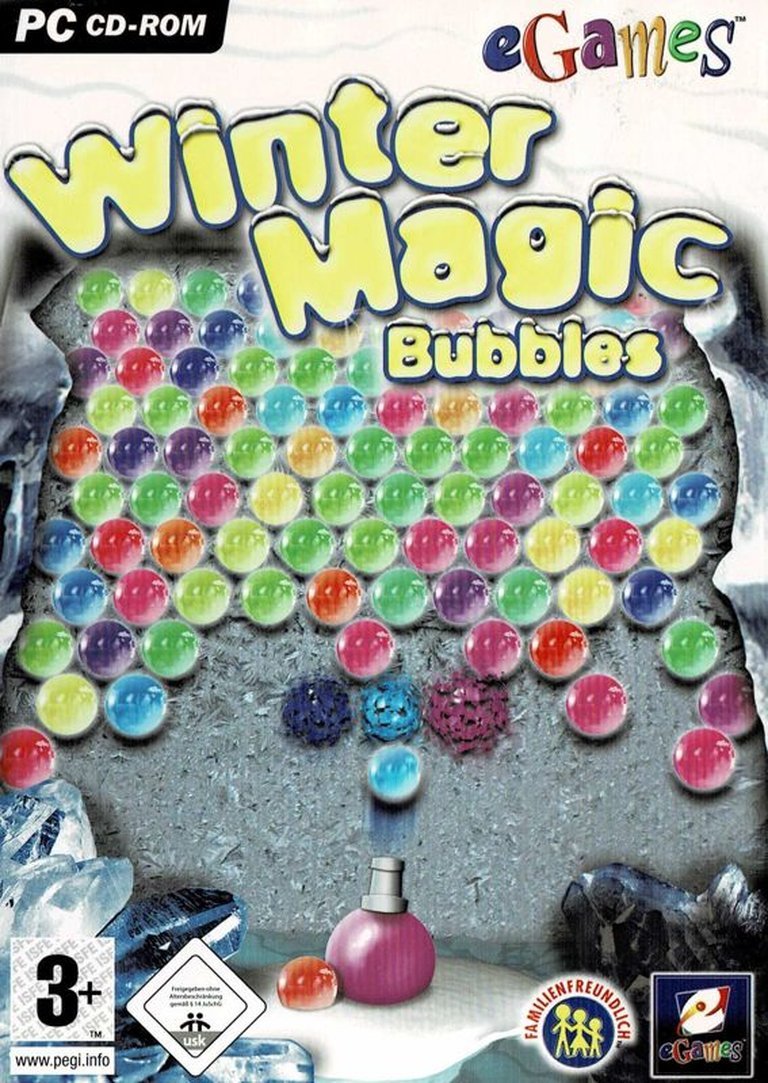
Description
Winter Magic Bubbles is a real-time puzzle game that reimagines the Bust-A-Move formula with a frosty twist. Players use a ball cannon to shoot ice balls, matching same-colored balls to combine and break down color chains in an arcade-style, tile-matching challenge set against a wintry backdrop.
Winter Magic Bubbles: Review
Introduction: The Frosted Footnote
In the vast, crowded necropolis of puzzle game history, certain titles achieve a peculiar kind of immortality not through acclaim or innovation, but through sheer, unadulterated obscurity. Winter Magic Bubbles, released on January 23, 2008, for Windows by the German studios Contendo Media GmbH and rondomedia Marketing & Vertriebs GmbH, exists as such a footnote. It is a game that whispers rather than shouts, a spectral variant of the genre-defining Bust-A-Move/Puzzle Bobble formula, lost in the blizzard of mid-2000s casual PC gaming. This review argues that Winter Magic Bubbles is not a forgotten masterpiece, nor a spectacular failure, but a perfect case study in derivative design—a game whose primary historical significance lies in its exemplification of a specific moment: the late-stage, theme-skinning of a classic arcade template for a budget-conscious, family-oriented PC market. Its legacy is one of quiet erasure, a title that faded not with a bang, but with a barely audible digital sigh.
Development History & Context: The Ice Age of Casual Games
The development context of Winter Magic Bubbles is as thin and translucent as the ice balls it tasks players with popping. Contendo Media GmbH, its developer, was a small German concern active in the late 1990s and 2000s, primarily producing low-budget, packaged casual games for the European PC market. They were not innovation drivers but pragmatic adapters, often working under publisher rondomedia, a common dynamic in Germany’s value-priced software sector. The year 2008 was a pivot point: digital distribution (Steam was growing but not dominant) still coexisted with physical CD-ROMs in mass retail, and the casual market was being fiercely contested by established franchises (Bejeweled, Zuma) and a flood of cheaply produced clones. The “Puzzle Bobble variant” label is not a critique but a literal description; Winter Magic Bubbles represents the tail end of an era where a functional, thematic reskin of a proven arcade mechanic was considered a viable commercial product. There was no “development hell” narrative—this was a game likely conceived, built, and released within a standard, modest budget cycle, aiming for shelf space alongside other winter-themed time-killers. Its technological constraints were those of the era: simple 2D sprites, basic fixed-screen layouts, and minimal system requirements to ensure it ran on the vast array of underpowered family PCs still prevalent.
Narrative & Thematic Deep Dive: The Story of Ice and Nothingness
To speak of a “narrative” in Winter Magic Bubbles is to engage in a act of archaeological reconstruction from almost no artifacts. The game presents no plot, no characters, no dialogue. The “Winter Magic” is a purely aesthetic and nominal theme. The implied narrative is one of pure, abstract conflict: a relentless, descending ceiling of multicolored ice bubbles, and a cannon at the bottom. The player’s avatar is an invisible, disembodied force. The “chains” to be broken are color-based, with no story reason given for their existence or dissolution.
Thematically, the game operates on the most primal level of its genre: order vs. chaos, creation vs. destruction. The “magic” is the player’s ability to introduce order (matching colors) to cause spectacular, chain-reaction destruction (the popping). The “winter” motif suggests a temporary, fragile beauty—the ice chains are delicate structures that must be precisely toppled. It’s a metaphor for the fleeting nature of resolve against a persistent, encroaching threat (the ceiling). In the context of 2008, this minimalist approach was standard for the sub-genre; any deeper lore would have been seen as unnecessary bloat. The game’s story is the player’s own session: a tense, silent battle against gravity and color, where victory is a clear screen and failure is a suffocating collapse of ice. It is narratives of pure process, a Zen-like meditation on pattern recognition and rapid decision-making, devoid of all but the faintest seasonal contextual dressing.
Gameplay Mechanics & Systems: Faithful, Forgettable, Functional
Winter Magic Bubbles is a 1:1 mechanical translation of the Puzzle Bobble (aka Bust-A-Move) blueprint, with one minor thematic modifier. The core loop is immutable:
1. The Cannon: Aimed via mouse or keyboard, fires a single bubble into a matrix of hanging bubbles.
2. Clumping: Bubbles of the same color that touch form a “clump.”
3. Popping: A clump of three or more same-colored bubbles pops, dropping any disconnected bubbles below.
4. The Ceiling: Periodically, the entire matrix lowers one row. If bubbles pass a fatal line at the bottom, the game ends.
5. The “Magic”: The ice theme is purely visual. Bubbles look like glistening, translucent orbs. There is no gameplay mechanic differentiating “ice” from standard bubbles—no slippery surfaces, no melt effects, no special power-ups intrinsic to the theme. Any “magic” is in the player’s mind, a cognitive association between the visual palette and the familiar mechanics.
Systems Analysis:
* Progression: The game likely features a simple level-based structure with increasing complexity (faster ceiling drops, more colors introduced). There is no persistent character progression, unlockable content, or skill tree. It is a pure arcade score-attack loop.
* UI/UX: Given its budget origins, the UI is expected to be stark and functional: a score display, level indicator, and perhaps a simple “next bubble” preview. No frills, no elaborate menus.
* Innovation/Flaws: Its only “innovation” is the theme. Its flaws are the inherent flaws of the template when not masterfully tuned: potential for “dead locks” (unbreakable color islands), heavy reliance on the random bubble generator for fairness, and a likely lack of sophisticated balancing or adaptive difficulty. It offers the tight, stressful gameplay of its inspiration but without the legendary level design or the vibrant character charm of Taito’s series. It is mechanics divorced from personality.
World-Building, Art & Sound: A Pastel Prison
The “world” of Winter Magic Bubbles is a fixed, static backdrop. The setting is a vertically scrolling void, likely adorned with a simple, repeating winter landscape graphic—snowflakes, perhaps a stylized frosty sky, maybe a distant snowy hill. The atmosphere is one of chilly, quiet emptiness. The art direction is low-fidelity, sprite-based, and utilitarian. Bubbles are simple circles with a gradient or highlight to imply translucence. The color palette is predictably cool: blues, whites, purples, with warmer colors (reds, yellows) for bubble differentiation.
Sound design follows the casual game conventions of 2008. A repetitive, inoffensive jingle likely plays on the title screen. Sound effects are minimal: a generic pop for bubble destruction, a crushing thud when the ceiling descends, a simple ascending/descending arpeggio for aiming, and a doubtless tinny, MIDI-style fanfare for level completion or game over. There is no voice acting, no dynamic soundtrack. The audio is purely functional feedback. Together, the art and sound create a cold, repetitive, almost hypnotic environment that serves only to focus the player on the grid of bubbles. It is a pastel prison, visually pleasant but devoid of the whimsical character (think Bobble‘s dinosaur mascots) that gave its inspiration lasting appeal. The “magic” is entirely in the player’s mind, spurred by the name, not evoked by the assets.
Reception & Legacy: The Sound of Silence
Critical reception for Winter Magic Bubbles is virtually non-existent. It generated no notable reviews in mainstream or enthusiast press of the time. On aggregators like MobyGames, it holds no score and has no critic reviews cited. Its commercial performance is unknown but presumed negligible. It was a budget title, likely sold in German discount software bins or as part of a “casual games” compilation, and quickly forgotten.
Its legacy is one of near-total obscurity. It did not influence any significant developers or trends. It is not cited in post-mortems or design analyses. It exists today primarily as a database entry on sites like MobyGames, a ghost in the machine of gaming history. It represents the vast majority of video games: those that are made, sold in modest numbers, and vanish without altering the cultural landscape. In the specific genealogy of the Puzzle Bobble lineage, it is a dead-end branch, a variant that failed to distinguish itself from hundreds of others (Bubbles, Bubble Shooter, Ice Bubbles, etc.). Its primary lesson is a commercial one: in a saturated market, a mere skin-deep theme is insufficient to secure attention. It is the gaming equivalent of a forgotten paperback novel—competently constructed but possessing no compelling reason to be remembered.
Conclusion: AFrosted Epitaph
Winter Magic Bubbles is a perfectly competent, utterly unremarkable game. It executes the Bust-A-Move formula with technical correctness but without a single jot of creative vitality or distinguishing feature. Its “winter magic” is a superficial coat of paint on a decades-old architecture. In the grand tapestry of video game history, its thread is so thin as to be invisible. It serves not as an example of what to emulate, but as a cautionary tale of anonymity: a game that had no identity beyond its genre and its season, and thus was swallowed by the tide of time. Its place in history is as a datum point—proof of the sheer volume of disposable, derivative software that filled the physical shelves of the late 2000s. It is a game you play for five minutes, recognize instantly, and forget just as fast. Its final, definitive verdict is that it is a perfectly functional piece of software that represents the absolute nadir of artistic ambition in the puzzle genre, a cold, clear, and empty bubble that popped the moment it ceased to occupy screen space. It is less a game and more a placeholder: the space where a more interesting Winter Magic Bubbles could have been, but never was.