
- Release Year: 2013
- Platforms: Macintosh, Windows
- Publisher: Big Fish Games, Inc
- Developer: Top Evidence Studio
- Genre: Adventure
- Perspective: 1st-person
- Game Mode: Single-player
- Gameplay: Hidden object, Mini-games, Point and select
- Setting: Fantasy
Description
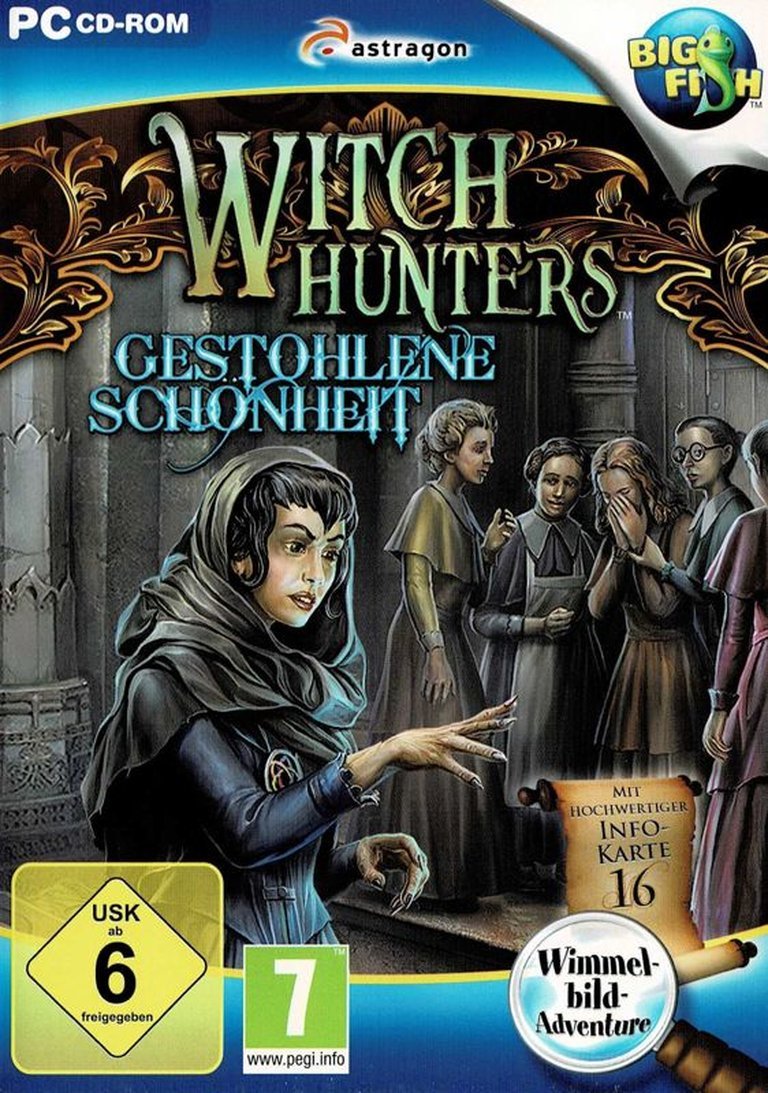
In the dark fantasy adventure Witch Hunters: Stolen Beauty, Angelica loses her beauty to a witch’s curse and embarks on a quest to reclaim it while exploring a haunted school building where students have been trapped for over a century. Players solve hidden object scenes and mini-games to uncover secrets, free the trapped souls, and ultimately defeat the witch in this first-person, point-and-click horror-mystery adventure.
Gameplay Videos
Where to Buy Witch Hunters: Stolen Beauty
PC
Witch Hunters: Stolen Beauty Guides & Walkthroughs
Witch Hunters: Stolen Beauty Reviews & Reception
jayisgames.com : it’s one of the most gorgeous games you could ask for if you’re looking for a relaxing evening’s play.
Witch Hunters: Stolen Beauty: Review
Introduction
In the shadowed realm of casual gaming, few titles manage to weave a narrative tapestry as rich as Witch Hunters: Stolen Beauty. Released in 2013 by Big Fish Games and developed by Top Evidence Studio, this hidden-object adventure plunges players into a fairy-tale horror story where vanity becomes a battleground. The game’s premise is deceptively simple: Angelica’s grandmother, recounting her traumatic youth at a finishing school, unwittingly summons the witch Madame Flemet—who promptly curses Angelica, stealing her youth and beauty. What follows is a quest through a decaying, puzzle-laden school to reclaim Angelica’s stolen vitality. While adhering to familiar hidden-object tropes, Witch Hunters distinguishes itself through its stunning artistry, thematic depth, and innovative magical systems. This review argues that despite its formulaic structure, the game’s mastery of atmosphere and narrative cohesion elevates it to a standout entry in the casual genre—a testament to Top Evidence Studio’s artistic vision and Big Fish Games’ prowess in curating compelling adventures.
Development History & Context
Top Evidence Studio, a developer known for its clean, painterly aesthetic, crafted Witch Hunters: Stolen Beauty during a golden era for casual games. Released in 2013 on Windows and Mac (with a Collector’s Edition following), the game arrived amid a surge in hidden-object adventures, dominated by publishers like Big Fish Games. Its development was constrained by the era’s technological limitations: a fixed/flip-screen perspective, point-and-click interface, and reliance on pre-rendered 2D artwork. Yet these limitations became strengths, enabling the developers to focus on intricate environmental storytelling. The studio’s vision was clear: create a story that balanced whimsy and unease, inspired by Roald Dahl-esque fairy tales. As noted in contemporaneous reviews, the goal was to evoke “a hefty dose of charm” without veering into outright horror—a delicate tonal tightrope walk executed through decaying gothic architecture and cursed spirits. The game’s business model—sold via digital distribution (CD-ROM) and later through the Big Fish Games Club—reflected the casual market’s shift toward accessible, story-driven experiences. Competing with titles like Mystery Case Files and G.H.O.S.T. Hunters, Witch Hunters carved its niche by emphasizing narrative cohesion and magical innovation over pure puzzle density.
Narrative & Thematic Deep Dive
At its core, Witch Hunters: Stolen Beauty is a meditation on vanity and the cyclical nature of time. The narrative unfolds through Angelica’s journey to reclaim her youth from Madame Flemet, a witch who has sustained herself for over a century by draining the beauty of her students. This premise—beauty as a stolen commodity—anchors the game’s themes of aging, power imbalances, and generational trauma. Angelica’s quest isn’t merely personal; she liberates other cursed spirits trapped in the school, each representing facets of Flemet’s cruelty. These characters—such as the spectral woman in the painting or the ethereal pottery-room dweller—serve as narrative anchors, providing context for the witch’s motives and granting Angelica magical powers in return for her freedom.
The dialogue, while sparse, is rich with subtext. Notes and conversations hint at Flemet’s loneliness and obsession with eternal youth, transforming her from a one-dimensional villain into a tragic figure. The game’s fairy-tale framing—complete with talking animals (a raven, a dog) and enchanted objects—softens the horror, making the witch’s curse feel like a dark fable. This tonal duality is key: the narrative oscillates between the whimsical (a possessed teddy bear) and the macabre (a century-old beehive), creating a sense of wonder unease. The 12 Snake Keys, collected throughout the journey, symbolize the fragmented pieces of Angelica’s stolen youth, coalescing only at the climax to unlock the final confrontation. Thematically, this underscores the idea that reclaiming one’s identity requires piecing together disparate memories and experiences—a poignant metaphor for growth and self-acceptance.
Gameplay Mechanics & Systems
Witch Hunters operates on a classic hidden-object adventure loop, but it distinguishes itself through a layered progression system. The core gameplay revolves around two pillars: Hidden Object Scenes (HOS) and environmental puzzles. HOS, triggered by sparkling areas, task players with locating randomly generated items from a list, often requiring interaction (e.g., moving a vine to reveal grapes). These scenes are varied, blending realism (a “Rolling pin”) with fantastical elements (“Letter B,” “Circular saw”), and are leavened by environmental storytelling—clues to puzzles are often hidden amidst the junk.
The game’s true innovation lies in its magical abilities, acquired by freeing cursed spirits and integrated into gameplay:
– Reveal Power: Uncovers hidden paths or objects (e.g., revealing a shawl in the gazebo).
– Freeze Motion: Stops time-sensitive elements (e.g., freezing water to cross a bridge).
– Tame Power: Pacifies hostile creatures (e.g., a dog or lizard).
– Turn Good Power: Transforms corrupted objects (e.g., a bush into a flower).
– Animate Power: Brings inanimate objects to life (e.g., a statue to block a passage).
These abilities transform puzzles from static challenges into dynamic interactions. For instance, using Reveal to access a hidden door or Freeze Motion to stabilize a treacherous walkway adds strategic depth. The inventory system is straightforward, with items used contextually—a knife to open latches, a pitcher to collect water. Puzzles range from logic-based (arranging tea cups in a kiln) to pattern-matching (aligning a ballet dancer with a window reflection). The difficulty settings (Casual, Advanced, Expert) adjust the game’s accessibility, with slower hint/skip recharge in Expert mode and fewer glints to guide players. While the HOS and puzzles follow genre conventions, the magical abilities introduce a welcome layer of creativity, making progression feel earned rather than rote.
World-Building, Art & Sound
The game’s setting—an abandoned finishing school—serves as a character in itself. Top Evidence Studio’s hand-painted environments evoke a gothic fairy tale, with decaying grandeur in every corner: the ivy-choked garden, the dusty pottery room, the eerie library, and the oppressive attic. Each location is meticulously designed, with details like peeling wallpaper, antique furniture, and flickering candles immersing players in the witch’s haunted domain. The school’s layout—a labyrinth of interconnected rooms—mirrors Angelica’s fragmented psyche, as she navigates past traumas to reclaim her identity. This world-building is enhanced by the trapped spirits, who linger as ethereal presences, their stories revealed through environmental cues (e.g., a broken teapot hinting at a past accident).
The visual direction is the game’s crowning achievement. Described as “gorgeous” and “stunning” in contemporary reviews, the art style blends realism with whimsy—detailed backgrounds (a mosaic of hexagons in the gazebo floor) contrast with stylized characters (the angular, spectral form of Madame Flemet). Color palettes shift from the warm, nostalgic browns of Angelica’s home to the cold, blues of the school, symbolizing her transformation from youth to age and back. Sound design complements the visuals, with ambient sounds (dripping water, creaking floorboards) and a haunting musical score that intensifies during HOS and climactic moments. Though the composer remains uncredited (as noted in player queries), the music’s fairy-tale melodies underscore the game’s tonal balance of magic and melancholy. Voice acting, minimal but effective, gives life to spirits, their soft, pleading voices heightening the emotional stakes.
Reception & Legacy
Upon release, Witch Hunters: Stolen Beauty received a mixed but largely positive reception, with critics praising its art and atmosphere while acknowledging its formulaic gameplay. JayIsGames lauded it as “elegant and gleefully cheesy,” highlighting its “stunning artwork” and “fairytale charm,” though noting it was “slow to start” and “not a big risk taker.” Metacritic shows no aggregated critic scores, but player reviews on platforms like Steam and Big Fish Games reflect a similar sentiment—many commended the narrative and visuals while wishing for greater innovation. Commercially, the game found success as a staple of Big Fish Games’ catalog, bolstered by its Collector’s Edition (featuring bonus scenes and an art gallery).
The game’s legacy is twofold. As part of the Witch Hunters series (followed by Full Moon Ceremony in 2015), it established a niche for magical-themed hidden-object adventures, influencing titles like The Mystery of the Crystal Portal by emphasizing narrative-driven puzzles. Its magical ability system presaged similar mechanics in later casual games, proving that genre conventions could be enriched with creative twists. Culturally, the game preserves a snapshot of 2010s casual gaming—prioritizing accessibility and storytelling over complexity, with a devoted fanbase still dissecting its lore. Though it may not have revolutionized the genre, its artistry and thematic cohesion have cemented its status as a cult favorite, preserved in archives like MobyGames for future historians to dissect.
Conclusion
Witch Hunters: Stolen Beauty is a masterclass in atmospheric storytelling within the casual gaming framework. It leverages genre conventions—hidden-object scenes, environmental puzzles, and a linear narrative—to craft a compelling fairy-tale horror experience. While its gameplay may not break new ground, its strengths lie in its art, narrative depth, and innovative magical systems, which elevate it above its contemporaries. Top Evidence Studio’s painterly visuals and Big Fish Games’ polished execution create a world that is both enchanting and unsettling, while the themes of beauty and aging resonate beyond its fantasy setting. For fans of hidden-object adventures, it remains a must-play—proof that even within a formulaic genre, artistry and vision can create timeless magic. In the pantheon of casual games, Witch Hunters: Stolen Beauty stands not as a radical innovator, but as a paragon of thoughtful, evocative design—a jewel in the crown of its developer’s legacy and a testament to the enduring power of fairy tales reimagined for the digital age.