
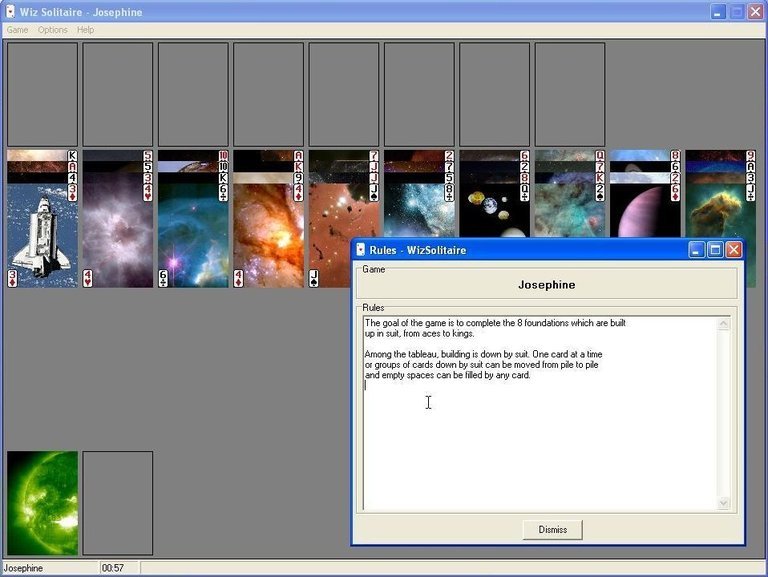
Description
Wiz Solitaire is a freeware card game released in 2004 for Windows, featuring a unique deck of cards based on NASA images. The game offers a variety of classic solitaire variations such as Klondike, Freecell, Spider, and more. Each game mode comes with its own help file, and the developer uniquely requested that players who enjoyed the game consider purchasing something from their Amazon wish list instead of paying for the game.
Wiz Solitaire Reviews & Reception
metacritic.com : the ideal game for all your relax moments
download.cnet.com (60/100): total trash
Wiz Solitaire: A Forgotten Gem in the Digital Card Game Pantheon
Introduction
In the vast ocean of digital card games, Wiz Solitaire (2004) emerges as a curious artifact—a freeware passion project that blended classic solitaire mechanics with idiosyncratic charm. Released during a transitional era for PC gaming, this little-known title by developer Simone Tellini offered a customizable twist on the timeless solo card game, even as it stumbled over its own ambitions. This review explores how Wiz Solitaire carved out a niche in the early 2000s freeware scene, its technological constraints, and its lasting (if underappreciated) legacy.
Development History & Context
The Indie Freeware Landscape
In the early 2000s, the PC gaming ecosystem was bifurcated: AAA studios dominated retail, while independent developers leveraged freeware platforms to distribute experimental or niche titles. Wiz Solitaire emerged from this latter category, crafted by Italian programmer Simone Tellini as a labor of love. Tellini’s vision was simple yet personal: to create a solitaire suite that allowed players to customize decks using their own images—a novelty at a time when most digital card games shipped with static, uninspired assets.
Technological Constraints
Built for Windows, Wiz Solitaire operated within the limitations of early-2000s hardware. Its fixed/flip-screen perspective and point-and-select interface reflected the era’s standard for casual games, prioritizing accessibility over innovation. The game’s most ambitious feature—the ability to import custom card decks—was hindered by clunky implementation, requiring users to manually assign images to each card. Despite this, Tellini embraced the DIY ethos of early internet culture, even incorporating NASA imagery as a default “space deck,” a quirky nod to the public domain resources of the time.
A Unique Business Model
In lieu of traditional payment, Tellini requested that satisfied players purchase items from his Amazon wishlist—an early example of the “pay what you want” model later popularized by platforms like Humble Bundle. This approach underscored the game’s status as a heartfelt hobby project rather than a commercial venture.
Gameplay Mechanics & Systems
A Solitaire Variety Pack
Wiz Solitaire bundled 13 variants, including staples like Klondike, FreeCell, and Spider, alongside deeper cuts like Forty Thieves, Pyramid, and Seahaven. Each mode adhered to traditional rulesets, with little deviation from established norms. While the lack of gameplay innovations may disappoint enthusiasts seeking novelty, the collection’s breadth catered to purists.
Customization: A Double-Edged Sword
The game’s standout feature was its deck editor, which allowed users to replace card faces with personal images. However, the process was laborious: players had to individually assign images to all 52 cards, a tedious task in an era before drag-and-drop simplicity. The default NASA-themed deck—a collage of planetary photographs—polarized players. Some praised its whimsy, while others (like CNET reviewers) derided it as visually distracting, with suits and ranks rendered nearly illegible.
Quality-of-Life Features
For its time, Wiz Solitaire offered robust features:
– Unlimited undo: A lifesaver for strategic play.
– Move suggestions: A beginner-friendly aid.
– Save states: Allowing interrupted games to resume later.
Yet, the UI felt dated even in 2004, with bland menus and a lack of visual flair compared to contemporaries like Microsoft Solitaire.
World-Building, Art & Sound
The NASA Deck: Love It or Hate It
The game’s default visual identity hinged on its NASA-derived card faces—a mosaic of nebulas, planets, and spacecraft. While imaginative, the design clashed with practicality: card suits and ranks were often obscured by vibrant imagery, complicating gameplay. This choice reflected Tellini’s artistic freedom but alienated players seeking clarity.
Minimalist Audio
Sound design was sparse, limited to basic card-shuffling effects and win/lose jingles. Unlike the orchestral scores of premium card games, Wiz Solitaire’s audio faded into the background—a pragmatic choice for a freeware title.
Reception & Legacy
A Quiet Launch
With no formal marketing, Wiz Solitaire flew under the radar. Critics ignored it, and user reviews were sparse. Those who engaged with it praised its customization options but lamented its clunky execution. CNET users described the NASA deck as “ugly as sin,” while SoftwareLode commenters celebrated the ability to create personalized decks despite the tedious process.
Influence on Customizable Card Games
Though overshadowed by Microsoft’s polished offerings, Wiz Solitaire foreshadowed the DIY ethos of later indie hits. Its deck editor presaged modern tools in games like Tabletop Simulator, where player creativity drives content.
The Freeware Time Capsule
Today, Wiz Solitaire serves as a relic of a bygone era—when indie developers distributed passion projects via GeoCities pages and early download hubs. Its blend of earnestness and jank epitomizes the pre-Steam freeware scene, where innovation often outpaced polish.
Conclusion
Wiz Solitaire is not a masterpiece. Its NASA deck is a misfire, its interface archaic, and its customization tools unwieldy. Yet, within its imperfections lies an authentic snapshot of early-2000s indie gaming—a time when a single developer could whimsically fuse space imagery with solitaire and toss it into the digital ether. For historians, it’s a fascinating footnote; for nostalgic players, a charming oddity. In the grand tableau of card games, Wiz Solitaire is a humble card tucked in the corner—easy to overlook, but quietly meaningful to those who bother to look.
Final Verdict: A flawed but heartfelt artifact of PC gaming’s freeware era, best appreciated as a curiosity rather than a contender.