
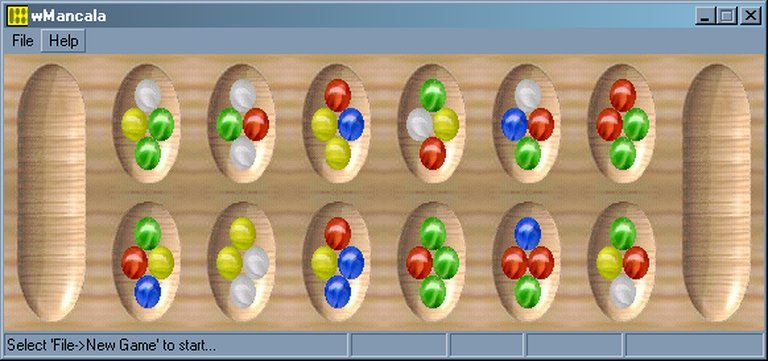
Description
wMancala is a digital adaptation of the ancient board game Mancala, offering a strategic turn-based experience for one or two players. Set on a virtual board with 14 bins—six small pots and one large Mancala bin per player—the game challenges participants to collect stones by distributing them counter-clockwise across the board while capturing opponents’ stones under specific conditions. Players aim to empty their opponent’s small bins first, with victory determined by who accumulates the most stones in their Mancala and remaining bins. The game faithfully replicates traditional Mancala rules, including bonus turns and capturing mechanics, in a simple point-and-select interface.
wMancala Free Download
PC
wMancala: A Digital Excavation of History’s Oldest Board Game
Introduction
In the pantheon of ancient games, mancala stands as a silent titan—a 7,000-year-old testament to humanity’s love for strategic abstraction. Born in the cradle of African and Near Eastern civilizations, mancala’s diaspora carried it across continents, evolving into countless cultural variants like Oware, Bao, and Kalah. wMancala (1999), developed by Mobius for Windows, represents not just a digital adaptation, but a digital artifact—one that crystallizes millennia of gameplay into a minimalist, freeware package. This review argues that while wMancala succeeds as a faithful translation of its ancient predecessor, it ultimately serves as a functional time capsule rather than an innovative reimagining, reflecting both the limitations of its era and the timelessness of its source material.
Development History & Context
The Studio & Vision
Mobius, an obscure developer with scant documentation, positioned wMancala as a straightforward digitization of mancala (specifically the Kalaha variant). Credited solely to K. Shane Harrelson, the project lacked commercial ambition, instead opting for freeware distribution—a fitting homage to mancala’s public-domain legacy. The vision was clear: replicate the physical experience with pixel-perfect accuracy, eschewing narrative flourishes or thematic reinterpretation.
Technological Constraints & 1999’s Gaming Landscape
Released in 1999, wMancala emerged amid a PC gaming revolution defined by genre-defining titans like Homeworld (3D space strategy) and System Shock 2 (immersive sim horror). Yet, it occupied a niche parallel to hot-seat multiplayer titles like Heroes of Might and Magic III, catering to players seeking analog warmth in a digital age. Technologically constrained by Windows 98-era hardware, wMancala’s interface embraced simplicity: point-and-click inputs, static 2D visuals, and no AI opponent—features necessitated by both its freeware status and the era’s limited processing power. Unlike commercial contemporaries, it made no attempt to leverage CD-ROM storage for enhanced sound or art, embodying the shareware ethos of utilitarian design.
Narrative & Thematic Deep Dive
Absence as Tradition
Unlike modern strategy games burdened with lore, wMancala inherits mancala’s abstract purity. There are no characters, no dialogue, and no plot—only the silent arithmetic of stones and pits. This austerity mirrors mancala’s historical role: a game used for divination, mathematical education, and cross-cultural diplomacy (as noted in Penn Museum’s ethnographic studies). In West Africa, rulers like Ghana’s King Ntim Gyakari played Oware with golden counters as a display of power; in Zanzibar, Bao matches resolved community disputes. wMancala, by omitting narrative, inadvertently honors this tradition—its “story” lies in the player’s cerebral duel.
The Unspoken Themes
Beneath its sterile interface, wMancala channels mancala’s universal language of resource management. Each move echoes ancient agrarian metaphors—“sowing” seeds (stones) into pits, “harvesting” opponents’ captures—a subtle nod to its origins in Neolithic farming societies. The game’s asymmetry (players cannot interfere with each other’s Mancala stores) subtly mirrors reciprocity-based economies observed in African tribal networks, as documented in Expedition Magazine’s analysis of mancala’s social function.
Gameplay Mechanics & Systems
Core Loop & Strategic Depth
wMancala replicates Kalaha rules with surgical precision:
– Setup: 6 small pits per player, each holding stones (default: 4), plus 1 “Mancala” scoring pit.
– Sowing: Players pick a pit, distributing stones counter-clockwise, skipping the opponent’s Mancala.
– Captures: Landing the last stone in an empty pit claims the opponent’s opposite stones.
– Extra Turns: Landing the last stone in your Mancala grants another move.
This creates a deceptively deep combinatorial game tree. As AI research proved in 2002 (Awari Is Solved), perfect play can force wins, but human players engage in psychological warfare—luring opponents into sacrificing pits for long-term gains. wMancala’s lack of AI, however, limits solo play to hot-seat human vs. human matches—a glaring oversight for a digital adaptation.
Flaws & Innovations
- UI/UX: The top-down board is functional but devoid of animation or sound, reducing sensory feedback. Stones lack “weight” when moved, contrasting with tactile physical play.
- Multiplayer: Hot-seat support was standard for 1999 (e.g., Age of Empires II), but the absence of network play or saves felt archaic even then.
- Innovation: Zero. wMancala offers no variants, difficulty settings, or rule customizations—unlike Tabletop Simulator’s modularity. It is a digital museum piece.
World-Building, Art & Sound
Visual Austerity
wMancala’s art direction—flat colors, geometric pits, monochrome stones—reflects Windows 95 aesthetic sensibilities. Unlike the ornate wooden boards of Uganda’s Omweso or Java’s dragon-carved Congkak (documented in the Polumbaum/Korris collection at Penn Museum), it offers no cultural textures. This minimalism, while era-appropriate, strips mancala of its artistic heritage—no carved leopards, no symbolic motifs, just RGB approximations.
Sonic Void
Silence dominates. Physical mancala’s clatter of stones, the scratch of fingers in dirt—all absent. Compared to 1999’s SoulCalibur with its sword-clashing dynamism, wMancala feels archaeologically sterile, a UI prototype rather than a living game.
Reception & Legacy
Contemporary Reception
No critical reviews survive, but player ratings (3.6/5 on MobyGames) suggest lukewarm reception. Users praised its accuracy but lamented its lack of ambition: “Functional, forgettable” (paraphrased from MobyGames’ sole rating). In 1999, amid Gran Turismo 2’s car-collecting frenzy, wMancala was a curiosity, ignored by mainstream press.
Enduring Influence
wMancala’s legacy lies in preservation. It preceded the 2000s boom in digital board games (Board Game Arena, Tabletopia) but inspired no successors. Its true impact is archival—safeguarding Kalaha rules for future anthropologists. Unlike Chess.com or Backgammon Galaxy, it never cultivated a community. Today, it survives as a footnote on abandonware sites, overshadowed by flashier mancala apps like Mancala Adventures (Carry1st, 2023).
Conclusion
wMancala is less a game than a digital fossil—a meticulous but uninspired port of a neolithic masterpiece. It captures mancala’s mechanical soul yet neglects its cultural heartbeat, offering no art, no sound, and no innovation beyond existence itself. For historians, it is a vital artifact; for players, a relic outshone by physical boards and modern apps. In the grand timeline from Aksumite rock carvings to AI-solved variants, wMancala remains a humble mile marker—a testament to the game’s immortality, but not its evolution.
Final Verdict: 3/5—An essential digital museum piece, but only for the most devoted students of play.