
- Release Year: 2003
- Platforms: Linux, Macintosh, Windows Apps, Windows
- Publisher: Activision Publishing, Inc., Bethesda Softworks LLC, Splash Damage, Ltd
- Developer: Splash Damage, Ltd
- Genre: Action
- Perspective: 1st-person
- Game Mode: LAN, Online PVP
- Gameplay: Class-based, Objective-based, Shooter
- Setting: Futuristic, Sci-fi, World War II
- Average Score: 87/100
Description
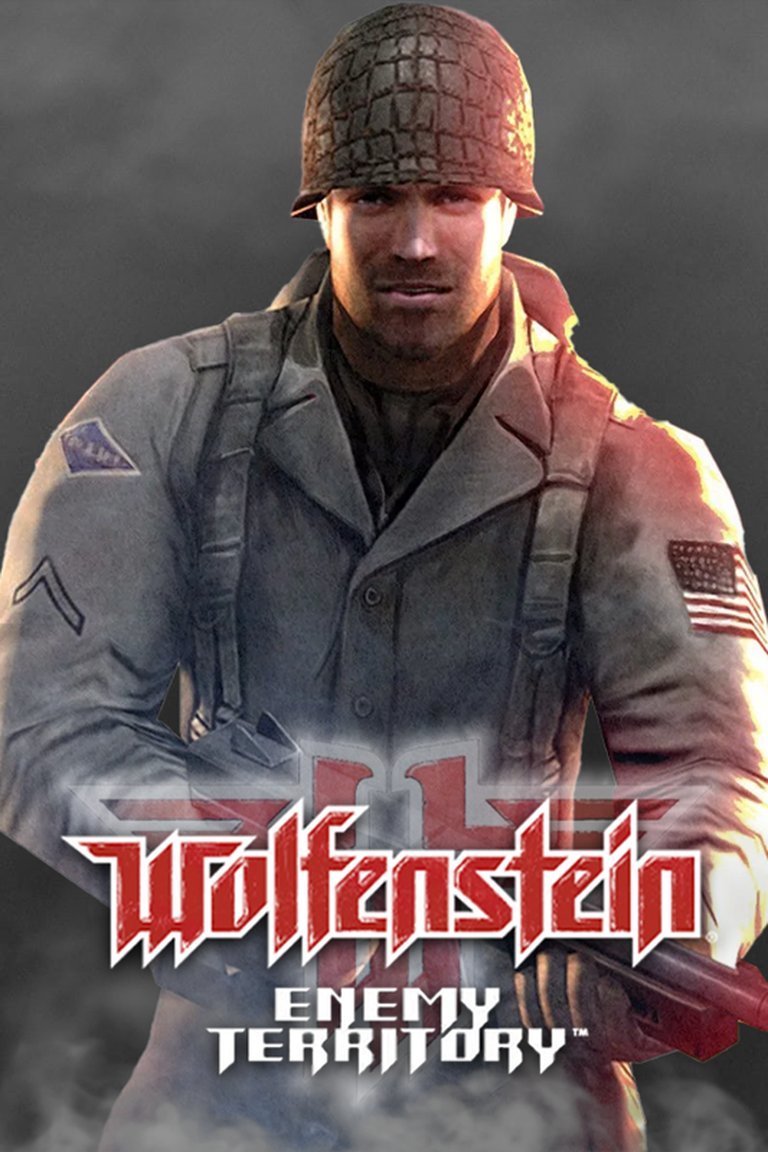
Wolfenstein: Enemy Territory is a free-to-play multiplayer first-person shooter set during World War II, serving as a spin-off to Return to Castle Wolfenstein. Players engage in team-based objective-driven battles across two campaigns—North Africa and Northern Europe—with missions ranging from escorting tanks to stealing gold or sabotaging enemy installations. The game features distinct character classes, such as the covert operative (who can infiltrate enemy lines by stealing uniforms) and the engineer (who builds structures and deploys defenses), each with unique abilities and weapons. Additionally, it introduces the ‘Last Man Standing’ mode, where teams compete in rounds to eliminate the opposition through tactical combat and teamwork.
Gameplay Videos
Where to Buy Wolfenstein: Enemy Territory
Wolfenstein: Enemy Territory Free Download
Wolfenstein: Enemy Territory Patches & Updates
Wolfenstein: Enemy Territory Mods
Wolfenstein: Enemy Territory Guides & Walkthroughs
Wolfenstein: Enemy Territory Reviews & Reception
imdb.com : A triumphant return to form for the series.
metacritic.com (90/100): An excellent game that is well-balanced and addictively fun to play.
steambase.io (84/100): Wolfenstein: Enemy Territory has earned a Player Score of 84 / 100.
gamesreviews2010.com : Wolfenstein: Enemy Territory is a multiplayer spin-off to Return to Castle Wolfenstein, developed by Splash Damage and published by Activision.
mobygames.com (88/100): Great, free multiplayer game.
Wolfenstein: Enemy Territory Cheats & Codes
PC
Press ~ to display the console window, then enter one of the following codes to activate the corresponding cheat function.
| Code | Effect |
|---|---|
| /autoscreenshot | Take a screenshot. |
| /cmdlist | Show all command codes. |
| /cg_thirdperson 1 | Changes to a third person view. |
| /cg_uselessnostalgia 1 or 0 | Toggles old Wolfenstein style HUD on/off. |
| /cg_FOV | Change field of view (number). |
| /g_debugbullets 1 | Shows red lines where the player shoots. |
| /give ammo pack | Receive an ammo pack. |
| /give all | Gives all weapons and ammo. |
| /give ammo | Gives 9999 ammo and 15 grenades. |
| /give health | Gives full health. |
| /give stamina | Refill stamina count. |
| /god | Invincibility. |
| /kill | Kills the player. |
| /mapname | Display the current map name. |
| /noclip | Allows player to pass through walls and items in a spectator mode. |
| /notarget | Disables enemy A.I. (so they can’t target the player). |
| /nofatigue | Unlimited stamina. |
| /playdead | Makes you appear dead to trick enemies; re-enter to wake back up. |
| /serverinfo | Shows server information. |
| /set g_gravity | Changes gravity to (number). Smaller numbers allow high jumping/floating. |
| /give skill | Then one of the following: 0 = Battle sense, 1 = Engineering, 2 = First aid, 3 = Signals, 4 = Light weapons, 5 = Heavy weapons, 6 = Covert ops. |
| /give armor | 100 armor. |
| /give armor |
Set armor amount. |
| /give health |
Set health amount. |
| /give |
Spawn indicated item. |
| /dir maps | List maps. |
| /spdevmap or /devmap | Advance to indicated map. |
| /reconnect | Reconnect to last server. |
| /screenshot | Screenshot of current screen. |
| /toggle r_fullscreen | Toggle between windowed and full screen; Restart game when changed. |
| /toggle cg_drawcompass | Toggle compass display. |
| /toggle cg_draw2d | Toggle HUD display. |
| /toggle cg_drawfps | Toggle frame rate display. |
| /toggle cg_drawtimer | Show time left. |
| /toggle cg_gibs | Toggle gibs. |
| /toggle cg_drawteamoverlay | Toggle team overlays. |
| /quit | Exit game. |
| /set g_speed x | Set a speed (x is your number of speed). |
Wolfenstein: Enemy Territory – A Masterclass in Multiplayer FPS Design
Introduction: The Free Gem That Redefined Team-Based Shooters
In the pantheon of first-person shooters, few titles have left as indelible a mark as Wolfenstein: Enemy Territory. Released in 2003 as a free standalone multiplayer spin-off of Return to Castle Wolfenstein, this game didn’t just iterate on its predecessor—it revolutionized the team-based shooter genre. Developed by Splash Damage and published by Activision, Enemy Territory emerged from the ashes of a canceled expansion pack, transforming into a cultural phenomenon that still thrives decades later. This review will dissect why Enemy Territory remains one of the most influential and beloved multiplayer shooters of all time, examining its development, gameplay innovations, community impact, and enduring legacy.
Development History & Context: From Expansion to Phenomenon
A Phoenix Rising from Cancelled Plans
Wolfenstein: Enemy Territory was originally conceived as a commercial expansion pack for Return to Castle Wolfenstein, featuring both a new single-player campaign and enhanced multiplayer modes. However, due to developmental challenges—particularly with the single-player component—Activision and id Software made the unprecedented decision to cancel the expansion’s commercial release. Rather than abandoning the project entirely, they opted to release the multiplayer portion as a free standalone game on May 29, 2003. This decision was both a gesture of goodwill to fans and a strategic move to bolster the Wolfenstein franchise’s multiplayer community.
The Engine: id Tech 3’s Swansong
Built on a heavily modified version of the id Tech 3 engine (the same engine powering Quake III Arena and Return to Castle Wolfenstein), Enemy Territory pushed the technical boundaries of its time. The engine’s robustness allowed for:
– Large-scale battles (up to 64 players).
– Dynamic lighting and shadow effects that enhanced immersion.
– Modular map design, enabling complex objective-based gameplay.
The engine’s open-source release in 2005 further cemented its legacy, allowing modders to extend the game’s lifespan indefinitely.
The Studio: Splash Damage’s Breakout Moment
Splash Damage, a relatively unknown UK-based studio at the time, was tasked with developing Enemy Territory. Founded by Paul Wedgwood and Richard Jolly, the studio’s vision was to create a team-focused, objective-driven shooter that emphasized strategy over mindless frag-fests. Their work on Enemy Territory would later pave the way for future titles like Enemy Territory: Quake Wars and Brink, though none would capture the same magic.
The Gaming Landscape in 2003
At the time of Enemy Territory’s release, the FPS genre was dominated by:
– Battlefield 1942 (team-based, vehicle-heavy combat).
– Counter-Strike (tactical, round-based gameplay).
– Call of Duty (cinematic single-player experiences).
Enemy Territory carved its niche by blending:
– The objective-based gameplay of Battlefield.
– The class-based teamwork of Team Fortress.
– The fast-paced action of Quake III Arena.
Its free-to-play model was also revolutionary, predating the modern free-to-play boom by nearly a decade.
Narrative & Thematic Deep Dive: War as a Team Sport
The Setting: WWII Through a Multiplayer Lens
Wolfenstein: Enemy Territory is set during World War II, with players choosing between the Allies and the Axis in two primary campaigns:
1. North Africa Campaign (maps: Gold Rush, Siwa Oasis, Atlantic Seawall Battery).
2. Northern Europe Campaign (maps: Rail Gun, Würzburg Radar, Fuel Dump).
Unlike its single-player counterparts, Enemy Territory eschews a traditional narrative in favor of emergent storytelling. The “story” is crafted through player actions, team dynamics, and the ebb and flow of each match. The game’s objectives—such as stealing radar parts, escorting tanks, or destroying fuel dumps—are grounded in historical plausibility, lending a veneer of authenticity to the chaos.
Themes: Teamwork, Sacrifice, and Strategy
Enemy Territory’s themes revolve around:
– Collective Effort Over Individual Glory: Success hinges on players fulfilling their roles rather than chasing kill streaks.
– The Fog of War: Limited information (e.g., no minimap in most modes) forces players to rely on communication and reconnaissance.
– Resource Management: Ammunition, health, and objectives are finite, requiring careful coordination.
The game’s lack of a single-player mode reinforces its core philosophy: Enemy Territory is about shared victory and shared defeat.
The Absence of Dialogue and Character Depth
Unlike modern military shooters, Enemy Territory features no voiced characters or cutscenes. Instead, it relies on:
– Text-based communication (via chat or voice commands).
– Class-specific taunts and calls (e.g., medics shouting “Medic!” when wounded).
– Environmental storytelling (e.g., the eerie silence of a failed offensive).
This minimalist approach keeps the focus on gameplay while allowing players to project their own narratives onto the experience.
Gameplay Mechanics & Systems: The Blueprint for Modern Team Shooters
Core Gameplay Loop: Objectives Over Kills
Enemy Territory’s gameplay revolves around asymmetrical objectives where one team attacks and the other defends. The attacking team must complete a series of tasks within a time limit, while the defending team aims to stall or prevent completion. This structure creates high-stakes, dynamic matches where momentum can shift in an instant.
Game Modes:
- Campaign Mode: A series of three linked missions where progress carries over.
- Objective Mode: Standalone objective-based matches.
- Stopwatch Mode: Teams switch sides after one round, with the fastest completion time winning.
- Last Man Standing: A pure team-deathmatch mode (added later).
Class System: The Heart of Teamwork
Enemy Territory’s five distinct classes are the cornerstone of its gameplay, each fulfilling a unique role:
| Class | Role | Key Abilities | Weapons |
|---|---|---|---|
| Soldier | Frontline Assault | Heavy weapons, high damage output | Panzerfaust, Flamethrower, MG42 |
| Medic | Combat Support | Revive teammates, heal wounds, self-resurrection | Syringe, SMG |
| Engineer | Construction/Destruction | Build/destroy structures, repair vehicles, lay mines | Dynamite, Rifle Grenades |
| Field Ops | Tactical Support | Call airstrikes/artillery, resupply ammo | Binoculars, Mortar |
| Covert Ops | Reconnaissance/Sabotage | Disguise as enemies, sabotage objectives, scout enemy positions | Silenced weapons, Garrote Wire |
Key Innovations:
– Class Synergy: A well-balanced team requires all classes. For example:
– Engineers build command posts to speed up medic revives.
– Field Ops resupply soldiers with ammo for heavy weapons.
– Covert Ops scout enemy positions for artillery strikes.
– No “Best” Class: Each class has situational strengths, preventing meta stagnation.
Progression System: Experience and Unlocks
Enemy Territory introduced a persistent experience system where players earn XP for:
– Completing objectives.
– Killing enemies.
– Supporting teammates (e.g., healing, reviving, resupplying).
XP unlocks perks and abilities tied to specific skills:
– Battle Sense: Improved awareness (e.g., enemy detection).
– Light Weapons: Faster reloads, reduced recoil.
– Class-Specific Skills: E.g., engineers unlock faster construction, medics unlock faster revives.
Controversial Design Choice:
– XP Reset Options: Servers could reset XP after each match or campaign, ensuring fairness in competitive play.
Combat Mechanics: Weighty and Tactical
- Weapon Handling: Guns feel heavy and impactful, with noticeable recoil and reload times.
- Hit Registration: Precise and satisfying, rewarding accurate aim.
- Movement: Slightly slower than Quake III, emphasizing positioning over twitch reflexes.
User Interface and HUD: Functional Minimalism
The UI is clean and unobtrusive, prioritizing gameplay clarity:
– Objective Tracker: Always visible, showing current and upcoming tasks.
– Spawn Timer: Critical for planning attacks/defenses.
– Class-Specific HUD Elements: E.g., medics see wounded teammates, engineers see constructible objects.
Innovations and Flaws
Innovations:
– Dynamic Spawn Times: Longer spawn timers for defenders create tension.
– Command Post System: Engineers can build forward spawn points, shifting the battlefield.
– Disguise Mechanic: Covert Ops can infiltrate enemy lines, adding a layer of deception.
Flaws:
– No Bots: The lack of AI opponents made offline play impossible (though mods later added bots).
– Steep Learning Curve: New players often struggle with the complexity of objectives and class roles.
– Graphical Limitations: Even at launch, the visuals were dated compared to contemporaries like Doom 3.
World-Building, Art & Sound: Immersion Through Simplicity
Visual Design: Gritty and Functional
Enemy Territory’s art direction prioritizes readability and atmosphere over graphical fidelity:
– Maps: Designed with clear chokepoints, flanking routes, and objective pathways. Examples:
– Gold Rush: A sprawling desert mine with tight corridors and open sniper alleys.
– Rail Gun: A massive railway cannon requiring coordinated assaults.
– Character Models: Distinct silhouettes for easy class identification.
– Environmental Details: Weather effects (e.g., sandstorms in Siwa Oasis) and destructible elements (e.g., wooden barriers).
Sound Design: The Symphony of War
The audio design is understated but effective:
– Weapon Sounds: Each gun has a unique, weighty report (e.g., the Panzerfaust’s explosive whoosh).
– Ambient Noise: Distant artillery, wind howling through ruins, and the clanking of tanks.
– Voice Cues: Classes shout context-sensitive lines (e.g., “Need a medic!” or “Enemy disguised!”).
Standout Feature:
– The radio morse code Easter egg (a nod to Wolfenstein 3D), which translates to “Splashdamage rocks your socks.”
Music: Subtle but Memorable
Composed by Bill Brown, the soundtrack is sparse but atmospheric, featuring:
– Tense, orchestral cues during critical moments.
– Minimalist loops that avoid overpowering gameplay.
Reception & Legacy: The Game That Refused to Die
Critical Reception: Universal Acclaim
Enemy Territory was met with near-universal praise, earning an 88% average critic score on MobyGames and a 90 Metacritic score. Highlights from reviews:
– FiringSquad (96%): “The best multiplayer first-person shooter on the market.”
– IGN (85%): “A solid change from the pace set by Battlefield.”
– PC Gamer (83%): “An unmissable deal: a high-quality game… at no cost.”
Player Reception:
– MobyGames User Score: 3.9/5.
– Steam User Score: 84/100 (Very Positive, 2,131 reviews).
– Metacritic User Score: 8.4/10.
Commercial Impact: The Power of Free
As a free download, Enemy Territory’s commercial success is measured in player engagement rather than sales:
– Millions of downloads within months of release.
– Thousands of active servers at its peak.
– Longevity: Still played competitively today, nearly 20 years later.
Awards and Accolades
- GameSpy’s 2003 PC Multiplayer Game of the Year.
- Featured in 1001 Video Games You Must Play Before You Die.
Influence on Future Games
Enemy Territory’s DNA can be seen in:
– Team Fortress 2: Class-based teamwork and objective modes.
– Battlefield Series: Large-scale, objective-driven warfare.
– Overwatch: Hero-based abilities and team synergy.
– Hell Let Loose/Squad: Hardcore mil-sim teamwork mechanics.
Community and Modding: The Lifeblood of ET
The release of the source code in 2004 sparked a modding renaissance:
– ET: Legacy: A modernized client with bug fixes, updated engine, and new maps.
– Custom Maps: Hundreds of community-created levels (e.g., Adlernest, Venice).
– Total Conversions: Mods like ETPro (competitive league play) and NoQuarter (balanced gameplay).
Why the Community Endures:
– Dedicated Servers: Player-run servers with custom rulesets.
– Clan Culture: Competitive teams and tournaments (e.g., ETL League).
– Nostalgia and Accessibility: Free, low system requirements, and timeless gameplay.
Conclusion: A Timeless Masterpiece of Multiplayer Design
Wolfenstein: Enemy Territory is more than a game—it’s a testament to the power of emergent gameplay, teamwork, and community-driven design. Its influence permeates nearly every team-based shooter that followed, yet few have matched its pure, unadulterated focus on objective-driven warfare.
Final Verdict: 10/10 – A Legend
Strengths:
✅ Unmatched teamwork mechanics.
✅ Deep, rewarding class system.
✅ Free-to-play model that set a precedent.
✅ Enduring modding and community support.
Weaknesses:
❌ Steep learning curve for newcomers.
❌ Dated graphics (even for 2003).
❌ No single-player or bot support.
Legacy Rating: S-Tier (Essential Playing)
Enemy Territory isn’t just a relic of the early 2000s—it’s a living, breathing example of how multiplayer shooters should be designed. Its emphasis on strategy, cooperation, and player agency ensures it remains relevant in an era dominated by battle royales and hero shooters. For anyone interested in the evolution of the FPS genre, Wolfenstein: Enemy Territory is required playing.
Where to Play Today:
– Steam (Free).
– GOG (Free).
– ET: Legacy (Modernized client).
Final Thought:
If you’ve never experienced Enemy Territory, do yourself a favor: download it, find a populated server, and prepare to lose hours—and gain lifelong memories. This is team-based shooting at its absolute finest.