
- Release Year: 2014
- Platforms: PlayStation 3, PlayStation 4, Windows Apps, Windows, Xbox 360, Xbox Cloud Gaming, Xbox One
- Publisher: Bethesda Softworks
- Developer: MachineGames
- Genre: Action
- Perspective: 1st-person
- Game Mode: Single-player
- Gameplay: Shooter, Stealth
- Setting: Alternate history, Fantasy, Futuristic, Sci-fi
- Average Score: 84/100
Description
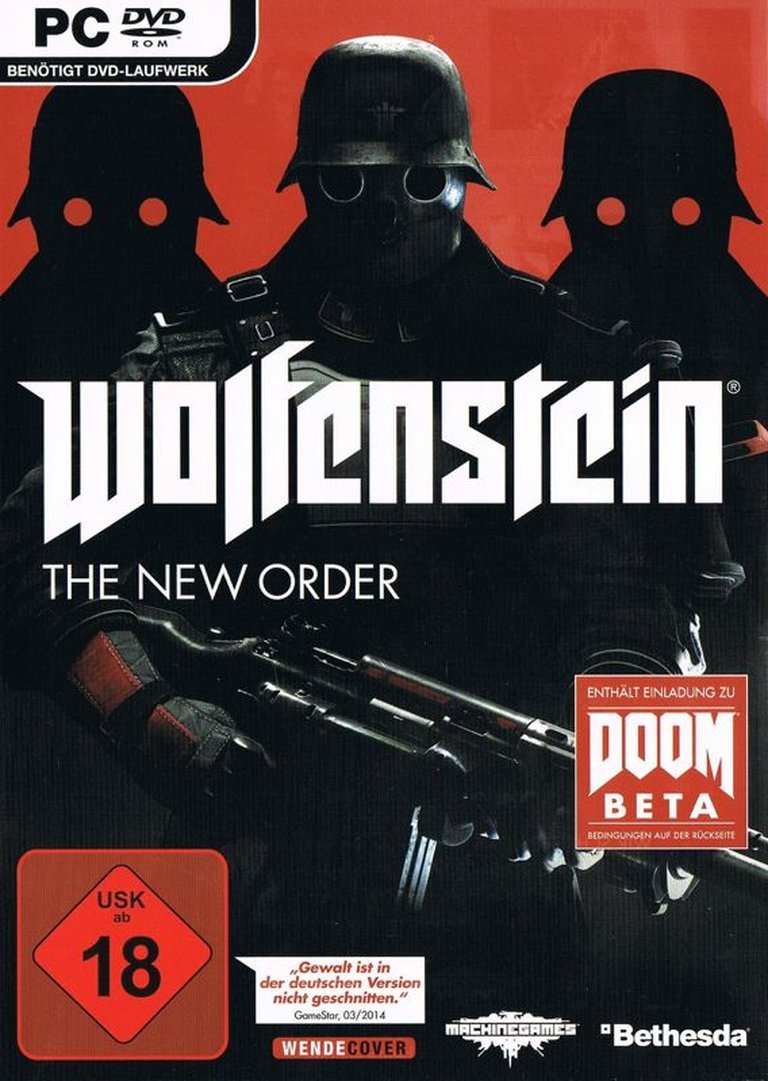
Wolfenstein: The New Order is a first-person shooter set in an alternate 1960s where the Nazis have won World War II, conquering the world through advanced robots, bio-mechanical beasts, and atomic bombings designed by General Deathshead. Players control Polish-American soldier William ‘B.J.’ Blazkowicz, who awakens from a 14-year coma in a Nazi-occupied Poland asylum, rescues his nurse Anya, and embarks on a violent rebellion to dismantle the regime, utilizing dual-wielded weapons, a laser cutter, stealth takedowns, and a perk system amid fast-paced combat against soldiers, guard dogs, and mechanical foes.
Gameplay Videos
Where to Buy Wolfenstein: The New Order
Wolfenstein: The New Order Cracks & Fixes
Wolfenstein: The New Order Mods
Wolfenstein: The New Order Guides & Walkthroughs
Wolfenstein: The New Order Reviews & Reception
metacritic.com (79/100): one of the finest first-person-shooters I’ve ever played, and the best iteration of one of gaming’s most storied franchises.
vg247.com : so far the response is pretty positive.
opencritic.com (82/100): The New Order’s got all the workings of a classic shooter… makes it something truly memorable.
biogamergirl.com : a really fun shooter game worth checking out on next generation consoles and PC immediately.
steambase.io (92/100): Very Positive
Wolfenstein: The New Order Cheats & Codes
PC
Console: Press Ctrl + ~ during gameplay to open the console, then type the code and press Enter. Enigma Codes: At the main menu, select Extras > Enigma Codes (or Tips and Hints), and enter the two rows of numbers for each code.
| Code | Effect |
|---|---|
| cvarAdd g_inhibitAi 1 | Easier AI / Dumb AI |
| cvarAdd g_permaGodMode 1 | God Mode (Invincible) |
| cvarAdd g_permaInfiniteAmmo 1 | Infinite Ammo |
| DebugUnlockPerkByAbility -1 | Unlock Perks |
| DebugUnlockPerkByRequirement -1 | Unlock Perks Set 2 |
| 1 2 3 4 5 6 7 8 9 / 8 7 6 5 4 3 2 1 9 | 999 Mode (UBER difficulty, 999 Health and Infinite ammo) |
| 3 6 9 3 6 9 3 6 9 / 6 3 9 6 3 9 6 3 9 | Hardcore Mode (UBER Difficulty, No Health/Armor drops) |
| 4 8 3 7 2 6 1 5 9 / 5 1 6 2 7 3 8 4 8 | Ironman Mode (Uber Difficulty, 1 Life/Permadeath) |
| 2 4 6 8 1 3 5 7 9 / 7 5 3 1 8 6 4 2 9 | Walk in the Park Mode (HUD disabled, Death Incarnate Difficulty) |
Xbox One
Enigma Codes: Enter the two rows of numbers in the Enigma Codes menu (accessed via Extras at the main menu).
| Code | Effect |
|---|---|
| 1 2 3 4 5 6 7 8 9 / 8 7 6 5 4 3 2 1 9 | 999 mode (UBER Difficulty, 999 health, Unlimited Ammo) |
| 3 6 9 3 6 9 3 6 9 / 6 3 9 6 3 9 6 3 9 | Hardcore mode (UBER Difficulty, No Health/Armor drops) |
| 4 8 3 7 2 6 1 5 9 / 5 1 6 2 7 3 8 4 8 | Ironman mode (UBER Difficulty, 1 life) |
| 2 4 6 8 1 3 5 7 9 / 7 5 3 1 8 6 4 2 9 | Walk in the Park mode (Death Incarnate difficulty, HUD disabled) |
PlayStation 4
Enigma Codes: Press the Tips and Hints button in the tabbed menu to enter the two rows of numbers.
| Code | Effect |
|---|---|
| 1 2 3 4 5 6 7 8 9 / 8 7 6 5 4 3 2 1 9 | 999 Mode (Uber Difficulty, health overcharged to 999 and unlimited ammo) |
| 3 6 9 3 6 9 3 6 9 / 6 3 9 6 3 9 6 3 9 | Hardcore Mode (Uber difficulty, no health or armor drops) |
| 4 8 3 7 2 6 1 5 9 / 5 1 6 2 7 3 8 4 8 | Ironman Mode (Uber difficulty, death is permanent) |
| 2 4 6 8 1 3 5 7 9 / 7 5 3 1 8 6 4 2 9 | Walk in the Park Mode (Death Incarnate difficulty, HUD invisible) |
Wolfenstein: The New Order: Review
Introduction
Imagine a world where the swastika flies over a gleaming 1960s skyline, where Nazi scientists have harnessed ancient Jewish mysticism to birth biomechanical horrors, and where a grizzled American soldier awakens from a 14-year coma to reignite a dying rebellion. Wolfenstein: The New Order isn’t just a shooter—it’s a audacious fever dream that resurrects one of gaming’s oldest franchises from the crypt of mediocrity. Born from the pixelated corridors of 1992’s Wolfenstein 3D, the series has endured reboots, spin-offs, and diminishing returns (Return to Castle Wolfenstein shone multiplayer bright in 2001, but 2009’s Wolfenstein stumbled). Enter MachineGames’ 2014 triumph: a single-player opus that fuses old-school glory with modern storytelling panache. Thesis: The New Order stands as a triumphant reboot, proving that raw, gib-splattering combat and mature narrative depth can coexist, carving a bold new path for FPS revival while honoring its Nazi-slaying roots.
Development History & Context
MachineGames, a Swedish studio founded in 2009 by ex-Starbreeze alumni (creators of The Chronicles of Riddick: Escape from Butcher Bay and The Darkness), entered the fray as ZeniMax Media (Bethesda’s parent) acquired id Software in 2009, inheriting the Wolfenstein IP. Led by managing director/executive producer Jerk Gustafsson, creative director Jens Matthies, and gameplay director Fredrik Ljungdahl, the team—bolstered by art directors like Kjell Emanuelsson and audio director Nicholas Raynor—pitched a vision: reimagine B.J. Blazkowicz not as a mute killing machine, but a heroic everyman with inner monologues revealing trauma and resolve.
Development kicked off in 2010 on id Tech 5 (fresh from Rage‘s 2011 woes), targeting last-gen (PS3, Xbox 360) and new consoles (PS4, Xbox One) alongside PC. Constraints were tight: id Tech 5’s dynamic lighting struggled with 1080p/60fps ambition, leading to pop-in, texture hitches, and ATI GPU woes at launch. Yet, the studio’s single-player focus—no multiplayer dilution—allowed exhaustive polish on levels blending linearity with exploration. Announced via cryptic “1960” teasers in 2013, it launched May 20, 2014, amid a multiplayer-saturated landscape (Call of Duty: Ghosts, Battlefield 4). The New Order bucked trends, embracing retro health-pickup mechanics over regen-health ubiquity, drawing from 1960s Bond films and Wagnerian bombast for its retrofuturistic flair. Budgeted modestly (~$20-30M est.), it prioritized narrative ambition over graphical spectacle, setting a blueprint for Bethesda’s post-Fallout 4 single-player shooters.
Narrative & Thematic Deep Dive
The New Order‘s plot is a masterstroke of pulpy alternate history, commencing in 1946’s desperate Allied raid on Deathshead‘s Baltic fortress. Protagonist William “B.J.” Blazkowicz (voiced masterfully by Brian Bloom) fails to assassinate his skull-faced nemesis (Dwight Schultz reprising the role), entering a 14-year coma. Awakening in Nazi-occupied 1960 Poland—post-U.S. atomic surrender—he learns the Reich’s victory stemmed from Da’at Yichud tech: sun guns, robot dogs (Panzerhunds), and mold-weak superconcrete.
A prologue choice—sacrifice Fergus Reid (Gideon Emery‘s grizzled Scot) or Probst Wyatt III (A.J. Trauth‘s greenhorn)—branches timelines subtly: Fergus teaches lockpicking (Wyatt timeline yields health upgrades, vice versa). B.J. rescues Anya Oliwa (Alicja Bachleda-Curuś), sparking romance amid asylum horrors, then liberates the Kreisau Circle (paraplegic leader Caroline Becker, Bonita Friedericy). Missions span Berlin prisons, London labs, Croatian death camps (Camp Belica, ruled by sadistic Frau Engel, Nina Franoszek), U-boat hijacks, lunar bases, and Deathshead’s redux.
Themes probe fascism’s banal evil: Engel’s disfigurement evokes body horror, concentration camp purges humanize victims (e.g., brain-damaged Max Hass), while B.J.’s poetry-reciting vulnerability (“The New Colossus”) contrasts his gore-soaked rampage. Dialogue crackles—Fergus/Wyatt banter humanizes allies; Deathshead’s glee in experiments chills. Pacing intersperses cinematics with downtime (Berlin apartment chats), but critiques abound: underdeveloped bosses, underused premise (sparse global locales). Still, it’s Wolfenstein’s deepest yarn, blending B-movie schlock with poignant anti-Nazi defiance.
Key Characters
- B.J. Blazkowicz: From stoic grunt to traumatized poet-hero; inner monologues reveal abusive childhood, forging empathy.
- Deathshead: Evolved mad scientist—skull visage, brain-jarred victims—into gleeful genocidaire.
- Frau Engel: Psychotic commandant; “upgrade” mutilation births nightmare fuel.
- Supporting Cast: Set Roth (Mark Ivanir)’s mystic inventor, Bombate (Peter Macon)’s Namibian brute add diversity; J (Wyatt TL) or Tekla (Fergus TL) flesh timelines.
Gameplay Mechanics & Systems
Core loop: infiltrate, slaughter, explore secrets. Combat thrives on flexibility—guns-blazing, cover-shooting, or stealth-stabbing—without punishing alerts. Dual-wield any gun (e.g., Sturmgewehr + shotgun), but ammo scarcity curbs spam; secondary modes shine (Assault Rifle‘s rocket pod, LaserKraftWerk‘s fence-cutter). Health hybrid (minor regen + packs) amps tension; armor manual-pickup evokes classics.
Perk tree (assault/stealth/demolition/tactical) unlocks via challenges (e.g., 10 silent knives = extra throws; overcharged kills = health siphons). UI is minimalist—clean HUD, intuitive wheel—though laser-cutter puzzles grate via repetition. Stealth rewards (melee backs, throw-knives) but AI flaws (blind peripherals, no body alerts) undermine tension. Exploration yields Enigma Codes (modes unlock), gold, letters (lore). Flaws: dumb AI clustering, dual-wield ammo drain, underwhelming bosses/moon level. Innovations: Commander hunts reveal maps; non-linear arenas foster replay (New Game+). ~12-hour campaign balloons via collectibles/perks.
| Mechanic | Strengths | Weaknesses |
|---|---|---|
| Combat | Gory, weighty feedback; flexible styles | AI pathing/aimbot quirks |
| Progression | Perks tailor playstyles; upgrades versatile | Tree impact marginal |
| Exploration | Secrets/replay hooks | Puzzles repetitive |
World-Building, Art & Sound
A retrofuturistic dystopia: 1960s Nazi utopia blends brutalist architecture, art deco zeppelins, and cybernetic abominations. Berlin’s hideout pulses with resistance warmth (record players, family banter); lunar bases evoke sterile menace. Art direction (Axel Torvenius et al.) excels—swastika-branded sun guns, flesh-metal hybrids—but id Tech 5 falters: pop-in, grain filters, LOD shifts mar vistas.
Sound design elevates: Mick Gordon‘s score fuses 1960s groove (odd signatures, distortion pedals) with industrial dread; Foley pops (gib splatters, Panzerhund whirs). VO shines—Bloom’s gravelly resolve, Schultz’s mania. Neumond Records promo (fictional Nazi pop) immerses via trailers. Atmosphere: oppressive propaganda yields cathartic rebellion.
Reception & Legacy
Launch acclaim: MobyScore 7.6 (#6028/26K); critics 79% (56 reviews)—Polygon (horror via camps), PCGamesN (“masterpiece”), Metro (best single-player shooter). Players: 3.7/5 (87 ratings), lauding story/combat, decrying AI/bugs/no MP/shortness (~12h). Commercial: UK #2 debut week; US top-10 May/June; ~400K EU physical by June.
Reputation evolved: initial “surprise gem” (Game Revolution 90%) to series savior. Noms: TGA Best Narrative/Shooter, Golden Joysticks GOTY. Influenced: Sequels Old Blood (2015 prequel), New Colossus (2017); revived single-player FPS amid MP fatigue (Doom 2016 echoed health model). Broader: normalized alt-history Nazis (post-Man in the High Castle), elevated character-driven shooters (Control, Metro Exodus).
| Metric | Score | Notes |
|---|---|---|
| Critics | 79-91% peaks (Nivelul2, games xtreme) | Combat/story highs; AI/engine lows |
| Players | 3.7/5 | Replay value, villains praised |
| Sales | Top charts; €21M EU | Solid for niche reboot |
Conclusion
Wolfenstein: The New Order alchemizes franchise fatigue into FPS renaissance: visceral combat hooks nostalgics, while empathetic storytelling (B.J.’s arc, timeline choice) ensnares moderns. Flaws—AI idiocy, tech stutters, untapped world—pale against triumphs in pacing, perks, and punk defiance. MachineGames didn’t just reboot; they reloaded, birthing a trilogy blueprint. Verdict: Essential masterpiece (9/10), cementing its place as 2014’s boldest shooter and Wolfenstein’s finest hour—a timeless antidote to fascist what-ifs. Play it, liberate the world, repeat.