
- Release Year: 1999
- Platforms: Browser, Macintosh, Windows
- Publisher: The Willy Wonka Candy Factory
- Genre: Educational
- Perspective: 1st-person
- Game Mode: Single-player
- Gameplay: Coloring
- Setting: Fantasy
Description
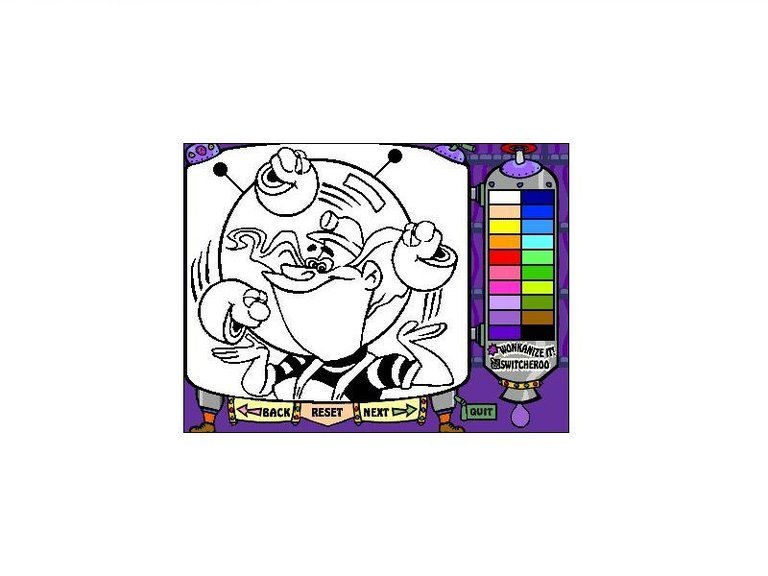
Wonkarific Colorizer is a single-player, freeware educational painting game from 1999, published on Nestlé’s Wonka brand website as part of a Willy Wonka-themed online experience. Players color eight candy factory-inspired pictures with a simple interface, featuring an auto-coloring ‘Wonkanize It! Switcheroo’ button and sound effects, designed for children’s entertainment and learning.
Wonkarific Colorizer Free Download
Wonkarific Colorizer: A Forgotten Artifact of Edutainment and Brand Synergy
Introduction: The Scrumdiddlyumptious Void
In the vast, often-overlooked archives of commercial web gaming, there exist countless titles that served a singular, transient purpose: to delight a child for three minutes while subtly reinforcing a brand. Wonkarific Colorizer (1999) is the very archetype of this phenomenon—a digital coloring book so minimal, so thoroughly devoid of mechanical depth or artistic ambition, that its very existence becomes a fascinating case study in late-1990s internet marketing and the precarious nature of digital preservation. Published as a freeware “game” on Nestlé’s official Willy Wonka brand website, it represents not a artistic endeavor but a functional, disposable piece of promotional content. This review will argue that Wonkarific Colorizer is historically significant precisely because of its insignificance; it is a perfect, unadulterated specimen of the “advergaming” era, a ghost of Flash-era browser culture that highlights the chasm between the imaginative richness of its literary and cinematic source material and the stark economic realities of web-based brand engagement at the millennium’s turn. Its legacy is not one of influence on game design, but of silent testimony to a specific moment where the internet was primarily a new catalog, and games were its glossy, interactive flyers.
Development History & Context: A Factory Assembly Line
Studio and Vision: The Brand as Developer
There is no credited “studio” in the traditional sense. The publisher is listed as The Willy Wonka Candy Factory, a Nestlé-owned brand entity. This is not a game developed by fans or enthusiasts, but a piece of content commissioned by a corporate marketing department. The “creators’ vision” was therefore dictated by brand guidelines: safe, familiar, instantly recognizable, and entirely subordinate to the Wonka IP. The goal was not to create a lasting game but to produce a simple, low-cost interactive experience that would:
1. Increase “stickiness” on the Wonka.com website.
2. Provide a family-friendly activity associated with the candy.
3. Collectively reinforce the whimsical, creative (yet safely controlled) imagery of Wonka’s world.
The vision was one of efficiency, not artistry. A “coloring book” was the most obvious, low-risk interactive translation of a creative activity for children, requiring minimal original asset creation (simple line art) and simple Flash programming (paint bucket fills, basic sound triggers).
Technological Constraints: The Flash Prison
The game was built for Adobe Shockwave (formerly Macromedia Shockwave), the dominant plugin for browser-based multimedia in 1999. This constraint defined every aspect of the title:
* Platforms: Explicitly listed as Windows, Macintosh, and Browser. Its life was entirely dependent on a proprietary browser plugin, a format now defunct and famously difficult to archive.
* Input: Mouse-only. The interface reflects the assumption of a child using a mouse to click and drag, not a gamer using keyboard combos.
* Distribution: It was a freeware / free-to-play title, distributed either as a direct download (.dcr or .exe file) or played directly in-browser. This商业模式 was standard for promotional web games—no cost to the user, funded entirely by the brand’s marketing budget.
* Technical Fidelity: The description suggests rudimentary vector or simple sprite-based graphics. The sound effects are described generically, implying pre-made stock sounds or simple synthesized beeps/jingles common in early Shockwave. The “Wonkanize It! Switcheroo” button is a classic cheat mechanic for such games, auto-filling colors to satisfy a child’s desire for instant gratification.
Gaming Landscape: The Wild West of Web Ads
1999 was the peak of the “.com bubble” and the golden age of the Flash/Shockwave portal. Websites like Shockwave.com, AddictingGames.com, and corporate sites saw these mini-games as essential engagement tools. The gaming landscape was bifurcated: console/PC “real” games and these disposable, browser-based curiosities. Wonkarific Colorizer existed in the latter world, where the bar for “gameplay” was exceptionally low. It competed not with Half-Life or Final Fantasy, but with other branded coloring books, simple maze games, and “dress-up” apps. Its context is one of commercial utility, not cultural competition.
Narrative & Thematic Deep Dive: The Absence of Story
Here, the analysis must acknowledge a fundamental truth: Wonkarific Colorizer has no discernible narrative, characters, dialogue, or themes beyond the pixelated suggestion of its source material.
- Plot: None. The player is presented with a static line drawing. There is no story progression, no challenge, no win/lose state. The “game” begins and ends with the completion of a single image.
- Characters: The only “character” is the implied presence of Willy Wonka and his world, represented through the eight line-art scenes. These scenes are drawn from the IP’s iconography (candy, Oompa-Loompas, the factory) but present no characters with agency or voice.
- Dialogue: Silent. The only audio is generic, non-verbal sound effects (a chime on color selection, a whimsical tune on the “Wonkanize” button).
- Underlying Themes: The thematic content is entirely borrowed and utterly passive. It taps into the Wonka brand’s established themes of imagination, creativity, and confectionary wonder. However, it does so with a profound irony: the activity of coloring is a constrained, fill-in-the-blank act of creativity. The player does not create; they complete. The “Wonkanize It!” button, a one-click auto-completion feature, is the ultimate thematic betrayal—it replaces the (limited) act of creative choice with algorithmic instant fulfillment, perfectly mirroring the brand’s core product (candy: instant, pre-made pleasure). The game’s thematic depth is a hollow echo, offering the form of creativity without its substance.
Gameplay Mechanics & Systems: The Architecture of Nothingness
Wonkarific Colorizer is a masterclass in minimalist, almost anti-game design. Its systems are not deep but shallow by design.
Core Gameplay Loop
- Select one of eight pre-rendered line-art images (scenes of the Wonka factory, candy, etc.).
- Click on a color palette.
- Click on areas of the image to fill with chosen color.
- (Optional) Click “Wonkanize It! Switcheroo” to have the computer instantly fill all areas with supposedly “wonkarific” colors.
- End. No save, no print, no share. The loop is a closed, pointless circuit.
Combat, Progression, UI
- Combat: None.
- Character Progression: None. The player’s “skill” does not increase. There are no points, unlocks, or rewards.
- UI/UX: Extremely simple. A static image pane, a color palette, and the titular button. The “Wonkanize It! Switcheroo” is the only feature with a named identity, and it functions as both a tool and a commentary on the player’s potential lack of patience or interest. The exclusion of a print option is a staggering and telling omission for a coloring book. It confirms the game’s sole purpose was to drive traffic to the website and keep users on the site, not to provide a useful, shareable product. The completed artwork was trapped in the browser, a digital ephemera meant to be discarded.
Innovative or Flawed Systems
- Innovation: None in a gameplay sense. Its only “innovation” was as a cheap, branded utility. The auto-color button was a UX shortcut, not a game mechanic.
- Flaws (By Modern Standards):
- Zero Replayability: Eight images, no variation.
- No Persistence: No way to save one’s work.
- No Purpose: The activity has no goal beyond momentary engagement.
- Technical Obscurity: Its dependence on Shockwave makes it a dead format, a preservation nightmare.
From a 1999 perspective, these weren’t “flaws” but features for a marketing tool. It was never meant to be replayed or saved. Its impermanence was part of its cost-effective model.
World-Building, Art & Sound: A Brand’s Snapshot
The game’s “world” is purely aesthetic and referential, not explorable.
- Setting & Atmosphere: The setting is the Wonka Candy Factory, but rendered as static, unanimated line art. There is no atmosphere in the traditional sense—no music (just sound effects), no dynamic elements, no sense of place. The atmosphere is one of static, sterile advertisement. It’s the factory as a coloring page, stripped of all danger, mystery, and life from Roald Dahl’s book or the 1971 film.
- Visual Direction: The art is simple, clean, and child-friendly. It likely used official Wonka brand assets or closely imitated the style of the film’s production design. The color palette is primary and bright, aligning with candy branding. The first-person perspective (“Perspective: 1st-person” per MobyGames) is purely a functional descriptor of the coloring interface (the player “looks at” the page), not an immersive POV.
- Sound Design: Described minimally as “sound effects.” Presumably, these are simple, whimsical auditory cues: a happy ding on color selection, a magical sparkle sound for the “Wonkanize” button. There is no melody, no ambient soundscape. The sound design serves only to punctuate basic interactions, adding a thin layer of feedback to an otherwise silent, meditative (or boring) task.
These elements combine not to build a world, but to frame a branded activity. The art and sound are the minimum required to invoke the Wonka aesthetic without licensing complex animations or music.
Reception & Legacy: The Echo in the Void
At Launch (1999)
There is no critical reception to speak of. No contemporary reviews from gaming press exist in the provided material, which is expected for a piece of obscure web advergaming. Its audience was children and parents visiting the Wonka website, not critics. Its “success” would have been measured in web traffic metrics and session duration, not sales or review scores. The Los Angeles Times article from April 1999 simply lists it as part of the website’s offerings, noting its place alongside other “educational” and “entertaining” mini-games like “Planet-O-Matic” and “Space Rescue Game.” It was treated as a minor feature of a brand website, not a standalone product.
Evolution of Reputation
Its reputation has evolved from “obscure promotional item” to “lost media artifact.” On MobyGames, it has been collected by only 1 player (as of the provided data). Its entry was added in 2018 by a user (“piltdown_man”), indicating it was largely forgotten until the era of digital preservation and obsessive archiving of all things “90s internet.” It now exists as a data point in databases, a curiosity for researchers of:
1. Advergaming History: A pure, unadulterated example of a brand using a simple game for website engagement.
2. Flash/Shockwave Preservation: A title whose survival is entirely dependent on abandoned plugins and community archivists. It is presumed lost to all but the most determined archivists with legacy browsers and emulators.
3. Nostalgia Niche: For a tiny subset of 90s/00s kids who remember visiting Wonka.com, it might trigger a vague, fuzzy memory of a coloring game.
Influence on the Industry and Subsequent Games
Wonkarific Colorizer had zero direct influence on game design. It did not innovate a mechanic, tell a new story, or inspire developers. Its influence is purely contextual and cautionary:
* The Advergame Template: It perfected a now-rare model: a hyper-simple, single-purpose, free web game tied to a consumer product. This model has largely been replaced by more sophisticated mobile ads, social media campaigns, and branded experiences within larger platforms (like Roblox or Fortnite).
* The Ephemeral Web: It is a prime example of the “digital dark age.” Thousands of such Shockwave/Flash titles are gone because their container technology died. Its “legacy” is a reminder that much of the early internet’s interactive culture was not designed to last.
* Kitsch and Irony: In the 2020s, such games are often revisited with a sense of kitsch appreciation or absurdist irony. The sheer pointlessness of Wonkanizing a picture is now a meme template in itself—a button that does all the work for you, a perfect metaphor for effortless, prefab consumption.
Conclusion: A Perfect, Pointless Footnote
Wonkarific Colorizer is not a “good” game by any conventional metric. It lacks depth, challenge, narrative, and even basic utility (no printing!). Evaluated on the criteria of fun, artistry, or innovation, it scores zero. And yet, as a historical document, it is invaluable.
It stands as a perfectly intact specimen of a bygone web paradigm: the corporate-sponsored, browser-based mini-game. It赤裸裸地(exposes) thetransactional relationship between brand and user in the early web—the user receives a few minutes of simple distraction; the brand receives engagement and reinforces its imagery. The game’s total lack of pretension is its most honest feature. It does not try to be Super Mario; it tries to be a thing on a candy website.
Its ultimate verdict in video game history is as a ghost in the machine. It is a game that was never meant to be remembered, a digital ghost that haunts the archives as proof of how much of our cultural digital output was designed to be temporary. To study Wonkarific Colorizer is to study the economic and technological constraints that shaped the earliest forms of interactive advertising. It is a testament to the fact that not every artifact of gaming history is a masterpiece; some are perfectly functional, utterly forgettable, and historically crucial precisely because of their oblivion. In the scrumdiddlyumptious factory of gaming history, Wonkarific Colorizer is a simple, unadorned piece of candy wrapper—forgotten by all except the archivists, yet essential for understanding the full packaging of the medium’s evolution.