
- Release Year: 1998
- Platforms: Windows
- Publisher: Ubisoft Entertainment SA
- Genre: Simulation
- Perspective: Diagonal-down
- Game Mode: Hotseat, Online PVP, Single-player
- Gameplay: Commentary, Cup editing, Difficulty levels, Handicap, League editing, Replay system, Speed control, Team editing, Weather conditions
- Setting: Football (European), Soccer
- Average Score: 88/100
Description
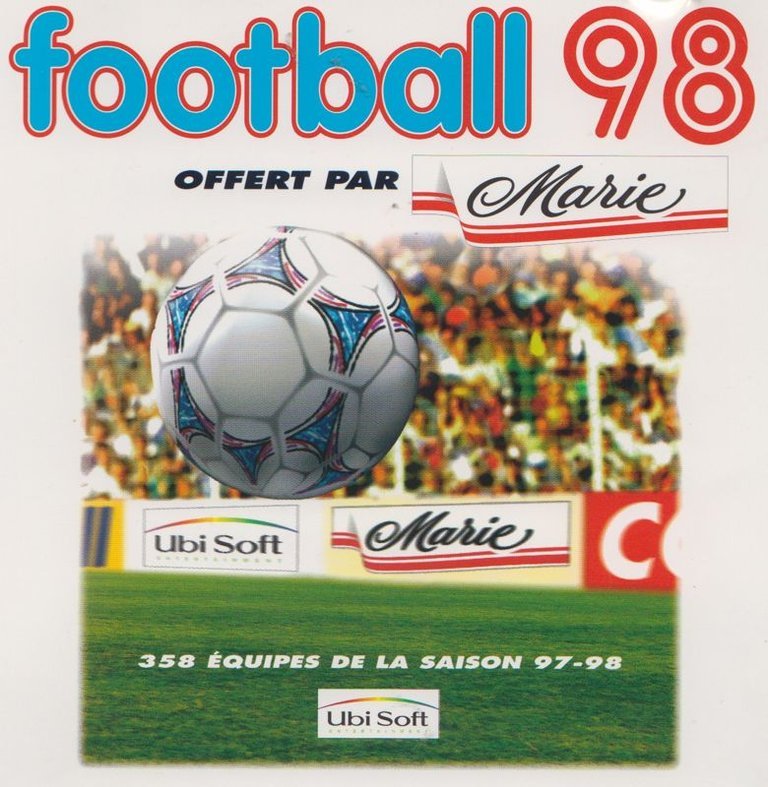
World Football 98 is a football (soccer) simulation game released in 1998, just before the FIFA World Cup, featuring 358 teams from around the world with over 6,000 players from the 1997/98 season. It includes five game modes—Cup, Friendly, League, Training, and Tournament—along with European cups like the Champions League, weather effects that influence gameplay, editable teams and leagues, multiplayer support for up to four players, and commentary by Martyn Tyler, with some versions incorporating advertisements between halves as an ad-supported release.
Gameplay Videos
World Football 98 Free Download
World Football 98 Reviews & Reception
ign.com (88/100): This one’s a keeper.
World Football 98: The Advergaming Artifact Lost in the Shadow of the World Cup
Introduction: A Game of Two Halves
In the feverish summer of 1998, as the world’s eyes turned to France for the FIFA World Cup, the videogame aisle was a crowded field. The titans, EA Sports’ FIFA: Road to World Cup 98 and Konami’s International Superstar Soccer 98, battled for supremacy. Yet, tucked between these behemoths, often on a budget shelf or bundled with yogurt, was a strange and fascinating footnote: World Football 98. Known by a bewildering array of aliases—Kiko World Football, Puma World Football, Danone World Football—this game represents a unique, if flawed, intersection of sports simulation, licensed branding, and pure, unadulterated advergaming. This review will argue that World Football 98 is not a failed contender to the era’s greats, but rather a significant historical curio. It is a testament to the Wild West of late-90s sports licensing, a functional but derivative simulation propped up by its curious business model and comprehensive, if superficially implemented, global team list. Its legacy is not one of gameplay innovation, but of commercial pragmatism and the often-bizarre ecology of budget software distribution in the pre-digital marketplace.
Development History & Context: Born from a Brand Deal
The development history of World Football 98 is shrouded in the kind of corporate obscurity befitting its primary identity as an ad game. The sources consistently attribute its development and publication to Ubisoft Entertainment SA, with its roots firmly in the European PC market. Unlike EA’s internally developed World Cup 98, which built upon the robust FIFA: Road to World Cup 98 engine, Ubisoft’s title was almost certainly built on a more generic, in-house or licensed sports simulation framework. The technological constraints of 1998 are evident: the game employs a 2D scrolling, diagonal-down perspective with 340 animations, placing it a generation behind the 3D polygon-based engines of FIFA 98 and World Cup 98. This was a conscious cost-saving measure, allowing for a lower price point and, crucially, a product that could be given away as a promotional item.
The gaming landscape of early 1998 was defined by the heated rivalry between EA’s FIFA series and Konami’s ISS Pro Evolution. Both were pushing 3D graphics and sophisticated mechanics. Into this race, World Football 98 entered not as a technical showcase, but as a licensed product with a purpose. Its primary identities—Kiko World Football (featuring Spanish striker Kiko Narváez) and Danone World Football—reveal its true genesis: a brand partnership. It was an “ad game,” a term used explicitly in the MobyGames description, where advertisements were shown during the half-time break. This was not a subtle in-game placement; it was the game’s fundamental business model. It was later distributed as a gift with Danone yogurt purchases, a common practice in Europe for low-cost software. This context is everything: World Football 98 was not designed to win critical battles against ISS Pro; it was designed to satisfy a marketing contract, move product (or yogurt), and capitalize on the inevitable World Cup hype with a superficially comprehensive roster.
Narrative & Thematic Deep Dive: The Story is the Sale
In a traditional sense, World Football 98 possesses no narrative, plot, or characters beyond the statistical representations of its 6,086 players and 358 teams. There is no career mode story, no fictional protagonist, no dramatic arc. Its “narrative” is entirely diegetic and transactional: the player is offered the fantasy of managing or playing with any national or club team from the 1997/98 season, culminating in a World Cup tournament. The theme is pure, unadulterated licensed authenticity, though the execution is porous.
The game’s thematic core is comprehensive inclusion. The inclusion of the three major European cups (Champions League, Cup Winners’ Cup, UEFA Cup) and the ability to edit teams, leagues, and create custom tournaments speaks to a desire to be the definitive catalog of football, not necessarily the definitive simulation. This is a game for the completist who wants to replay the 1994 World Cup with the actual 1998 squads, or to lead a hypothetical Australia to glory. The “Classics” mode, a feature borrowed and adapted from more prestigious titles, attempts thematic depth by recreating historical matches with period-appropriate kits, hairstyles, and even black-and-white or sepia tone graphics for older finals. However, the sources highlight glaring historical inaccuracies—the use of the modern Adidas Tricolor ball for all color matches from 1970 onward, the application of yellow/red cards and the golden goal rule to pre-1970 eras. This betrays a thematic superficiality: the appearance of history without the commitment to authenticity. The true narrative of World Football 98 is one of license coverage over historical rigor, quantity over quality.
Gameplay Mechanics & Systems: Functional Foundation, Limited Flair
Deconstructing the core loops of World Football 98 requires reading between the lines of its sparse documentation and the comparative reviews of its cousin, EA’s World Cup 98. The gameplay is described in a review from Micro Hebdo as having “mouvements des footballeurs répondant parfaitement aux commandes” (player movements that respond perfectly to the commands), with a limited but effective set of actions: passing, shooting, and special moves. The control scheme emphasizes shot direction and power determined by button duration, offering a “vaste panoplie d’actions” (vast array of actions).
- Core Loop: The match loop is standard for 2D football sims of the era: possession-based, with an emphasis on strategic passing and finding openings. The weather conditions that influence gameplay are a noted feature, adding a layer of environmental strategy absent from some competitors.
- Progression & Depth: The game’s primary depth comes from its extensive editing suite. Players can update rosters, create custom teams and championships, and implement handicaps by adjusting the number of players on a team. This editor is its saving grace, offering near-infinite replayability for the dedicated tinkerer.
- AI & Difficulty: Three difficulty levels are offered. Reviews suggest the AI is competent but not revolutionary. The mention of “correct reactions” from goalkeepers in Micro Hebdo indicates a functional, if not supremely intelligent, defensive AI.
- Innovation & Flaws: The innovation is purely in scope and accessibility. The sheer number of teams (358) and the inclusion of multiple cup competitions were notable for a budget title. However, the 2D engine was its greatest flaw in 1998. Compared to the dynamic 3D camera, individual player animations, and stadium detail of World Cup 98 and ISS Pro, World Football 98 must have presented a static, less immersive spectacle. The Power Unlimited review that scored it 55% starkly states: “Ze kunnen alle opties van de wereld bieden, maar een voetbalspel zonder goede gameplay en graphics brengt ons terug naar een aangepaste versie van Pong” (“They can offer all the options in the world, but a soccer game without good gameplay and graphics brings us back to a modified version of Pong”). This is the critical verdict: quantity cannot compensate for an antiquated presentation.
World-Building, Art & Sound: The Aesthetic of the Checklist
The atmosphere of World Football 98 is one of statistical completeness, not sensory immersion. The setting is the global football landscape of 1997/98, rendered in a 2D, scrolling format. Visually, it is a product of its technological constraints. The 340 animations are cited, suggesting a focus on varied player movements, but without the 3D polygonal models of its rivals, the “visual direction” is inherently limited. There is no mention of detailed stadiums, dynamic lighting, or expressive player faces. The art is functional, prioritizing recognizable kit colors and formations over cinematic flair.
The sound design, however, is a relative highlight. The game boasts 1,100 lines of commentary from Sky Sports’ Martyn Tyler. This is a substantial amount, likely covering common match situations, goals, and fouls. For a budget title to secure a named commentator from a major network is a significant coup, directly tying into its licensed, “authentic” branding. The commentary, combined with crowd sounds and in-game audio, would have contributed to a sense of verisimilitude that the 2D graphics could not. The soundtrack, if any beyond the commentary, is unmentioned, placing it in stark contrast to EA’s use of licensed music like Chumbawamba’s “Tubthumping” for World Cup 98. World Football 98’s soundscape is one of broadcast mimicry, attempting to replicate the TV experience through voice alone.
Reception & Legacy: The Ghost in the Machine
At launch, World Football 98 existed in a netherworld of reception. The only formal critic score on MobyGames is 80% from Power Unlimited, but this masks a contradictory internal conflict within the magazine, as a separate review from the same source gave it 55%. The 80% review describes it as “oke” (fine/chill), “keurig uitgewerkt” (neatly finished), with “nauwelijks storende elementen” (hardly any irritating elements). This suggests a view of it as a perfectly acceptable, middle-of-the-road simulator that achieved its modest goals without offending. The 55% review is a scathing indictment of its graphical and gameplay poverty.
Its commercial fate is more telling than its critical one. It was a budget and promotional title, bundled with yogurt and sold cheaply. Its “legacy” is not one of influence on game design but as a case study in alternative distribution. It proved that a sports game could be viable without competing on graphical prowess, by leveraging a vast license list and a novel (if intrusive) ad-based revenue model. Its direct influence on the FIFA or ISS Pro series is nonexistent. Instead, its legacy is shared with other advergames like Pepsi Man or the Cheggers Party Quiz—curiosities that reveal the mechanics of 90s marketing.
When compared to its contemporaries, the distinction is stark:
* EA’s World Cup 98: The benchmark. A full 3D engine, official stadiums, refined gameplay from FIFA 98, historical “Classics” mode with authentic commentary, and a blockbuster soundtrack. It was a premium, must-have product.
* Konami’s International Superstar Soccer 98: The critical darling on N64, famed for its tight controls and gameplay depth, often considered superior to EA’s offering in pure football feel.
* World Football 98: The budget spreadsheet simulator. It had the list of teams but not the feel of the game. Its primary value was in its editing tools and its price (often free with purchase).
Its reputation has not evolved; it has faded into obscurity. With only 4 collectors on MobyGames, it is a forgotten artifact. Yet, for historians, it is invaluable. It demonstrates the fragmentation of the sports licensing market. Ubisoft, not yet the powerhouse it would become, saw an opportunity to license team names and a striker’s likeness (Kiko) for a PC title aimed at a European audience, bypassing the console war entirely. It highlights how the “World Cup” license was not monopolized by EA in all territories or for all platforms at that moment.
Conclusion: A Curious Footnote in the Pantheon
World Football 98 cannot be judged by the standards of a World Cup 98 or an ISS Pro Evolution. To do so is to miss the point. As a video game, it is a competent but visually dated 2D sports sim. As a product, it is a fascinating artifact of 1990s advergaming and budget distribution. Its thesis is not “this is the best way to play football,” but rather “this is a complete list of football teams, and you can have it for almost nothing.”
Its place in video game history is not on a pedestal, but in a curio cabinet. It represents an era where the barrier to entry for a licensed sports game was lower, where a publisher could secure team names and a marquee player, wrap a basic simulation engine around them, and sell the package through unconventional channels. It is a testament to the power of the checklist—the sheer volume of 358 teams—as a selling point in itself, a tactic that would later be mirrored in the “Ultimate Team” modes that came to dominate the genre.
For the collector and historian, World Football 98 is essential for understanding the full ecosystem of 1998 football games. For the player seeking the definitive 1998 World Cup experience, it is an actively worse choice than its 3D-powered rivals. Yet, in its own bizarre way, it succeeds at its unique goal: it delivers a functional, editable, globally comprehensive football game, advertisements and all, exactly as its business plan intended. It is the game that was never meant to be great, and in that, it is perfectly, authentically itself.
Final Verdict: 6/10 – A historically significant but mechanically mediocre advergame whose value lies entirely in its status as a budget licence-cash-in. A must-study, not a must-play.