
- Release Year: 1992
- Platforms: Android, Arcade, Genesis, iPad, iPhone, Neo Geo CD, Neo Geo, Nintendo Switch, PlayStation 3, PlayStation 4, PS Vita, PSP, SNES, Wii, Windows Apps, Windows, Xbox One
- Publisher: Alpha Denshi Kōgyō Co., Ltd., D4 Enterprise, Inc., Hamster Corporation, SEGA of America, Inc., SNK Corporation of America, SNK Playmore Corporation, SNK Playmore USA Corp., Sun Corporation of America, Sun Electronics Corp., Tec Toy Indústria de Brinquedos S.A.
- Developer: Alpha Denshi Kōgyō Co., Ltd.
- Genre: Action
- Perspective: Side view
- Game Mode: Single-player
- Gameplay: Fighting
- Setting: Historical
- Average Score: 74/100
Description
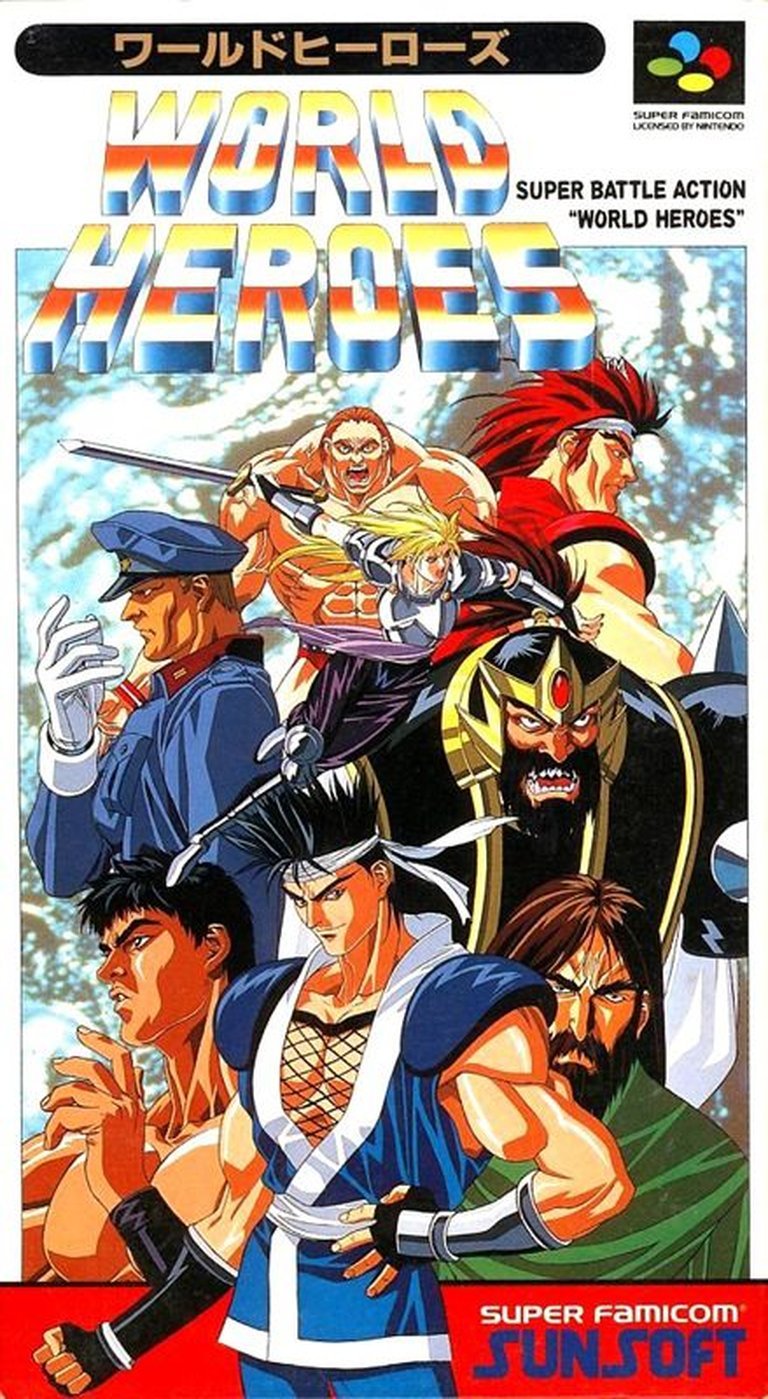
In the year 3091, an alien entity named Geegus threatens Earth after defeating all conventional forces, prompting a scientist to use a time machine to summon history’s greatest fighters from various eras and countries—characters inspired by real figures like Hattori Hanzo, Bruce Lee, Joan of Arc, Genghis Khan, and others endowed with supernatural powers—to compete in versus battles, including standard one-on-one matches and hazardous Deathmatches with spiked walls and landmines.
Gameplay Videos
World Heroes Free Download
PC
World Heroes Guides & Walkthroughs
World Heroes Reviews & Reception
infinityretro.com : World Heroes is a fighting game made by people who had little passion for it.
neo-geo.com (74/100): A decent fighting game with good nostalgia feel.
fightersgeneration.com : The game can be entertaining for a while, but I wouldn’t go as far as calling the overall gameplay experience ‘fun’ compared to other fighters of the time.
World Heroes Cheats & Codes
SNES (USA) [Game Genie]
Enter these codes using a Game Genie device for Super Nintendo or an emulator with Game Genie support before starting the game.
| Code | Effect |
|---|---|
| D509-8F04 | Player 2 wins a draw |
| D409-8F04 | Player 1 wins a draw |
| 4008-8FAF | Player 1 has infinite energy |
| CD07-84AF | Slow timer down by half |
| 5349-87D4 | Player 1 starts with more energy |
| 7D49-87D4 | Player 1 starts with 1/2 energy |
| DF49-87D4 | Player 1 starts with very little energy |
| 534A-8F64 | Player 2/CPU starts with more energy |
| 7D4A-8F64 | Player 2/CPU starts with half energy |
| DF4A-8F64 | Player 2/CPU starts with very little energy |
| 7B86-84A4 | Player 1 always wins |
| FB0C-7D64 DD0B-77A4 | 3 hits to win round for either player |
| 7F0C-7D64 DD0B-77A4 | 2 hits to win round for either player |
| 1F0C-7D64 DD0B-77A4 | 1 hit to win (sudden death) for either player |
| 6D7B-8704 | Easier special moves |
| ADFE-746D DDFE-74AD FDFE-77DD 7DFE-776D | Hit anywhere P1 |
| 3D06-770D DD06-776D FF06-77AD 6D0F-840F | Invincibility P1 |
| B3D5-8FDF | Skip intro screens |
| DAF6-6F0D | One hit causes dizziness (both players) |
| DA7B-0F0D | Opponent mostly paralyzed |
| DAF5-DF0F | Hanzo’s hard & light punches sound different |
SNES (USA) [Button Sequences]
Perform these button sequences during gameplay or console startup as described.
| Code | Effect |
|---|---|
| Hold SELECT + START (at character selection screen) | Alternate costume color |
| Hold A + B + X + Y + L + R + SELECT + START while powering on, release at ‘Press Start’ | Unlocks hidden/extra characters |
SNES (USA) [Standard]
These are direct memory modifier codes. Enter using Pro Action Replay, GameShark, or an emulator’s cheat/memory editor.
| Code | Effect |
|---|---|
| 7E084C:?? | Battle round text modifier |
| DE747E:72 DE76BE:72 DE76FE:73 DE74BE:73 | Makes dragon punch easy to do |
| 7E107B:63 | Infinite health P1 |
| 7E08C1:99 | Infinite time |
| 7E117B:00 | No health P2 |
| 7E0BC3:08 | P1 controls Geegus (boss) |
| 7E0839:02 | P1 wins the match after winning a round |
World Heroes: Review
Introduction
In the sweltering arcade summers of 1992, amid the thunderous dominance of Street Fighter II, a plucky challenger emerged from the Neo Geo cabinets: World Heroes. Developed by Alpha Denshi (later ADK), this versus fighting game dared to summon history’s mightiest warriors—ninjas, mystics, wrestlers, and conquerors—into a time-warping tournament orchestrated by a mad scientist. Its legacy endures not as a genre revolutionary, but as a flavorful Neo Geo artifact: a bold, if derivative, entry that blended historical whimsy with brutal arena hazards, proving that even clones could spark joy in the fighting game gold rush. Thesis: World Heroes excels as an accessible, character-driven brawler whose innovative Deathmatch mode and eclectic roster elevate it beyond mere imitation, securing its status as a cult classic in early ’90s arcade lore despite technical rough edges.
Development History & Context
Alpha Denshi Kōgyō Co., Ltd., a Japanese studio founded in the mahjong arcade scene of the 1980s, pivoted to the booming fighting game trend with World Heroes. Released on July 28, 1992, for the Neo Geo MVS (arcade) and shortly after for AES (home), it marked ADK’s debut in the genre, assisted by SNK’s powerhouse hardware. Producer, director, and planner Kenji Sawatari helmed the project, supported by a 39-person team including programmers like Yuji Noguchi and TAT&MST, system coder Eiji Fukatsu, and a sprawling character design crew (Kazushige Hakamata, Akira Ushizawa, Atsushi Kobayashi, and more). Composers Hideki Yamamoto, Hiroaki Shimizu, and Yuka Watanabe crafted the soundtrack.
The era’s technological constraints shaped its 82-megabit ambition: Neo Geo’s Motorola 68000 CPU (12 MHz), 64KB RAM, and sprite-scaling prowess enabled large, colorful 2D fighters, but demanded optimization for fluid 60Hz performance. ADK drew from prototypes featuring infamous figures like Al Capone, Billy the Kid, Musashi Miyamoto, Napoleon, Adolf Hitler, and Jack the Ripper—a Korean sub-boss and Egyptian warrior were scrapped. Controversy loomed; Hitler morphed into the cyborg Brocken (Nazi-inspired uniform intact), while Hattori Hanzo survived as protagonist. This reflected the post-Street Fighter II landscape: Capcom’s 1991 hit ignited a clone wave (Fatal Fury, Mortal Kombat), with operators clamoring for conversion kits. World Heroes topped U.S. RePlay charts in July 1992 (edging SFII), hit #3 in Japan per Game Machine, and ranked among 1993’s top earners—proving ADK’s timing impeccable amid Neo Geo’s luxury-home-console push.
Ports proliferated: Sunsoft’s faithful SNES (1993), Sega Midwest Studio’s choppy Genesis (1994), ADK’s arranged-music Neo Geo CD (1995), and modern revivals like Hamster’s ACA NeoGeo (2017 onward) and World Heroes Anthology (2007 PS2). These adaptations highlighted hardware limits—SNES preserved animations impressively, Genesis lagged—yet preserved ADK’s vision of historical spectacle on a budget.
Narrative & Thematic Deep Dive
World Heroes‘ plot is a lean, arcade-friendly hook: In 3091, alien overlord Geegus ravages Earth. Scientist Dr. Sugar Brown (or Dr. Brown in variants) activates a time machine, yanking eight legends from history into a tournament to crown the ultimate warrior and repel the invader. Cutscenes are sparse—text dumps and posed sprites—but endings personalize victories: Hanzo seeks ninja enlightenment, Rasputin preaches universal love, Muscle Power eyes wrestling fame.
Characters, the narrative core, reimagine history with supernatural flair:
– Hattori Hanzo (protagonist, 16th-century Iga ninja): Stoic seeker of perfection, rival to Fuuma.
– Kotaro Fuuma (rival ninja clan head): Laid-back womanizer adapting to timelines.
– Kim Dragon (20th-century martial artist, Bruce Lee homage): Idol-worshipping star proving his mettle.
– Janne (Jeanne d’Arc) (15th-century French fencer): Beauty questing for a worthy husband.
– J. Carn (Genghis Khan analogue): Mongolian horde leader, Eurasia-conquering brute.
– Muscle Power (Hulk Hogan-inspired wrestler): Muscle-obsessed American showman (redesigned in sequels to dodge likeness issues).
– Brocken (WWII Nazi cyborg): Science supremacist post-Reich defeat.
– Rasputin (Russian mystic “Mad Monk”): Love-cult sorcerer wielding psychic healing vibes.
Themes probe historical anachronism and power myths: Time travel flattens eras into a coliseum, questioning “greatest fighter” via cross-cultural clashes—ninja shadows vs. cyborg rockets. Subtext critiques glorification: Rasputin’s “love for mankind” masks cult mania; Brocken’s Nazi roots evoke tech’s dark side (Hitler prototype sanitized). Geegus, a polymorphic future abomination by madman Damned, embodies existential threat, lurking as unseen voyeur. Dialogue is minimal but quirky—win quotes hilariously mangled (e.g., pseudo-profound ninja wisdom)—lending campy charm. Yet, the story prioritizes spectacle over depth, a thematic echo of arcade ephemerality.
Gameplay Mechanics & Systems
World Heroes streamlines versus fighting into a 3-button (A: punch, B: kick, C: throw) + 8-way joystick setup—innovative pressure sensitivity: tap for weak (fast/low damage), hold for strong (slow/high). No meter limits specials, enabling spam; throws reverse via timely opposite input. Core loop: deplete health via basics, projectiles, and command grabs.
Modes:
– Normal Game: Sequential 1v1 vs. randomized roster + Geegus boss. Bonus stages post-fights 3/6: 10-30s stone-carving (punches/specials) or pot-smashing for points.
– Deathmatch: Hazard-ring variants (electric barriers, spikes, oil slicks, landmines, fire ropes)—slam foes into walls for bonus damage/KOs. All in audience-ringed boxing arenas.
Mechanics Deep Dive:
| Mechanic | Description | Strengths/Flaws |
|---|---|---|
| Combos | Link normals into specials (e.g., Hanzo’s Rekko Zan projectile → follow-ups). | Simple but limited depth; no chains/air juggles. |
| Mobility | Dashes, double-jumps (Hanzo/Fuuma), aerial projectiles (Rasputin). | Pioneered multi-jumps; sluggish base speed drags. |
| AI/UI | Direct control; energy bars, timers. Random order adds replay. | CPU blocks excessively; UI crisp but sparse (no combos counter). |
| Balance | Grapplers (Muscle Power’s charges) vs. zoners (Rasputin’s fireballs). | Uneven—projectiles dominate; dizziness recoverable via mashing. |
Flaws: Clunky hitstun, high damage yields short/timeout-prone rounds. Innovations like hazards add chaos—force slides into mines!—but feel gimmicky. Ports amplify issues: Genesis slows to crawl, SNES shines in fidelity.
World-Building, Art & Sound
Settings immerse via era-specific stages:
– Normal: Hanzo’s Asakusa marketplace (Kaminarimon gate), Fuuma’s Mt. Fuji monkey park, Dragon’s Chinese temple (breakable vases), Janne’s Paris circus, Carn’s Karakorum barracks, Muscle’s NYC cage (breakable spotlights), Brocken’s Ramstein base (tippable barrels), Rasputin’s Moscow clock tower (gears/candles), Geegus’ space station (crystals).
– Deathmatch: 9 variants (High Energy, Needle Oil, etc.) with crowds.
Visuals: Neo Geo sprites dazzle—beefy, colorful (4096 palette)—but animations stutter (few frames). Backgrounds vivid yet static; breakables add interactivity. Art direction mixes historical fidelity (Mongol flags) with arcade excess (zeppelins over NYC).
Sound: Yamaha YM2610 FM synth/Z80-driven tracks are serviceable chiptunes—temple flutes, circus whimsy—but uninspired vs. Fatal Fury. FX grate (zaps, thuds); digitized voices (“Fight!”) arcade-authentic but shrill. Ports downgrade: SNES music “uninspired gedudel,” Genesis “horrendous.”
Atmosphere thrives on contrast: Serene Fuji monkeys underscore ninja duels; hazards amp tension, forging visceral, unpredictable vibes.
Reception & Legacy
Launch acclaim was polarized—MobyGames 6.9/10 (67% critics). Arcade thrived: U.S. #1 conversion kit (RePlay), Japan’s #3 (Game Machine), top-5 1993 earner. Neo Geo: GameFan 91% (“rivals SFII, tops all but Art of Fighting“), Joystick 88%; Sinclair User 81% (86MB “wasted” vs. SFII’s polish). Home ports faltered: SNES 65-91% (EGM: “happy for non-Neo owners”); Genesis 25-84% (slow/choppy, “third-rate clone”).
Reputation evolved: Early “SFII rip-off” (copied moves, archetypes) softened to “underrated gem.” Modern retrospectives (Nintendo Life 50-60%, Defunct Games 60%) praise Deathmatch innovation, historical gimmick—influencing multi-jumps/projectiles in later fighters—yet decry simplicity. Legacy: Spawned sequels (WH2 1993 onward), Anthology (2007), ACA ports (2017+). Boosted Neo Geo visibility; characters cameo in NeoGeo Battle Coliseum. Cult status endures—62nd best SNES (Complex 2018)—as quirky historical romp amid SNK giants.
Conclusion
World Heroes is no Street Fighter II, but therein lies its charm: a scrappy Neo Geo underdog blending time-travel spectacle, hazardous twists, and historical homage into addictive arcade bouts. Development ingenuity overcame constraints; narrative whimsy and Deathmatch flair compensate mechanical clunk; ports democratized access. Critically middling yet commercially potent, its influence ripples subtly. Verdict: Essential for fighting game historians—a 7/10 Neo Geo staple deserving modern play, forever the plucky pioneer that proved history’s heroes punch hardest in pixels.