
- Release Year: 2008
- Platforms: Windows
- Publisher: Anuman Interactive SA, Matrix Games, Ltd.
- Developer: Games GI
- Genre: Strategy, Tactics
- Game Mode: Single-player
- Gameplay: Combat dynamics, Force management, Real-time strategy, Scenario editor
- Setting: Historical events, World War II
Description
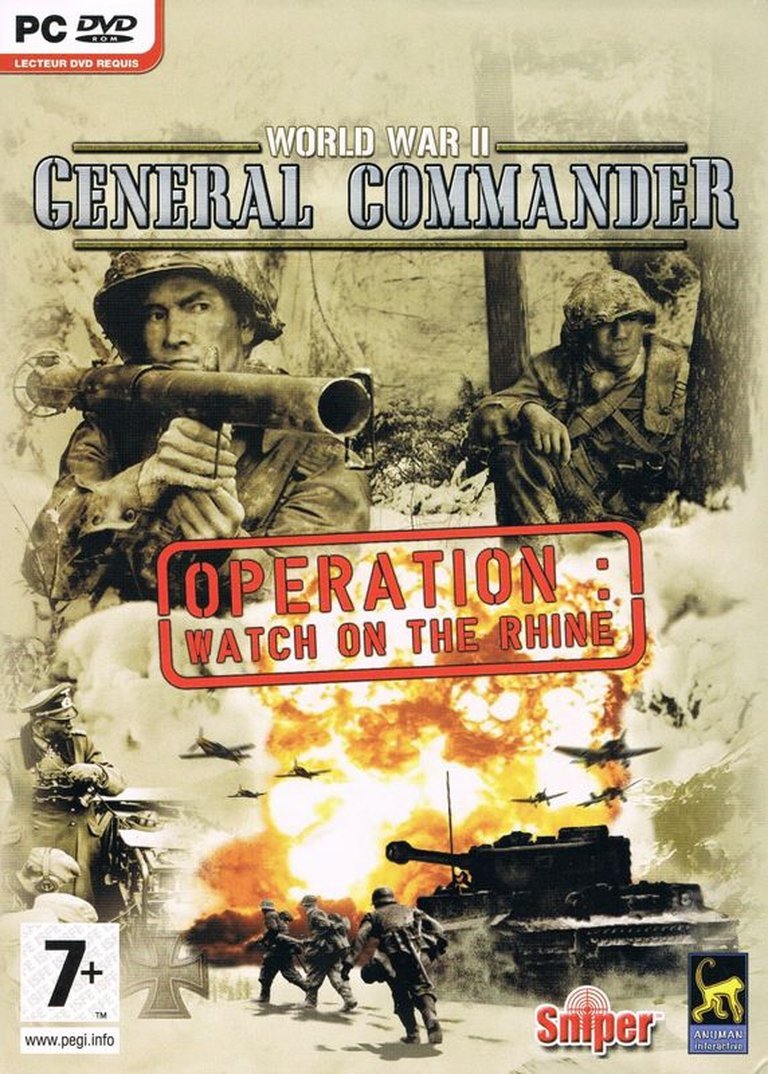
World War II General Commander: Operation: Watch on the Rhine is a real-time strategy game set during the historic Battle of the Bulge in the Ardennes region of World War II. Players command 3D military units across vast, rendered topographic maps spanning hundreds of miles, engaging in 14 scenarios from either the Allied or Axis side, with a full scenario editor for custom battle creation.
World War II General Commander: Operation: Watch on the Rhine: A Bridge Too Far for Real-Time Operational Strategy
Introduction: The Ambition of the “RTOS”
In the crowded landscape of World War II strategy games, World War II General Commander: Operation: Watch on the Rhine (2008) stands as a audacious, if deeply flawed, manifesto. Developed by the Spanish studio Games GI and published through the niche wargame portal Stragames.com (with later distribution by Matrix Games), it explicitly sought to invent a new genre: the Real-Time Operational Strategy (RTOS) game. This was not merely another real-time tactics (RTT) or traditional real-time strategy (RTS) title. Its stated ambition was to merge the grand, logistical scale of operational-level board wargames with the immediacy and continuous time of real-time digital play, focusing on the colossal, desperate battles of the Battle of the Bulge. The thesis of this review is that General Commander is a fascinating but failed experiment—a game whose conceptual brilliance in scale and supply is ultimately undermined by a compromised design philosophy, uneven technical execution, and a disastrous digital rights management (DRM) decision that ensured its swift oblivion. It represents a crucial “what if” in the evolution of the operational wargame, a bridge between the turn-based giants of the ’90s and the modern pausable-real-time epics, but one that collapsed under its own weight.
Development History & Context: A Studio, a Portal, and a Precarious Platform
World War II General Commander emerged from a specific, convergent cultural and technological moment for hardcore wargaming.
The Studio: Games GI
Games GI, founded in 2005, was a small Spanish developer with a stated focus on “new IPs for the PC platform” leveraging “connectivity possibilities and design freedom.” Their prior work included Tahoe World, a fantasy RTS, suggesting a background in more conventional strategy design. The core team, as listed in the credits, was tight-knit and multi-role: Victor Perez (Producer, Lead Designer) and Enrique Garcia (Project Director, Design, Programming Coordinator, Lead Artist) were the clear creative anchors, wearing many hats. Fernando José Colomer Pérez handled the main engine and network programming, while Sergio Masip and Saul Santana tackled AI, physics, and gameplay. This small team size explains both the game’s ambitious scope and its technical roughness.
The Publisher & Platform: Stragames.com’s Gamble
The game’s most significant context is its relationship with Stragames.com, which launched simultaneously with the game’s announcement in July 2008. Stragames presented itself as “the first Web Game Hosting for Wargame,” a dedicated portal and community for the niche wargame audience that felt neglected by mainstream publishers and console-focused trends. It offered developers pre-configured websites, forums, wikis, and an online store. WWII: GC was its flagship launch title, the “first RTOS game for the PC platform.” This was a conscious effort to create a direct-to-consumer ecosystem for a hardcore genre, bypassing traditional retail. The choice of the Battle of the Bulge—a densely forested, logistically fraught, and historically significant scenario—was perfect for proving the “operational” scale the team claimed.
Technological Constraints & The 3D Gamble
The late 2000s saw the RTS genre dominated by visually spectacular, micro-intensive titles like Company of Heroes (2006) and Supreme Commander (2007). General Commander made a bold, contradictory technical choice: a 3D engine for a vast, zoomable topographic map (claimed as a “continuous 300 square km real playing field”) that could zoom from a strategic view down to 1 km scale. This was designed to provide immersion and intuitive terrain assessment, as one forum poster noted: “the 3D stuff excels regarding immersion… it gives the player a good idea how rough the terrain is.” However, achieving this on typical mid-2000s hardware (Pentium 4 3 GHz, 1GB RAM, 256MB GPU recommended) while simulating hundreds of battalion-sized units was a monumental task. The system also offered a “double representation” for less powerful hardware, suggesting performance was a known concern. This technical ambition directly fueled the game’s primary innovation and its most glaring potential weaknesses.
Narrative & Thematic Deep Dive: The Bulge as Simulation Sandbox
General Commander does not have a “plot” in the conventional video game sense. There is no campaign with scripted events, character arcs, or cinematic story beats. Its narrative is purely emergent and systemic, delivered through the scenario descriptions and the historical framework of the Ardennes Offensive.
-
The Historical Frame: The game explicitly frames itself around Operation “Watch on the Rhine” (Unternehmen Wacht am Rhein), the German codename for the Ardennes Offensive. All 14 scenarios are drawn from this three-week period in December 1944-January 1945. The player is presented as the “General Commander,” making the grand decisions. The scenarios range from the desperate defense of Bastogne to the broader operational push towards the Meuse. This is not a story of individual heroes but of divisions, regiments, and battalions. The theme is logistical attrition and operational momentum. Victory conditions are not just about eliminating enemy units but about “occup[ying] the most strategic positions,” securing highway networks, and managing supply—themes central to historical analysis of the Bulge’s failure (German fuel shortages) and Allied success (rapid reinforcement via intact logistics).
-
Lack of Traditional Narrative: The absence of a story campaign, voice-acted briefings, or character portraits is a deliberate, if isolating, design choice. It aligns the game with the “sandbox simulation” tradition of board wargames like Advanced Squad Leader or the Panzer General series, where the history is the context, not the plot. The “narrative” is whatever Operational Art the player crafts. This will appeal to purists but likely left the broader RTS audience, accustomed to Company of Heroes‘s dramatic storytelling, feeling cold and unengaged. The game’s thematic depth lies entirely in its systems, not its scripting.
Gameplay Mechanics & Systems: The Promise and Peril of “RTOS”
This is the core of General Commander‘s identity and its greatest area of divergence from both traditional wargames and RTS titles.
1. Scale and Unit Representation:
* Unit Size: The fundamental unit is the battalion (with some regiments), a scale uncommon in real-time games. An RTS like Starcraft has squads; a traditional operational wargame like War in the East uses divisions or corps. The battalion scale is a middle ground attempting to offer tactical texture without overwhelming the player with hundreds of individual units. A forum commentator correctly noted the similarity in scale to the Airborne Assault/Command Ops series, which also uses battalion/company scale in a pausable-real-time model.
* Representation: Units are 3D models on a textured topographic map, with NATO-style icons optionally overlaid. The ability to zoom from a god’s-eye strategic view down to see individual vehicles and soldiers was the game’s flagship visual feature, aiming to provide both strategic clarity and visceral immersion.
2. The “New Combat Systems” – A Mixed Bag:
The press materials and developer claims touted “new combat systems,” “combat distance,” and “supply dependency” as revolutionary. Deconstructing these from the sparse details:
* Supply as King: This is the game’s most credible and significant systemic innovation. Supply lines depend on secured roads, towns, and railheads. Units consume supplies over time and in combat. The forum post from user “CeltiCid” confirmed this: “the game is good… its very fun. The game includes a scenario editor… I cant wait to play on multiplayer !!” Critically, air drops were a feature, allowing players to supply surrounded units like Bastogne—a direct simulation of the historical event. This systemic focus on logistics over pure attrition is a hallmark of serious operational design and a major differentiator from traditional RTS where resources are gathered from static points.
* Combat Resolution & “Energy Bars”: This is where the design philosophy becomes muddled. Forum users explicitly observed that units have “energy bars” (hit points/strength points). This is a gross simplification compared to the detailed combat matrices of board wargames or the morale/stance/cover systems of Company of Heroes. It suggests a combat model closer to traditional RTS, where units whittle each other down. The claim of “authentic WWII tactical and strategic decision making” clashes with this RTS trope. Was this a concession to real-time play, or a lack of depth? The evidence points to the latter.
* Formations & Movement: The game promised “realistic operational maneuvers and formations.” In practice, this likely meant basic movement logic (columns on roads, spread in combat) but without the complex, phased movement orders of the Airborne Assault engine. The forum skepticism (“it looks like all