
- Release Year: 2001
- Platforms: Antstream, Browser, Dreamcast, Game Boy Advance, N-Gage, PlayStation 4, PlayStation 5, PlayStation, Symbian, Windows Mobile, Windows
- Publisher: Blaze, Focus Multimedia Ltd., Hexacto Games Inc., Novitas GmbH, Russobit-M, Sold Out Sales & Marketing Ltd., Team17 Digital Limited, THQ Wireless Inc., Titus France SA, Ubi Soft Entertainment Software
- Developer: Team17 Software Limited
- Genre: Strategy, Tactics
- Perspective: Side view
- Game Mode: Co-op, Hotseat, LAN, Online PVP, Single-player
- Gameplay: Artillery, Destructible terrain, Turn-based
- Setting: Comedy, War
- Average Score: 80/100
Description
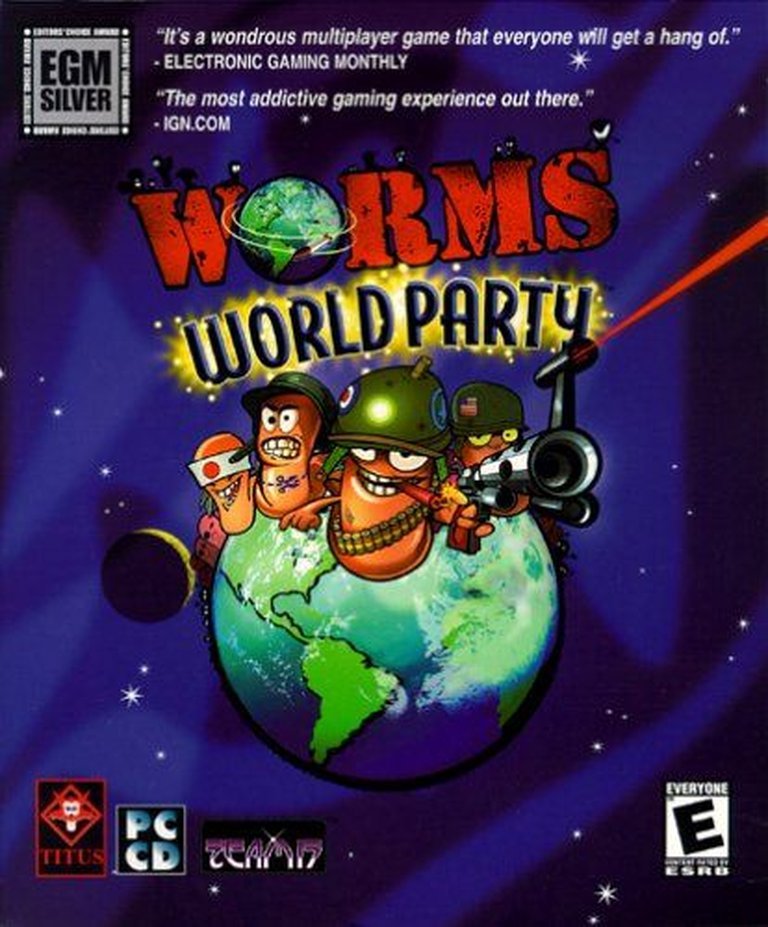
Worms World Party is a comedic turn-based artillery strategy game where players command teams of anthropomorphic worms on destructible 2D landscapes. Building on the classic gameplay of Worms: Armageddon, it introduces the Wormpot modifier system, new campaign missions, co-operative modes, and fort battles, all set in wacky environments with humorous weapons and worm voices for lighthearted tactical combat.
Gameplay Videos
Where to Buy Worms World Party
PC
Worms World Party Free Download
Game Boy Advance
PC
PlayStation
Worms World Party Cracks & Fixes
Worms World Party Patches & Updates
Worms World Party Guides & Walkthroughs
Worms World Party Reviews & Reception
metacritic.com (79/100): A masterpiece of online gaming.
allaboutsymbian.com (88/100): this is classic, timeless, perfect Worms.
Worms World Party Cheats & Codes
PC
Enter codes at team name selection for win game, or in multiplayer chat screen for whispers.
| Code | Effect |
|---|---|
| Winners | Automatically win the game by entering as team name. |
| /msg wiptistean | View private whispers in multiplayer by typing in chat with your nickname. |
PlayStation
Enter codes at team name or player name selection screen.
| Code | Effect |
|---|---|
| winners | Automatically win the match by entering as team name. |
| FartKing | Unlock all weapons in weapon select by entering as player name. |
Game Boy Advance
During game setup: select Skip-Go without using it, then hold L + Down + B and press Select repeatedly.
| Code | Effect |
|---|---|
| Hold L + Down + B and press Select repeatedly | Grants one of each weapon and utility to all human players. |
Dreamcast
Enter ‘winners’ as team name.
| Code | Effect |
|---|---|
| winners | Automatically win the game by entering as team name. |
Worms World Party: The Pinnacle and Paradox of 2D Artillery Chaos
Introduction: The Last Great Stand of the Pink Phalanx
In the annals of turn-based strategy, few franchises have captured the essence of chaotic, accessible, and hilariously destructive fun quite like Team17’s Worms. By the dawn of the new millennium, the series had already cemented its legacy with three mainline entries, each refining the core “artillery” mechanic of teams of adorable, weapon-wielding annelids battling across destructible landscapes. Worms Armageddon (1999) was widely regarded as the zenith of the series’ 2D era—a near-perfect synthesis of depth, humor, and mechanical polish. Into this climate of creative satisfaction stepped Worms World Party (2001), a game born not from a passionate desire to innovate, but from a specific commercial opportunity. Its legacy is a fascinating duality: for many, it is the definitive, feature-rich capstone to the classic 2D Worms experience, bolstered by groundbreaking online play. For others, it represents a cynical, incremental “product recycling” that stalled the series’ creative evolution and left a sour taste of redundancy. As both the final major 2D entry before the ill-fated jump to 3D and a title whose reputation has fractured over time, Worms World Party demands an examination not just as a game, but as a pivotal moment where the franchise’s past, present, and contested future collided.
Development History & Context: Born from a Console’s Request
The genesis of Worms World Party is inextricably linked to the shifting tectonics of the early 2000s gaming market. Following the critical and commercial success of Worms Armageddon, Team17 originally intended it to be the final chapter in the series’ 2D lineage, with plans already underway for a fully 3D successor (which would become Worms 3D in 2003). Crucially, this was the first Worms game developed without the involvement of series creator Andy Davidson, who had departed the studio after Armageddon‘s release (he would not return until 2012). This set the stage for a new creative team, led by designers like Kevin Carthew, to steer the franchise.
The project’s catalyst came from an external source: Sega. Seeking a flagship online title for its struggling but beloved Dreamcast console, Sega approached Team17 and requested an online-enabled Worms game. Since Armageddon lacked robust internet functionality, Team17 began work on what was initially conceived as a Dreamcast-exclusive online expansion. However, publisher dynamics intervened. The original planned publisher, MicroProse, exited the picture, and Titus Interactive (later Titus France SA) took over. Titus, recognizing the franchise’s broader value, insisted on a multi-platform release to maximize profit. This commercial imperative is the key to understanding World Party‘s design: it was retrofitted from an add-on into a full release, padding the Armageddon core with new modes and, most importantly, the long-awaited official online infrastructure via “WormNet.”
Technologically, the game was built upon the proven, sprite-based engine of its predecessor. This was not a generational leap but a refinement, allowing Team17 to focus on content addition and networking code (handled by Sascha Kettler) rather than rebuilding from the ground up. The era’s constraints were evident: 2D pixel art on hardware now capable of 3D, and the nascent, often unreliable, nature of consumer broadband internet for gaming. The team’s solution—a dedicated server browser and peer-to-peer matchmaking—was revolutionary for a Worms title but carried the growing pains of the early 2000s online landscape.
Narrative & Thematic Deep Dive: Lore in the Trenches
The Worms series has never been about linear narrative; its “story” is an abstract, perpetual state of whimsical, miniature warfare. World Party adheres to this tradition, eschewing a plot for a thematic framework of absurdist conflict. The game’s universe is one where teams of worms—each with their own heraldry, voice, and grave marker—engage in endless, consequence-free battles across fantastical, often anachronistic landscapes (pirate ships, medieval castles, “Jail Break” fortresses). The conflict is its own justification, a playground for tactical mayhem.
Where World Party makes its most significant narrative contribution is through the “Wormopaedia”—an in-game encyclopedia that is far more than a simple weapon list. This feature represents a deliberate effort by Team17 to deepen the lore and “world” of Worms. It contains entries not only on every weapon, utility, and gameplay mechanic (with precise damage statistics and usage tips) but also “behind the scenes” background. Most famously, it details the fictionalized, Monty Python-esque origin of the Concrete Donkey weapon, transforming it from a simple projectile into a piece of series mythology. It also catalogs the franchise’s long history of April Fools’ jokes, reinforcing the meta-narrative of Worms as a self-aware, community-engaged property. This attention to in-universe detail elevates the game from a pure mechanics sandbox to a world with its own internal logic and history, however silly.
The core theme remains unchanged: the juxtaposition of cute, easily dismissed protagonists with apocalyptic firepower. The worms’ high-pitched, stereotypical voices (Redneck, “British,” Russian, Cyber-Worm) deliver quips like “Yes, ma?” upon selection and pained cries of “Dangit!” upon death, framing each turn not as a grim military engagement but as a chaotic, personal, and darkly comic mishap. The arsenal—from the sheep that wanders before exploding to the Old Woman who shuffles toward doom to the divine fury of the Holy Hand Grenade—embodies a philosophy of war as a spectacular, unpredictable, and ultimately hilarious failure of coordination. World Party‘s expansion of this arsenal and its systematic documentation in the Wormopaedia only deepened this comedic, almost alchemical, approach to destruction.
Gameplay Mechanics & Systems: Refinement Over Revolution
Worms World Party’s gameplay is, at its core, Worms Armageddon. This is its greatest strength and its most criticized weakness. The foundational loop is pristine: teams of 1-8 worms take turns on a fully destructible 2D landscape, using a turn’s limited time (default 45 seconds) to move, jump, and employ a vast arsenal. Movement is nuanced, with jumps, backflips, and tools like the Ninja Rope (a grappling hook enabling swinging traversal) and Jetpack (limited flight) allowing for incredible verticality and positioning tricks. Terrain deformation is not a gimmick but the central strategic pillar; a well-placed shot can create cover, open a path, or—more often—cause a cascade of collapse that drowns or crushes worms.
The weaponry, divided into standard (Bazooka, Grenade, Shotgun), utility (Blow Torch for digging, Girder for building), and super-weapons (Concrete Donkey, Armageddon meteor shower), operates within a balanced ecosystem where wind, gravity, and fuse timing (for grenades) must be calculated. The PC version inherited all of Armageddon‘s ~50+ weapons, though console ports (PlayStation, Dreamcast) notably omitted fire-based weapons like the Napalm Strike and Flamethrower due to engine/performance limitations, a significant loss for the series’ chaotic chain reactions.
What World Party added was not new mechanics, but new containers for those mechanics:
- The Wormpot: This is the game’s signature innovation. Functioning like a slot machine, it allows players to apply up to three random game-modifying mutators before a match. These range from cosmetic (blood effects) to mechanically profound (low gravity, “slippery” terrain, infinite ammo, “super” weapons, “forts” mode where teams start on pre-built structures). With over 400 possible combinations, the Wormpot theoretically ensures no two matches feel identical, directly addressing player demand for endless customization without manual scheme editing. In practice, some combinations are unbalanced or chaotic to the point of nonsense, but its existence is a testament to the team’s commitment to systemic variety.
- New Campaign Missions: Replacing Armageddon‘s missions, World Party introduced 45 new, often more complex and puzzle-oriented scenarios (e.g., “Roping with Dinosaurs,” “Hindenburger,” “Invertebrate Invaders”). These required specific use of weapons and utilities to complete objectives beyond simple elimination, serving as a rigorous tutorial for advanced technique.
- Co-operative Campaigns: A simple but profound addition allowing two players to control a single team’s worms in mission mode, fostering teamwork and shared problem-solving.
- Forts Mode & Predefined Maps: Built on the Wormpot concept, Forts gave teams set defensive structures, changing the defensive/offensive dynamic. New predefined maps like “Ahoy Matey” (pirate ships facing off) became instant classics.
- All Schemes Available From Start: A quality-of-life improvement removing the need to unlock the deep customization options of Armageddon.
The AI received praise for being “vastly superior” to Armageddon‘s, with opponents better at using the Ninja Rope and advanced weapons, though player reviews consistently noted its schizophrenic difficulty—sometimes “godly,” sometimes “stupid.” The user interface was a point of contention, particularly on consoles. The Dreamcast version was famously criticized for a “convoluted” and “atrocious” setup menu with “non-descript icons” and “inconsistent navigation,” making game configuration a chore—a failure of console UI design that hindered accessibility.
World-Building, Art & Sound: Charm in Pixels and Squeaks
Visually, Worms World Party made no attempt to compete with the emerging 3D graphics of its era. It proudly upheld the 2D sprite-based aesthetic of its lineage. The landscapes are charmingly simple, often lush and green or arid and rocky, with a limited but expressive palette. The true visual magic lies in the pixel-perfect destructibility and the worms themselves: tiny, rosy-cheeked, and endlessly expressive in their idle animations, weapon-windups, and death throes. The art direction, by Dan Cartwright and David Smith, prioritized clarity and character over technical prowess, ensuring that in the heat of chaotic battle, players could always distinguish their worms, their enemies, and the deadly projectiles arcing through the air.
This aesthetic was the perfect vessel for the game’s sound design, widely cited as one of its greatest assets. Composer Bjørn Lynne returned to deliver a fantastic, melodically catchy and dynamically shifting soundtrack that underscored the action—from tense, quiet plinking during positioning to frantic, chaotic themes during all-out war. The sound effects for weapons are iconic: the thwump of the Bazooka, the clink of a bouncing grenade, the baa of the Sheep Launcher, the serene drip of the concrete donkey’s descent before impact.
However, the true star is the voice work. With over 40 distinct sound banks (Redneck, British, Russian, German, French, Cyber-Worm, etc.), each worm team is given a personality through a library of high-pitched squeaks, affirmations (“Yes, sir!”), exclamations of dismay (“Oh, crumbs!”), and death rattles. This layer of audio comedy is not incidental; it is fundamental to the experience. Hearing a posh British worm declare “Jolly good show!” before accidentally launching himself into the sea, or a Russian worm grunt “Blyat!” as a barrel explodes nearby, creates a continuous, reactive narrative that fills the gaps left by the lack of a traditional story. It transforms a strategy game into a sitcom of catastrophic failure and schadenfreude.
Reception & Legacy: A fork in the Road
Upon release in 2001, Worms World Party received generally favorable reviews across platforms, with aggregate scores typically in the 75-80% range (Metacritic: PC 75, Dreamcast 79, GBA 75, N-Gage 77). Critics universally praised its addictive multiplayer, deep customization via Wormpot, and signature humor. Eurogamer called it “the jewel in the crown of the Worms series,” while GameSpot noted it was “an excellent investment” for the Dreamcast. Planet Dreamcast hailed its online play as nearly latency-free, a remarkable feat for the time.
However, the overwhelming and persistent criticism was that the game was too similar to Worms Armageddon. Reviews from major outlets like IGN, GameSpot, PC Gamer, and PC Zone all echoed the sentiment that it felt like an expansion pack or a minor iteration rather than a true sequel. Electric Playground stated it was “a little too recognizable,” and GameStar (Germany) bluntly categorized it under “Clever Product Recycling.” For players who already owned Armageddon, the value proposition was questionable: the new Wormpot, missions, and online play were significant, but were they worth a full-price purchase? The answer for many was no, leading to a schism in the community that persists.
This perception cemented World Party‘s commercial and cultural role. It was a commercial success in the UK (ELSPA Silver award for 100,000+ sales), and its PC version consistently ranked in PC PowerPlay‘s top 100 games for years. Its real legacy, however, is twofold:
- The Last Bastion of 2D: It was the final major 2D entry in the main series before the controversial pivot to 3D with Worms 3D (2003). For purists, World Party represents the perfected, final form of the classic formula before the series experimented with dimensionality and physics that diluted the crisp, tactical control of the 2D era.
- The Online Pioneer: Its integration of WormNet was revolutionary for the franchise. It fostered a massive, dedicated online community that created countless custom rulesets (the “Shopper” and “RopeRace” modes became legends), clans, and leagues. This online culture extended the game’s lifespan by a decade or more. Ironically, the community’s ultimate loyalty often coalesced around the more stable and feature-rich Worms Armageddon patched by fans (to v4.0), leaving World Party‘s official servers to dwindle, a victim of its own success in solidifying the Armageddon ruleset as the competitive standard.
The 2015 remaster, Worms World Party Remastered, attempted to preserve its legacy by updating the resolution to 1080p at 60fps, adding controller support and Steam achievements. Yet, it too was criticized for not addressing deeper AI or balance issues and for being a preservation effort rather than a revitalization. Its recent inclusion in subscription services (PlayStation Plus Premium) and bundles has introduced it to new generations, but the core debate remains: is it the ultimate Worms package or a stopgap?
Conclusion: A Flawed Masterpiece, A Definitive Ending
Worms World Party is a game of profound contradictions. It is the most complete and content-rich 2D Worms experience, offering unparalleled customization, a robust online suite that defined a community, and a charming, deeply humorous presentation that remains utterly infectious. It is also, undeniably, a game that coasted on the monumental success of its predecessor, offering evolutionary rather than revolutionary changes. Its development, born from a console manufacturer’s request and a publisher’s profit motive, explains its “more of the same” DNA.
To judge it solely on its lack of innovation is to miss its core achievement: it successfully translated the intimate, couch-based joy of Worms into a global, online phenomenon. The Wormpot, the new missions, the forts—these were meaningful extensions of a brilliant core. For the Worms virgin in 2001, it was an embarrassment of riches. For the Armageddon veteran, it was a tempting but ultimately redundant collection.
In the grand timeline of video game history, Worms World Party is the closing of a golden age. It was the last time a mainline Worms game was built from the ground up for the 2D artillery formula before the series’ uncertain 3D experiment and subsequent search for identity. It preserved the pure, turn-based, destructible-terrain tactics that defines the genre at its best. Its legacy is not one of groundbreaking design, but of perfect preservation and global dissemination. It ensured that the specific magic of pink worms, sheep cannons, and concrete donkeys would not die with the Dreamcast or the dial-up era, but would live on in LAN parties, online clans, and remastered collections. It may not have advanced the art, but it decisively secured the throne for the art it inherited. For that, and for the thousands of hours of chaotic, hilarious warfare it enabled, Worms World Party earns its place as a flawed but definitive masterpiece—the last great party on the 2D battlefield.
Final Verdict: 8.5/10 – The last and most comprehensive classic 2D Worms. Its historical value as the franchise’s online pioneer and endpoint of its purest form outweighs its creative stagnation. Essential for newcomers, a glorious but optional deluxe edition for veterans.