
- Release Year: 2006
- Platforms: PlayStation 2, PlayStation 3, Windows
- Publisher: Midas Interactive Entertainment Ltd.
- Developer: Na.p.s. Team s.n.c.
- Genre: Action
- Perspective: Behind view
- Game Mode: Single-player
- Gameplay: Aviation, Flight, Shooter
- Setting: World War I
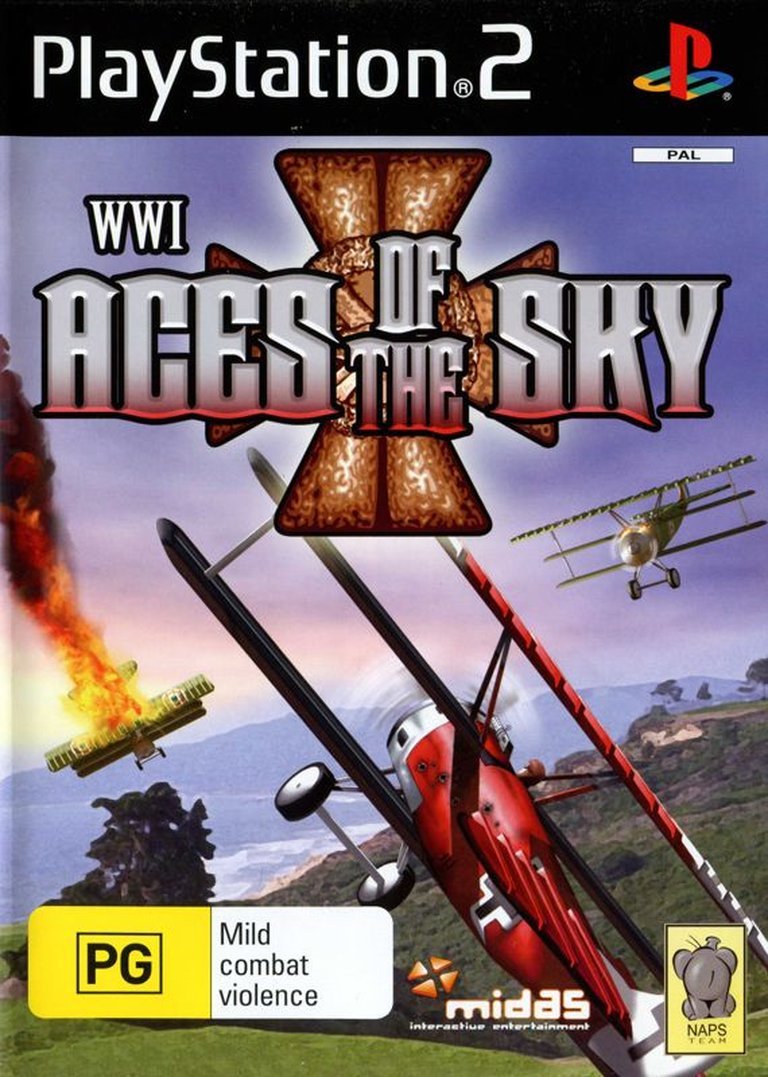
Description
WWI: Aces of the Sky is an action-oriented flight combat game set during World War I, where players control biplanes in thirty diverse missions over both land and sea. The gameplay involves engaging in aerial dogfights against enemy aircraft like bombers and other biplanes, as well as targeting ships and trains, with the added strategic element of landing on airfields to repair, refuel, rearm, and switch planes for tactical advantages.
Gameplay Videos
WWI: Aces of the Sky Free Download
PlayStation 2
WWI: Aces of the Sky Cracks & Fixes
WWI: Aces of the Sky Patches & Updates
WWI: Aces of the Sky: Review
Introduction: A Fading Echo Over the Trenches
In the grand canon of World War I video games, the skies above the Western Front have always held a particular romantic and tragic allure. The chivalric, yet brutally lethal, dance of biplanes and triplanes represents a unique technological and human epoch. Into this niche, but perpetually fascinating, genre stepped WWI: Aces of the Sky in 2006, a title that promised “intense dog fighting action” and the chance to become a “true flying ace.” However, a thorough excavation of its history, design, and reception reveals a game that is less a seminal classic and more a poignant artifact of a specific developmental moment—a modest, accessible, and ultimately ephemeral entry that struggled to find a definitive identity between arcade thrills and genuine simulation. Its legacy is not one of acclaim, but of quiet obscurity, serving as a benchmark for the challenges of crafting a compelling Great War flight experience on a budget.
Development History & Context: The NAPS Team and the Budget Flight Sim
The game was developed by Na.p.s. Team s.n.c., an Italian studio whose name is synonymous with a particular strand of European budget and mid-tier flight games. Their portfolio, including titles like Sky Odyssey and WarBirds contributions, indicates a specialization in vehicular combat, often with a historical bent. WWI: Aces of the Sky fits squarely within their wheelhouse: a focused, mechanically straightforward take on a specific historical period.
The publisher, Midas Interactive Entertainment Ltd., was a notable European (primarily UK-based) publisher of the 2000s, renowned for distributing a vast array of budget-priced titles, Simulations, and niche games across PAL regions. Their involvement immediately signals the game’s commercial positioning: it was not a blockbuster aimed at the North American AAA market dominated by series like Ace Combat, but a product for the European budget and family software sections, evidenced by its PEGI 3 rating—an exceptionally low age rating for a combat flight game, underscoring its accessible, arcade-oriented design.
Technologically, the game was a PlayStation 2 exclusive at launch (2006), later receiving ports to Windows (2007) and PlayStation 3 (2012). This lifecycle is typical for Midas Interactive titles, often maximizing a console’s installed base before transitioning to PC digital storefronts. The PS2, while powerful, was in the latter half of its lifecycle, meaning the game competed not with next-gen visuals but with the rich library of established flight classics like IL-2 Sturmovik (hardcore sim) and Ace Combat (arcade sim). WWI: Aces of the Sky sought a middle ground that neither hardcore nor casual players widely recognized.
Narrative & Thematic Deep Dive: The Ace Without a Story
Here, the game presents its most significant and unambiguous failure. The provided source material contains zero information regarding a plot, characters, or thematic substance. The official descriptions are purely functional: “as a true flying ace you must take the battle to the enemy and help bring victory in the war to end all wars.” This is not a narrative premise; it is a generic mission brief.
- Plot & Characters: There is no campaign narrative, no named protagonist, squadron, or adversary. The player is an anonymous “Ace” inserted into 30 discrete missions with no connecting tissue. There are no cutscenes, no radio chatter with context, and no personal stakes beyond the abstract “big push” mentioned in marketing copy. The “war to end all wars” is used as a setting, not a theme.
- Dialogue & Themes: Absent. The game operates on the pure gameplay loop of takeoff, engage targets, return/destroy, land. Any thematic exploration of the horror, tragedy, or brief aerial chivalry of WWI is entirely missing. This positions the game not as a historical experience, but as a pure action game with a historical skin. The setting is atmospheric dressing, not a narrative driver. This lack of story is its most defining and damning characteristic, placing it in stark contrast to later narrative-rich flight games or even contemporary WWI titles that attempted squad-based storytelling.
Gameplay Mechanics & Systems: Arcade Dogfighting with a Strategic Glitch
The game’s design, as described, is a hybrid that leans heavily toward accessible arcade action, with one purported feature that hints at a deeper, underdeveloped layer.
- Core Loop & Combat: The player controls a biplane from a behind-view perspective. The primary tools are machine guns and bombs. Targets are explicitly varied: enemy aircraft (biplanes, bombers), and ground/naval units (ships, trains, tanks, observation balloons, fuel tanks, buildings). This variety is a key selling point, suggesting missions that combine air superiority with ground attack. The description of “aerial acrobatics” implies simple maneuvers like rolls and loops, likely mapped to a single button or stick flick, prioritizing ease of use over complex flight physics.
- The Airfield Mechanic: The most frequently cited and potentially intriguing system is the ability to land on airfields mid-mission to “repair, get new fuel and ammo and even switch planes.” This is a significant feature for a game of this scale and era. It introduces a layer of resource management and strategic choice—do you press the attack with a damaged plane, or risk a landing to re-arm and perhaps choose a more suitable aircraft for the remaining objectives? However, the sources do not elaborate on the implementation. Is landing a precise, challenging mini-game or a simple button press at a designated zone? How does “switching planes” work mid-campaign? This mechanic suggests an ambition for a persistent, mission-chain experience but appears to be presented in a simple, almost menu-driven way based on the context of other descriptions.
- Progression & UI: There is no mention of a pilot progression system, plane upgrades, or unlockable aircraft. The “switch planes” feature at airfields is the only hint of aircraft variety, but it’s unclear if this is a sandbox option or part of a progression path. The UI is presumed to be minimalistic, focused on ammo/fuel counters and a compass/radar, fitting the “intuitive arcade flight control system” marketing promise.
- Innovation vs. Flaws: The mid-mission airfield concept was relatively novel for accessible WWI flight games on consoles. However, the overall package appears mechanically shallow. The absence of a skill tree, damage modeling beyond a binary “repair” function, and a paper-thin mission structure (simply “destroy X”) suggests a game designed for short, pick-up-and-play sessions rather than sustained engagement. The primary flaw, beyond the narrative void, is likely a lack of depth in flight modeling and combat tactics. With only machine guns and bombs, and no mention of differing plane stats (speed, maneuverability, durability) affecting dogfights, combat probably devolves into simple turning fights and shooting.
World-Building, Art & Sound: A Serviceable But Forgettable Sky
The sources provide no direct commentary on audiovisual presentation, forcing an analysis based on period conventions and the game’s budget status.
- Visual Direction & Setting: As a 2006 PS2 title from a small studio, the graphics would be functional and dated even at release. The setting—WWI—is wonderfully captured in broad strokes: biplanes, muddy trenches below (implied by ground targets), seaplanes, and observation balloons. The “varied environments” (land, sea) are a plus, but the technical limitations of the PS2 mean environments were likely simplistic, with low-poly models, limited draw distance, and basic terrain textures. The atmosphere would depend on a dynamic sky and weather system, a common feature in flight games, but there’s no evidence here of a sophisticated or moody implementation. It would be a competent, non-distracting backdrop for dogfights, not a沉浸式 historical recreation.
- Sound Design: Sound would be critical for immersion in a flight game. The roar of inline vs. rotary engines, the rat-tat-tat of machine guns, and the whistle of bombs are essential. Given the budget and target audience (PEGI 3), the sound design was likely clear and punchy but not especially authentic or layered. No iconic period music or chaotic battlefield soundscapes are hinted at. The audio would serve gameplay function—signaling weapon fire, damage, and perhaps proximity warnings—over atmospheric storytelling.
Reception & Legacy: The Silence of Obscurity
The critical and cultural reception of WWI: Aces of the Sky is its most telling aspect, best summarized by the data within the provided sources:
- Metacritic lists no critic reviews for any platform.
- MobyGames shows a Moby Score of “n/a” and lists only 6 collected players. Critic Reviews are empty, with a prompt to “Be the first to add a critic review for this title!”
- Backloggd shows only 2 ratings and 5 plays logged by its userbase.
- HonestGamers has no staff or user reviews for the title.
This is not the profile of a cult classic or a forgotten gem; it is the profile of a functionally ignored game. It was released, likely stocked in European discount bins and bargain bins, and promptly forgotten by the critical press and most players. Its existence is a data point in databases, nothing more.
Its legacy is virtually non-existent in influencing major franchises. The “Related Games” list on MobyGames shows it as part of a long tail of low-to-mid-budget WWI flight titles (e.g., Sky Aces, WWI: The Great War), but it does not stand as a pioneer. Compare it to the later success of Warplanes: WW1 Sky Aces (2019) or the stylistic The Sky Crawlers: Innocent Aces (2010). WWI: Aces of the Sky represents a dead-end branch in the evolution of the genre: the budget, console-focused, arcade WWI flight game with a single, underdeveloped systemic idea (airfield landings) and no narrative ambition. It was superseded not by a direct competitor, but by the market moving towards either more accessible mobile titles or more complex, squad-based PC simulations.
Conclusion: A Historical Footnote in the Sky
WWI: Aces of the Sky is a game defined by its omissions. It offers the what—thirty missions, diverse targets, biplane combat—but none of the why or how that elevates a game from momentary distraction to memorable experience. It lacks a story, lacks deep mechanics, and, as the complete absence of contemporary or retrospective reviews demonstrates, it lacked the cultural impact to even warrant criticism or nostalgia.
Its place in video game history is as a tertiary artifact. It is a snapshot of a publisher’s (Midas Interactive) strategy of saturating the market with budget-priced, niche-aimed titles during the PS2/early-PC era. It demonstrates the perennial challenge of adapting the rich, tragic tapestry of World War I into a satisfying gameplay loop without resorting to simplistic arcade action or intimidating simulation. For the professional historian, it is a data point confirming the market space for WWI flight games was crowded with forgettable contenders. For the journalist, it is a prime example of a game that achieved nothing beyond a basic functional existence. It is not a lost masterpiece; it is a game that, against all odds, did not even achieve the infamy of being “so bad it’s good.” It simply was, and then it was gone, leaving behind only a sparse database entry and the faint, acrid smell of burnt oil and missed potential.