
- Release Year: 2013
- Platforms: Linux, Macintosh, Windows
- Publisher: EGOSOFT GmbH, Koch Media GmbH (Austria)
- Developer: EGOSOFT GmbH
- Genre: Action, Simulation
- Perspective: 1st-person
- Game Mode: Single-player
- Gameplay: Base building, Business simulation, Crafting, Managerial, Moral choices, Open World, Space flight, Vehicular
- Setting: Futuristic, Sci-fi
- Average Score: 38/100
Description
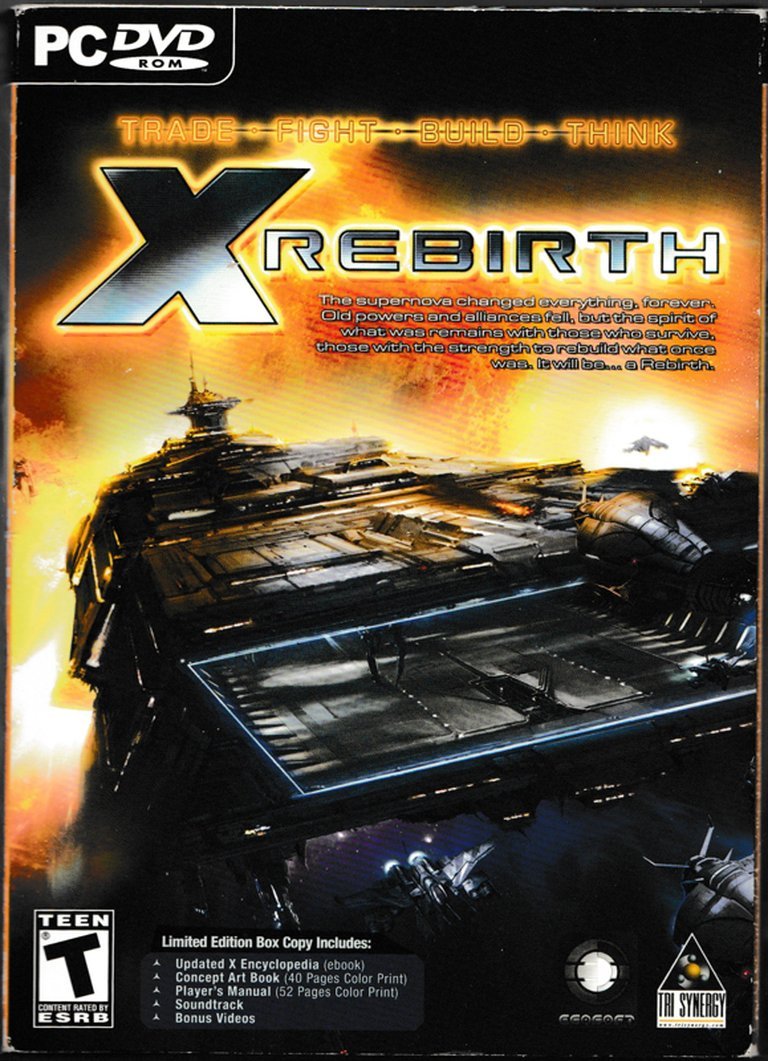
X: Rebirth is a space trading and combat simulation game set in the Albion system, where players assume the role of Ren Utani, who uncovers the legendary Albion Skunk spacecraft and becomes entangled in a faction war between the Pultrach Mining Corporation and the Heart of Albion rebels. The game emphasizes player freedom, allowing for activities like space combat, trading, mining, and station management, with a focus on a more streamlined and accessible experience compared to previous entries in the series. The game features four distinct solar systems, a single-ship constraint, and a control scheme optimized for gamepads, blending action and managerial simulation in a sci-fi setting.
Gameplay Videos
Where to Buy X: Rebirth
X: Rebirth Cracks & Fixes
X: Rebirth Mods
X: Rebirth Guides & Walkthroughs
X: Rebirth Reviews & Reception
opencritic.com (43/100): X Rebirth may be a space sim beyond saving, even after patches address stability and performance issues.
opencritic.com (39/100): X misses the spot. The occasional bit of spectacle can’t save this boring, broken and charmless space simulation.
opencritic.com (20/100): X Rebirth’s endless deficiencies make it an inferior husk of the X games that came before it.
opencritic.com (25/100): X Rebirth is simply a broken, flawed, and almost unplayable mess. It’s a shell that has potential, but it’s not a working game on its own.
opencritic.com : X Rebirth is a broken game right now. The UI is clunky, flying feels awkward at best, and you’re often left to figure out how to play without any real sort of guidance.
opencritic.com (30/100): I was wrong. It’s a universe filled with boring people living on boring space stations, and playing in this universe is, unsurprisingly, really bloody boring.
opencritic.com (20/100): X Rebirth is the most disappointing PC title of 2013. A heartbreaking, gut-churning mess.
opencritic.com (40/100): One to come back to in a couple of months, perhaps, and if you’re still deadest on picking this up, then try and wait for a sale or something at least.
opencritic.com (28/100): The interfaces and NPCs have this amazing ability to curdle every sense in your body, and at the end of it, you just wish you never attempted any of it in the first place.
opencritic.com (20/100): Those few aesthetic points aside, X Rebirth is a deeply flawed game. Riddled with bugs, poor design choices, weak core mechanics, and a shallow world, X Rebirth is not a game that I can recommend.
opencritic.com (40/100): X Rebirth will become something, but what that will be, only time will tell. In its current state, given room for potential and circumstances, I feel I am being extremely generous giving X Rebirth the score I have.
opencritic.com (33/100): An ambitious attempt to take the series in a new direction crippled by the fact that the direction in question turns out to be ‘down the drain’. Shoddy design and construction across the board leave this one without a leg to stand on.
metacritic.com (47/100): To top off a growing tower of gripes, navigation around space in Rebirth is an astounding hassle.
metacritic.com (45/100): In the distant future, the X universe faces a period of profound and irrevocable change. While the universe stumbles towards an uncertain future, countless adventures await as new enemies rise in search of power.
metacritic.com (44/100): The renovation fails: not only are the new additions crooked and wrong, they also bring the really solid foundation down.
metacritic.com (43/100): No matter what happens with stability and bug-fixing patches, its poor controls, awful interface, and dull pacing ensure that X Rebirth will remain unpleasant for all but the most forgiving, die-hard space jockeys.
metacritic.com (40/100): X Rebirth is a 4X game marred by numerous bugs and falsely good ideas.
metacritic.com (40/100): X: Rebirth will get better over time, and anyone who’s open-minded enough to look past the ‘X’ branding and see the ‘game’, may even find many hours of entertainment.
metacritic.com (40/100): Too many issues make X Rebirth an unplayable game.
metacritic.com (40/100): Rebirth lacks inspiration, purpose, good ideas. It’s riddled with bugs and, even when it seems to work, it manages to be dull. There isn’t any true reason to play it.
metacritic.com (39/100): The concept sounds good – bringing the complex X-Universe more comfortably to life, with improved handling and management. But the release version is a disaster, filled with many bugs and design issues, that neither satisfies veteran fans nor newcomers.
metacritic.com (39/100): X misses the spot. The occasional bit of spectacle can’t save this boring, broken and charmless space simulation.
monstercritic.com (40/100): X: Rebirth will get better over time, and anyone who’s open-minded enough to look past the ‘X’ branding and see the ‘game’, may even find many hours of entertainment.
bestgamesreviews.info (55/100): X Rebirth, even with its Collector’s Edition extras, is a difficult game to recommend. While the core concepts of space trading and empire building are engaging, the execution is severely hampered by its technical issues, clunky controls, and underwhelming presentation.
X: Rebirth Cheats & Codes
PC (Cheat Engine Table)
Load the cheat table in Cheat Engine and activate the desired scripts.
| Code | Effect |
|---|---|
| Minimum Money | Sets player’s money to a minimum value. |
| Unlimited Shield | Grants unlimited shield for the player’s current controlled ship. |
| God Mode | Makes the player’s current controlled ship invincible. |
| Unlimited Missile | Provides unlimited missiles for the player’s current controlled ship. |
PC (Trainer)
Use the trainer with customizable hotkeys for various cheats.
| Code | Effect |
|---|---|
| Quick Hull Repair | Instantly repairs the hull of the player’s ship. |
| Unlimited Energy | Provides unlimited energy for the player’s ship. |
| Unlimited Laser | Grants unlimited laser ammunition. |
| Unlimited Missiles | Provides unlimited missiles. |
| Unlimited Booster | Allows unlimited use of the booster. |
| Add Money | Increases the player’s money. |
X: Rebirth: A Flawed but Ambitious Space Odyssey
Introduction
The X series has long been a cornerstone of the space simulation genre, offering players unparalleled freedom to explore, trade, and conquer a vast, living universe. X: Rebirth, the sixth installment in Egosoft’s venerable franchise, promised to reinvent the series with a fresh perspective, modernized mechanics, and a more accessible entry point for newcomers. Yet, upon its release in 2013, it became one of the most divisive entries in the series—a game that dared to redefine its legacy but stumbled under the weight of its own ambition. This review dissects X: Rebirth in exhaustive detail, examining its development, narrative, gameplay, world-building, reception, and lasting impact on the genre.
Development History & Context
The Studio and Vision
Egosoft, a German developer with a reputation for deep, simulation-heavy space games, had spent over a decade refining the X series. From X: Beyond the Frontier (1999) to X3: Albion Prelude (2012), the studio cultivated a niche but devoted fanbase. X: Rebirth was conceived as a “reboot” of sorts—not a complete abandonment of the series’ roots, but a bold reimagining aimed at modernizing its mechanics and broadening its appeal.
Director Bernd Lehahn and producer Peter “Kulan” Kullgard spearheaded the project, envisioning a game that retained the series’ signature depth while streamlining its notoriously steep learning curve. The goal was to make X: Rebirth more accessible without sacrificing complexity—a balancing act that would prove elusive.
Technological Constraints and Design Choices
The development of X: Rebirth was fraught with challenges. The game was built on a new engine, a departure from the iterative updates of previous X titles. This shift allowed for improved visuals, physics, and AI but also introduced instability and performance issues. The decision to restrict players to a single, highly customizable ship—the Albion Skunk—was a radical departure from the fleet-management focus of earlier games. While this choice aimed to simplify gameplay, it alienated veterans who relished commanding armadas of capital ships.
Another controversial design decision was the introduction of “highways” and “super-highways,” which replaced the open-ended navigation of previous games with a more structured, lane-based travel system. This change was intended to make traversal more intuitive but instead felt restrictive to many players.
The Gaming Landscape at Launch
X: Rebirth arrived in November 2013, a time when the space simulation genre was experiencing a renaissance. Elite: Dangerous was on the horizon, and Star Citizen was generating massive hype with its crowdfunding campaign. Against this backdrop, X: Rebirth struggled to carve out its niche. Its launch was marred by bugs, performance issues, and a user interface that felt clunky and unintuitive. The game’s reception was overwhelmingly negative, with critics and players alike decrying its technical flaws and design missteps.
Narrative & Thematic Deep Dive
Plot Overview
X: Rebirth is set in the Albion system, a region of the X universe isolated after the collapse of the jump gate network following the events of X3: Albion Prelude. The player assumes the role of Ren Otani, a scrappy pilot who stumbles upon the Albion Skunk, a legendary but battered corvette with a storied past. Alongside his co-pilot, Yisha Tarren, Ren becomes entangled in a conflict between the oppressive Plutarch Mining Corporation and the rebellious Heart of Albion faction.
The narrative is more character-driven than previous X games, with Ren and Yisha serving as the emotional core. However, the story often feels underdeveloped, with thin character arcs and a lack of meaningful stakes. The overarching conflict between Plutarch and the Heart of Albion is compelling on paper but suffers from weak execution, with missions that frequently devolve into repetitive fetch quests or combat encounters.
Themes and Motifs
X: Rebirth explores themes of isolation, survival, and rebellion. The Albion system is a microcosm of the broader X universe, cut off from the rest of civilization and struggling to maintain order. The Plutarch Corporation represents unchecked corporate power, while the Heart of Albion embodies the fight for freedom against tyranny. These themes are timely and relevant, but the game’s narrative fails to explore them with the depth they deserve.
The game also touches on the idea of legacy, both in terms of the Albion Skunk’s history and the X series itself. The Skunk is a relic of a bygone era, a reminder of the glory days of the Argon military, and its discovery by Ren symbolizes the potential for renewal. Unfortunately, this thematic richness is often overshadowed by the game’s technical and design flaws.
Dialogue and Character Interaction
The dialogue in X: Rebirth is functional but uninspired. Characters like Yisha and the various faction leaders lack the charm and depth of their counterparts in other space RPGs. The voice acting is serviceable but rarely memorable, and the conversations often feel stiff and unnatural. The game’s attempt to incorporate a “conversation mini-game” for negotiating discounts or gathering information is a noble effort but ultimately feels tacked on and underutilized.
Gameplay Mechanics & Systems
Core Gameplay Loop
At its heart, X: Rebirth is a space trading and combat simulator. Players can engage in a variety of activities, including:
- Combat: Dogfighting against pirates, faction ships, and the ever-present Xenon threat.
- Trading: Buying and selling goods across stations to turn a profit.
- Mining: Extracting resources from asteroids.
- Empire Building: Hiring crews, purchasing additional ships, and constructing space stations.
The game’s sandbox nature is one of its strongest assets, offering players the freedom to approach the universe in their own way. However, the execution of these mechanics is often flawed.
Combat and Ship Customization
Combat in X: Rebirth is a mixed bag. The Albion Skunk is a versatile ship, capable of being outfitted with a variety of weapons, including lasers, railguns, and drones. The ability to deploy drones adds a tactical layer to combat, allowing players to scout ahead or launch remote attacks. However, the combat itself can feel sluggish and unresponsive, with enemy AI that ranges from incompetent to frustratingly aggressive.
Ship customization is one of the game’s highlights. The Skunk can be modified extensively, with different cockpits, weapon loadouts, and crew configurations. This level of customization allows players to tailor their ship to their preferred playstyle, whether they favor combat, trading, or exploration.
Trading and Economy
The trading system in X: Rebirth is deep but cumbersome. Players must manually buy and sell goods, monitor market fluctuations, and manage their inventory. While this level of detail will appeal to hardcore simulation fans, it can feel tedious and overwhelming to newcomers. The lack of automation in the early versions of the game exacerbated this issue, though later patches introduced some quality-of-life improvements.
UI and Controls
The user interface in X: Rebirth is one of its most criticized aspects. The game’s menus are convoluted and unintuitive, with critical functions buried beneath layers of sub-menus. The decision to eschew traditional hotkeys in favor of a menu-driven system was intended to make the game more accessible to console players, but it instead made navigation a chore. Later updates introduced optional HUDs and control schemes, but the damage to the game’s reputation had already been done.
Exploration and Navigation
The introduction of highways and super-highways was one of the most controversial changes in X: Rebirth. While these lanes make traversal faster and more structured, they also restrict the open-ended exploration that was a hallmark of previous X games. The highways are visually impressive, with ships hurtling through space at breakneck speeds, but they ultimately feel like a compromise rather than an improvement.
World-Building, Art & Sound
Setting and Atmosphere
The Albion system is a richly detailed setting, with distinct factions, cultures, and histories. The game’s four solar systems—Albion, Omicron Lyrae, The Void, and the later-added Teladi Outpost—each have their own unique characteristics. The stations are massive, sprawling structures, teeming with life and activity. The sense of scale is impressive, with capital ships dwarfing the player’s vessel and bustling trade routes crisscrossing the void.
However, the game’s atmosphere is often undermined by its technical issues. The stations, while visually impressive, are often empty and lifeless, with NPCs that feel more like mannequins than living beings. The lack of ambient chatter or dynamic events makes the world feel static and sterile.
Visual Design
X: Rebirth is a visually ambitious game, with detailed ship models, expansive space stations, and stunning celestial backdrops. The Albion Skunk is a standout, with its weathered exterior and customizable interior. The capital ships are particularly impressive, with intricate designs and massive scale.
However, the game’s visuals are held back by technical limitations. The textures are often muddy, and the lighting can be inconsistent. The game’s performance issues also detract from its visual appeal, with frequent frame rate drops and stuttering.
Sound Design and Music
The sound design in X: Rebirth is functional but unremarkable. The weapons have satisfying audio cues, and the ambient sounds of space travel are immersive. However, the voice acting is often flat, and the lack of dynamic music means that the soundtrack rarely elevates the experience.
The game’s score, composed by Alexei Zakharov, is atmospheric but forgettable. It sets the tone for the game’s sci-fi setting but fails to leave a lasting impression.
Reception & Legacy
Critical and Commercial Reception
X: Rebirth was met with overwhelmingly negative reviews upon release. Critics lambasted its technical issues, clunky UI, and lackluster narrative. The game holds a Metacritic score of 33/100, making it one of the lowest-rated entries in the X series.
Players were equally disappointed, with many requesting refunds and expressing frustration at the game’s unfinished state. The lack of polish and the abundance of bugs made it difficult for even the most dedicated fans to recommend.
Post-Launch Support and Patches
To their credit, Egosoft did not abandon X: Rebirth after its disastrous launch. The studio released numerous patches and updates, addressing many of the game’s most glaring issues. The 2.0 update introduced significant improvements, including a revamped UI, autopilot functionality, and new gameplay features. The 3.0 update, released alongside the Teladi Outpost DLC, further refined the experience, adding new content and quality-of-life improvements.
These updates helped to salvage some of the game’s reputation, but the damage had already been done. X: Rebirth remains a cautionary tale about the dangers of releasing a game before it is ready.
Influence on Subsequent Games
Despite its flaws, X: Rebirth had a lasting impact on the X series and the space simulation genre as a whole. The lessons learned from its development informed the creation of X4: Foundations (2018), which returned to the series’ roots while incorporating many of the improvements introduced in Rebirth. X4 was met with far more positive reception, proving that Egosoft had learned from its mistakes.
X: Rebirth also served as a reminder of the importance of player feedback and post-launch support. While the game’s initial release was a failure, the studio’s commitment to improving it demonstrated a willingness to listen to its community—a lesson that many developers would do well to heed.
Conclusion
X: Rebirth is a flawed but fascinating entry in the X series. It dared to reimagine a beloved franchise, taking risks that ultimately did not pay off. The game’s ambition is undeniable, but its execution was hampered by technical issues, design missteps, and a lack of polish. While later updates improved the experience, they could not fully redeem the game’s troubled launch.
For hardcore fans of the X series, X: Rebirth offers a glimpse into an alternate vision of the franchise—one that prioritized accessibility and modernization over depth and complexity. For newcomers, it serves as a cautionary tale about the dangers of ambition without execution.
Final Verdict: X: Rebirth is a noble failure—a game that aimed for the stars but crashed upon takeoff. While its post-launch support is commendable, it remains a difficult recommendation for anyone but the most dedicated fans of the series.
Score: 5.5/10 – A flawed but ambitious space odyssey that ultimately falls short of its potential.