
- Release Year: 2001
- Platforms: Windows
- Publisher: LucasArts Entertainment Company LLC
- Developer: LucasArts Entertainment Company LLC
- Genre: Compilation
- Perspective: Third-person
- Game Mode: LAN, Online PVP, Single-player
- Setting: Science fiction
- Average Score: 85/100
Description
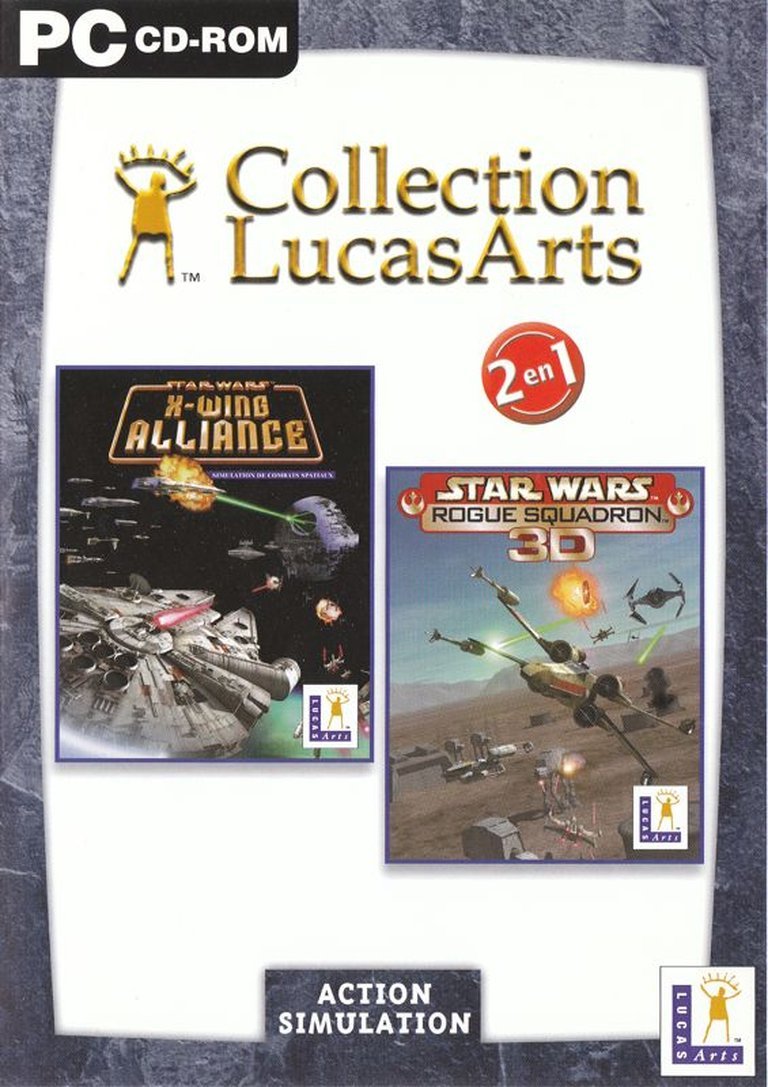
X-Wing Alliance & Rogue Squadron 3D is a 2001 Windows compilation bundling two iconic Star Wars flight combat games: Star Wars: Rogue Squadron 3D and Star Wars: X-Wing Alliance. Rogue Squadron 3D is an arcade-style action game set between the events of Star Wars and The Empire Strikes Back, where players pilot as Luke Skywalker commanding the elite Rogue Squadron across 16 planetary missions against the Galactic Empire. X-Wing Alliance offers a deeper simulation experience within the Galactic Civil War, immersing players in intense space battles as a Rebel Alliance pilot.
X-Wing Alliance & Rogue Squadron 3D Mods
X-Wing Alliance & Rogue Squadron 3D Reviews & Reception
metacritic.com (85/100): This is a title that no self-respecting N64 owner should pass up. Nintendo has created the first true N64 classic since “Mario 64.”
retro-replay.com : This duo offers hours of varied challenges for flight sim veterans and newcomers alike.
X-Wing Alliance & Rogue Squadron 3D Cheats & Codes
Rogue Squadron 3D (PC)
Enter codes at the Settings screen.
| Code | Effect |
|---|---|
| IAMDOLLY | Infinite Lives |
| LEIAWRKOUT | Enable Force Feedback |
| WOOKIEPELT | Enables Millennium Falcon |
| ACE | Expert Mode |
| MAESTRO | Sound Test |
| TOUGHGUY | Free Technology Upgrades |
| CHICKEN | Play as an AT-ST |
| DIRECTOR | View All Cutscenes |
| CREDITS | View Credits |
X-Wing Alliance (PC)
Enter ‘IMACHEATER’ first to enable cheat codes.
| Code | Effect |
|---|---|
| IMACHEATER | Enables cheat codes |
| EWOKSRULE | Invulnerability |
| MASTERYODA | Infinite Ammo |
| KILLMENOW | Lose Level |
| THETASTEOFVICTORY | Win Level |
| HYPERMETO## | Warp to level number (replace ## with level number) |
X-Wing Alliance & Rogue Squadron 3D: Review
Introduction
In the pantheon of Star Wars gaming, few compilations capture the franchise’s dual spirit of simulation grandeur and arcade spectacle as effectively as X-Wing Alliance & Rogue Squadron 3D (2001). This Windows anthology bundles LucasArts’ seminal space combat duo: the meticulously detailed X-Wing Alliance (1999) and the adrenaline-fueled Rogue Squadron 3D (1998). Together, they chronicle the Rebel Alliance’s fight against the Empire through diametrically opposed lenses—one a resource-management simulator, the other a third-person arcade shooter. This compilation stands as a time capsule, offering players the chance to experience the evolution of Star Wars flight combat, from the cockpit-level minutiae of the Galactic Civil War to the high-octane heroics of Luke Skywalker’s legendary squadron. Its legacy lies not just in technical prowess but in its encapsulation of Star Wars‘s core appeal: the visceral thrill of interstellar dogfights and the epic scale of rebellion.
Development History & Context
The compilation’s two titles emerged from distinct development philosophies, yet shared a commitment to pushing the boundaries of late-1990s technology. Rogue Squadron 3D was the brainchild of German studio Factor 5 and LucasArts, born from the success of the Shadows of the Empire Hoth mission. Factor 5 spearheaded revolutionary graphics and audio engineering, while LucasArts ensured narrative fidelity to the Star Wars canon. Notably, the team appealed to Nintendo to commercialize the N64’s Expansion Pak, enabling higher resolutions (640×480) and becoming one of the first games to leverage the peripheral. Constraints like cartridge memory necessitated inventive solutions, such as dynamic distance fog to mask draw distances and custom audio compression squeezing 80 minutes of stereo sound into ROM.
X-Wing Alliance, meanwhile, concluded Totally Games’ trilogy of PC space sims. Developed under LucasArts’ guidance, it built upon the complex, joystick-driven systems of its predecessors (X-Wing and TIE Fighter) while introducing innovations like multi-crew ships. The late-1990s gaming landscape was pivotal: Star Wars was revitalized by The Phantom Menace‘s hype, and PC gaming dominated hardcore simulations, while consoles craved accessible action. The compilation’s 2001 release capitalized on this duality, preserving both the hardcore sim ethos and the arcade revolution that would define Star Wars‘s future on platforms like GameCube.
Narrative & Thematic Deep Dive
Rogue Squadron 3D places players in the cockpit of Luke Skywalker, leading Rebel pilots through 16 missions set between A New Hope and The Empire Strikes Back. Its narrative, drawn from the X-Wing – Rogue Squadron comics, weaves a tapestry of defiance: rescuing defector Crix Madine from Corellia, thwarting Moff Kohl Seerdon’s bacta heist on Thyferra, and culminating in a post-Endor battle against Imperial World Devastators. Themes of hope, sacrifice, and the cost of freedom permeate missions like the defense of Chandrila, where Rogue Squadron protects civilians from Imperial blackmail. Character dynamics shine through—Luke’s leadership, Wedge Antilles’ pragmatism, and Kasan Moor’s defection—fleshing out the Rebellion’s camaraderie.
X-Wing Alliance shifts focus to Ace Azzameen, a freighter pilot drawn into the Rebellion. Its narrative is deeply personal, intertwining family drama (the Azzameens’ feud with the Viraxo cartel) with galactic stakes. Missions transition from civilian transport runs (evoking Han Solo’s scrappy origins) to Rebel operations, culminating in the Battle of Endor where players pilot the Millennium Falcon. Themes of legacy and betrayal resonate as Ace witnesses his family’s downfall and embraces his role as a hero. Both games enrich the Star Wars Expanded Universe, grounding epic conflicts in relatable human stories—whether Luke’s rise from farm boy to general or Ace’s journey from trader to rebel.
Gameplay Mechanics & Systems
Rogue Squadron 3D epitomizes accessible arcade action. Its core loop revolves around mission objectives—search-and-destroy, reconnaissance, rescue, and protection—executed via intuitive third-person controls. Five craft (X-wing, A-wing, Y-wing, snowspeeder, V-wing) offer distinct handling: the nimble A-wing excels at interception, while the Y-wing’s heavy payloads suit bombing runs. Power-ups enhance durability or firepower, encouraging risk-taking. A medal system (bronze, silver, gold) rewards precision, unlocking bonuses like the Millennium Falcon or Naboo Starfighter. Innovation lay in its replayability—replaying missions with any craft—and secrets like the T-16 Skyhopper, while flaws included limited N64 controls and repetitive objectives.
X-Wing Alliance demands mastery of simulation depth. Players manage shield allocation, power distribution, and wingman commands across hyperdrive sequences and hangar rearming sessions. Multi-crew ships (e.g., the Millennium Falcon) allow switching between pilot and gunner turrets, adding strategic layers. Its mission builder let players craft scenarios, enhancing longevity. Yet complexity was a double-edged sword; steep learning curves and dated UI (e.g., text-heavy command menus) alienated newcomers. The compilation’s dual design creates a fascinating dichotomy: one game thrills with instant action, the other rewards patient planning.
World-Building, Art & Sound
Both titles excel at immersing players in Star Wars’ iconic locales. Rogue Squadron 3D‘s art direction balances realism with vibrancy—Tatooine’s sun-scorched canyons, Hoth’s icy wastes, and Sullust’s volcanic terrain are rendered with texture-mapped detail, even if N64 fogging obscured distant vistas. Factor 5’s custom microcode enabled particle effects for engine trails and explosions, while Chris Huelsbeck’s score dynamically swells during combat. Sound design, powered by Factor 5’s MusyX engine, features authentic blaster fire, TIE screeches, and Dolby Pro Logic II positioning that aided spatial awareness.
X-Wing Alliance opts for grittier realism, with cockpits bristling with dials and switches. Ship models, though polygonal, captured the Millennium Falcon’s “lived-in” aesthetic and X-wing’s intricate details. Its soundtrack repurposes John Williams’ classics via the iMUSE system, reacting to gameplay intensity. Space battles evoke the films’ scale, with Star Destroyers dwarfing X-wings in the background. Together, these elements transport players from the Mos Eisley spaceport to the Death Star’s reactor core, proving that even with 1999-era hardware, Star Wars‘s universe felt expansive and authentic.
Reception & Legacy
Rogue Squadron 3D was a critical and commercial juggernaut, selling over 1 million copies by August 1999. Critics lauded its N64 version for graphics (85% on GameRankings) and sound (IGN’s “Best Overall Sound of 1998”), though PC ports suffered from clunkier controls and fogging. The medal system and unlockable secrets (e.g., the Naboo Starfighter, hidden via a six-month scramble to thwart GameShark users) became hallmarks of replayability. Its influence begat the GameCube Rogue Squadron trilogy (2001–2003), which refined the formula with progressive scan visuals.
X-Wing Alliance earned praise for its narrative depth (8.3/10 on IGN) and simulation fidelity, though its complexity divided audiences. As the culmination of Totally Games’ trilogy, it cemented the PC as the home for hardcore Star Wars sims before LucasArts pivoted to action titles. The 2001 compilation preserved both titles’ legacies, introducing new audiences to contrasting philosophies. Modern retrospectives celebrate Rogue Squadron 3D for its role in popularizing console-based Star Wars flight combat, while X-Wing Alliance‘s custom missions and multiplayer (LAN/internet) still inspire fan communities. Its cultural footprint endures in games like Star Wars: Squadrons (2020), which echoes the series’ blend of accessibility and authenticity.
Conclusion
X-Wing Alliance & Rogue Squadron 3D is more than a compilation—it is a testament to the versatility of Star Wars as an interactive medium. Rogue Squadron 3D delivers arcade thrills that capture the films’ heroic spectacle, while X-Wing Alliance offers a simulator’s depth that rewards dedication. Flaws like dated UI or repetitive missions are forgivable when measured against their historical impact: these games defined Star Wars flight combat for a generation. The compilation’s enduring appeal lies in its dual identity, preserving both the nostalgic charm of 1990s innovation and the timeless allure of galaxy-spanning rebellion. For historians, it is a relic of a golden era; for players, it remains an essential capsule of Star Wars‘s soul. Ultimately, this anthology proves that whether you’re chasing medals in an X-wing or calculating shield frequencies in the Falcon, the Force will always be with those who dare to pilot.