
- Release Year: 1982
- Platforms: 2000, 2500, Amstrad CPC, Antstream, Apple II, Arcade, Atari 7800, Atari ST, BREW, Commodore 64, FM-7, Game Boy Advance, J2ME, NES, Nintendo 3DS, Nintendo Switch, PC-6001, PC-8000, PC-88, PC-98, PlayStation 4, SEGA Master System, Sharp MZ-80B, Sharp X1, Sharp Zaurus, Wii U, Wii, Windows, Xbox 360, ZX Spectrum
- Publisher: Americana Software Limited, Atari Corporation, Atari, Inc., Bandai America, Inc., Dempa Shimbunsha, Enix Corporation, Erbe Software, S.A., Hamster Corporation, MediaKite Distribution Inc., Mindscape, Inc., Namco Bandai Games America Inc., Namco Bandai Games Inc., Namco Limited, Namco Mobile, Nintendo Co., Ltd., Nintendo of America Inc., Nintendo of Europe GmbH, Sharp Corporation, U.S. Gold Ltd., Zemina Co.
- Developer: Namco Limited
- Genre: Action, Scrolling shoot ’em up
- Perspective: Top-down
- Game Mode: Single-player
- Gameplay: Shooter, Vertical-scrolling
- Setting: Futuristic, Sci-fi
- Average Score: 80/100
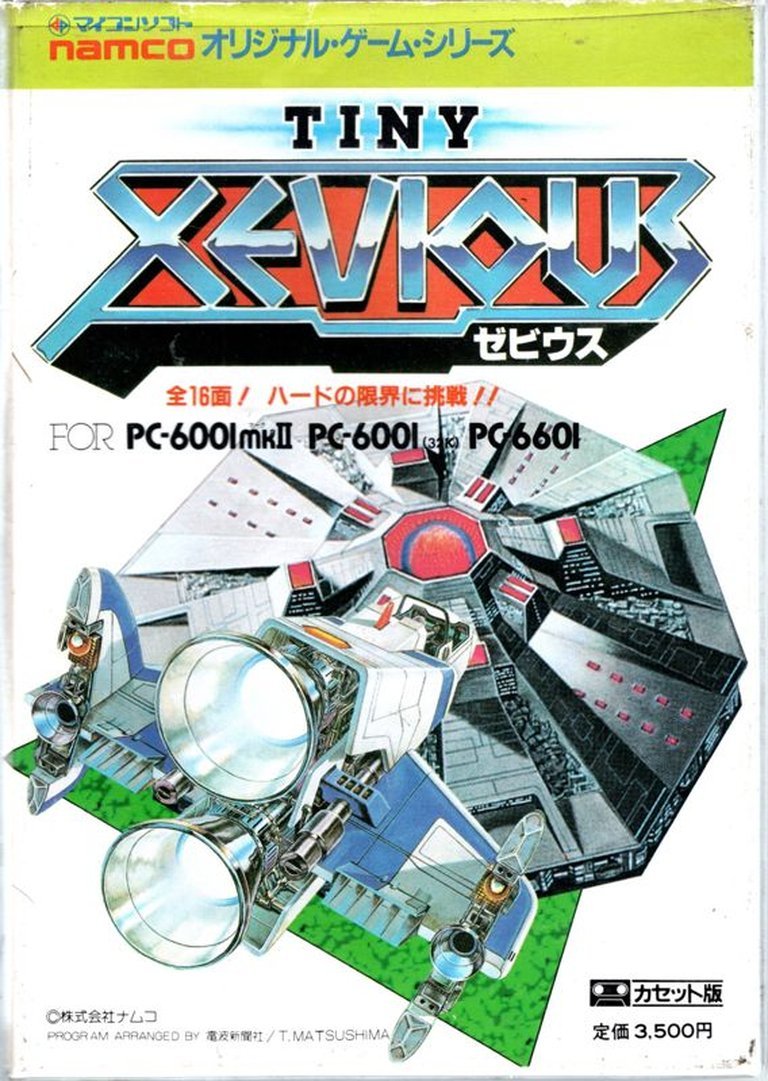
Description
Xevious is a vertically-scrolling shooter set in a sci-fi world where an ancient civilization, the Xevians, returns to Earth to reclaim their homeland. Players control the Solvalou, a prototype fighter craft, battling both aerial and ground-based enemies using two distinct weapons: the Zapper for air targets and the Blaster for ground threats. The game is notable for its innovative dual-weapon system and its unique setting, blending futuristic combat with Earth’s landscapes.
Gameplay Videos
Where to Buy Xevious
PC
Xevious Free Download
Xevious Cracks & Fixes
Xevious Mods
Xevious Guides & Walkthroughs
Xevious Reviews & Reception
metacritic.com (80/100): My only gripe with this game applies to all of the 3D Classics titles, and that’s the lack of an online leaderboard.
retrogamesnow.co.uk : Xevious may not have absorbed all the conceptual advances of the last three decades, but its appeal, even reduced, remains and, just for that, deserves to be revisited.
oldschoolarcaderoom.com : Xevious is considered one of the pioneering titles in the vertical-scrolling shoot ’em up genre and is often credited with setting many of the standards for future games in the genre.
arcade-history.com : Xevious (pronounced ‘zeevious’) is a vertically-scrolling shoot-em-up in which the player pilots the heavily-armed ‘Solvalou’ combat ship and must destroy the evil Xevious forces trying to take over the planet.
Xevious Cheats & Codes
NES (Game Genie)
Enter codes using a Game Genie device or emulator.
| Code | Effect |
|---|---|
| SZLNZY | Infinite Lives |
| PAZYOG | Start With 1 Life |
| TAZYOG | Start With 6 Lives |
| PAZYOK | Start With 9 Lives |
| YZZYOK | Start With Lots Of Lives |
| SEKYKISZ | Invincibility |
| AVEVVUSL + AAOIUILP + AAXIOIIA | Hit anywhere |
GBA (CodeBreaker)
Enter codes using a CodeBreaker device or emulator.
| Code | Effect |
|---|---|
| 93ECA3A6615A | Master Code (Must Be On) |
| 9FC6E5A44451 | Master Code (Must Be On) |
| 46D391D743C3 | Master Code (Must Be On) |
| 8DEB62CA6CFB | Unlimited Lives |
| 54B49FB50354 | Invincible |
| 6A04954FD623 | Rapid Fire |
| EDC9A9CB2DFC | Start With Hi-Score |
| 8DE9E3CA2DEA | Start With Hi-Score |
GBA (GameShark)
Enter codes using a GameShark device or emulator.
| Code | Effect |
|---|---|
| 93E588E8 32D19047 | Master code (must be on) |
| E5553AEB 83299FAB | Master code (must be on) |
| C2A2D54A 68785321 | Infinite lives |
| 1D8DE86B 9D484981 | Invincibility |
| 3FFBA671 65BAF78B | Hit anywhere |
| EC4CC5EE 06796718 | Hit anywhere |
| 0F99CABF EDA70C6E | Hit anywhere |
| F40D149C 11CDB639 | Rapid fire |
| 88FC9A00 CD9DEBF5 | Start with a high score |
| 0C11A8FF 4FE57EC0 | Start with a high score |
Xevious: A Comprehensive Retrospective of a Genre-Defining Classic
Introduction
In the pantheon of arcade shooters, few titles resonate with the historical significance and enduring influence of Xevious. Released in 1982 by Namco, this vertically scrolling shooter didn’t just refine the genre—it redefined it, introducing mechanics, aesthetics, and narrative depth that would echo through decades of game design. Xevious was more than a game; it was a cultural artifact, a technological marvel, and a blueprint for future shooters. This review delves into its development, gameplay, legacy, and the reasons it remains a touchstone for both historians and enthusiasts of the medium.
Development History & Context
The Birth of a Vision
Xevious emerged from the creative mind of Masanobu Endō, a programmer who joined Namco in 1981 with no prior game development experience. Tasked with creating a competitor to Konami’s Scramble, Endō and his small team initially conceptualized a Vietnam War-themed helicopter shooter titled Cheyenne. However, the project evolved into a science fiction epic, drawing inspiration from films like 2001: A Space Odyssey and Star Wars. Endō’s ambition was to craft a game with a cohesive world and storyline, a rarity in an era where narratives were often afterthoughts.
Technological Innovations
Running on the Namco Galaga hardware, Xevious pushed the limits of arcade technology. The team employed ray-tracing techniques, using shades of gray to create detailed sprites that conveyed depth and texture. This approach allowed for a level of visual fidelity unseen in previous shooters. The game’s dual-weapon system—a forward-firing “Zapper” for air enemies and a bomb-dropping “Blaster” for ground targets—was another innovation, requiring players to manage both horizontal and vertical threats simultaneously.
The Arcade Landscape of 1982
The early 1980s were a golden age for arcade gaming, with titles like Pac-Man, Galaga, and Donkey Kong dominating the scene. Xevious entered this competitive space as a vertically scrolling shooter, a subgenre still in its infancy. Its release in Japan in January 1983 was met with unprecedented success, breaking sales records and becoming Namco’s biggest hit since Space Invaders. In North America, Atari distributed the game under the slogan “The Atari game you can’t play at home,” a marketing tactic that underscored its arcade exclusivity.
Narrative & Thematic Deep Dive
The Lore of Xevious
Xevious is set in a universe where an ancient civilization, fleeing Earth during the Ice Age, settled on the planet Xevious. The remnants of this civilization, now known as the Xevians, return to reclaim Earth, led by the sentient supercomputer GAMP (General Artificial Matrix Producer). The player assumes the role of Mu, piloting the Solvalou spacecraft alongside his android companion Eve and the Xevian rebel Mio. This backstory, though minimal in the arcade version, was expanded in later media, including novels and sequels.
Themes of Invasion and Resistance
At its core, Xevious explores themes of invasion, resistance, and technological hubris. The Xevians, once human, have become an alien force seeking to reclaim their lost homeland. The game’s narrative framing—where humanity is both the invader and the invaded—adds a layer of moral complexity rare for its time. The GAMP supercomputer, a recurring antagonist, embodies the dangers of unchecked artificial intelligence, a theme that would resonate in later sci-fi works.
The Influence of Science Fiction
The game’s aesthetic and enemy designs are steeped in science fiction iconography. The Solvalou’s design is reminiscent of the Nostromo from Alien, while enemies like the Andor Genesis mothership and Bacura shields draw from Star Wars and Battlestar Galactica. The inclusion of Nazca Lines in the game’s terrain further grounds its sci-fi narrative in real-world mystery, blending the alien with the ancient.
Gameplay Mechanics & Systems
Core Gameplay Loop
Xevious is a vertically scrolling shooter where the player navigates the Solvalou through 16 distinct areas, each with unique terrain and enemy formations. The game’s dual-weapon system is its defining feature:
– Zapper: A forward-firing weapon for aerial enemies.
– Blaster: A bomb-dropping weapon for ground targets, aided by a lock-on reticle that flashes red when over an enemy.
This mechanic introduced strategic depth, requiring players to prioritize threats and manage both air and ground combat simultaneously.
Enemy Variety and Behavior
The game features a diverse roster of enemies, each with distinct attack patterns:
– Aerial Enemies: Including the Toroid (ring-shaped fighters), Zakato (exploding black spheres), and Bacura (indestructible rotating shields).
– Ground Enemies: Such as the Grobda (tanks), Derota (gun batteries), and Sol Citadels (hidden towers).
The Andor Genesis mothership, appearing in select areas, serves as one of gaming’s earliest boss fights, requiring players to destroy its core or blaster receptacles.
Dynamic Difficulty and Adaptive AI
Xevious pioneered dynamic difficulty adjustment, where the game adapts to the player’s skill level. If a player excels against a particular enemy type, the game introduces more advanced variants. Conversely, destroying Zolback radars (flashing red ground targets) resets the difficulty to easier enemies. This system ensured a consistently challenging experience tailored to the player’s proficiency.
Secrets and Easter Eggs
The game is renowned for its hidden secrets, including:
– Sol Citadels: Hidden underground structures that award points when bombed.
– Special Flags: Hidden throughout the game, granting extra lives when uncovered and collected.
– Developer Message: A hidden Easter egg displaying “NAMCO ORIGINAL Program by EVEZOO” when performing a specific maneuver at the game’s start.
These elements encouraged exploration and replayability, a novelty in arcade games of the era.
World-Building, Art & Sound
Visual Design and Atmosphere
Xevious’s visuals were revolutionary for 1982. The game’s detailed terrain, including forests, rivers, and Nazca Lines, created a sense of immersion unprecedented in arcade shooters. The use of shades of gray and palette-shifting allowed for intricate sprite designs, making enemies and environments visually distinct. The vertical scrolling mechanic, combined with the Solvalou’s lock-on reticle, gave players a tactical overview of the battlefield.
Sound Design and Music
Composed by Yuriko Keino, Xevious’ sound design was equally groundbreaking. The game’s iconic main theme, with its wind chime-like sound effects, became synonymous with the arcade experience. The explosion sounds and enemy fire were rendered with discrete circuitry, adding a tactile feel to the gameplay. The soundtrack’s minimalist yet memorable composition complemented the game’s sci-fi aesthetic.
Cabinet and Presentation
The arcade cabinet featured sleek, futuristic artwork, with the Solvalou prominently displayed in battle. The attract mode showcased the game’s dynamic environments and enemy encounters, drawing players in with its cinematic presentation. The upright and cocktail cabinets became staples of arcades, with Atari’s North American release featuring distinctive bezel artwork that emphasized the game’s sci-fi themes.
Reception & Legacy
Critical and Commercial Success
Xevious was a critical and commercial triumph, particularly in Japan, where it outsold Space Invaders in its early weeks. Critics praised its detailed graphics, innovative gameplay, and adaptive difficulty. In North America, while not as dominant, it still sold 5,295 arcade units by the end of 1983, grossing over $11 million.
Influence on the Shooter Genre
Xevious is widely regarded as the “father of vertically scrolling shooters”, establishing templates that influenced titles like TwinBee, RayForce, and Raiden. Its dual-weapon system, boss fights, and dynamic difficulty became staples of the genre. The game’s hidden secrets and Easter eggs also set a precedent for exploration-based gameplay in shooters.
Ports, Sequels, and Compilations
The game’s success led to numerous ports, including releases on the NES, Atari 7800, and Game Boy Advance. Sequels like Super Xevious (1984) and Xevious 3D/G (1995) expanded on its mechanics, while compilations like Namco Museum ensured its preservation. The 3D Classics: Xevious (2011) for the Nintendo 3DS introduced stereoscopic 3D, revitalizing the game for modern audiences.
Cultural Impact
Xevious transcended gaming, inspiring music, literature, and even television. Japanese musician Haruomi Hosono of Yellow Magic Orchestra produced an album featuring Xevious’ soundtrack, while the game’s Nazca Lines and Andor Genesis became iconic symbols of arcade culture. Its television commercial, the first for an arcade game, cemented its place in pop culture history.
Conclusion: The Enduring Legacy of Xevious
Xevious is more than a relic of the arcade era—it is a foundational text in the history of video games. Its innovations in gameplay, visuals, and narrative set the stage for generations of shooters, while its cultural impact extends beyond gaming into music and media. Though later titles may have surpassed it in complexity and spectacle, Xevious remains a timeless classic, a testament to the creativity and ambition of its developers.
For modern players, Xevious offers a glimpse into the origins of the shooter genre, a chance to experience the raw, unfiltered challenge of early arcade design. Its dual-weapon system, adaptive difficulty, and hidden secrets continue to inspire, proving that great gameplay is eternal. Whether played in its original arcade form or through modern compilations, Xevious stands as a monument to innovation, a game that dared to redefine what a shooter could be.
Final Verdict: 9.5/10 – A Genre-Defining Masterpiece
Xevious is not just a game; it is a milestone, a blueprint, and a legend. Its influence is immeasurable, its legacy undeniable. For anyone interested in the history of video games, Xevious is essential playing.