
- Release Year: 2008
- Platforms: Windows
- Publisher: 1C Company
- Genre: Special edition
- Average Score: 70/100
Description
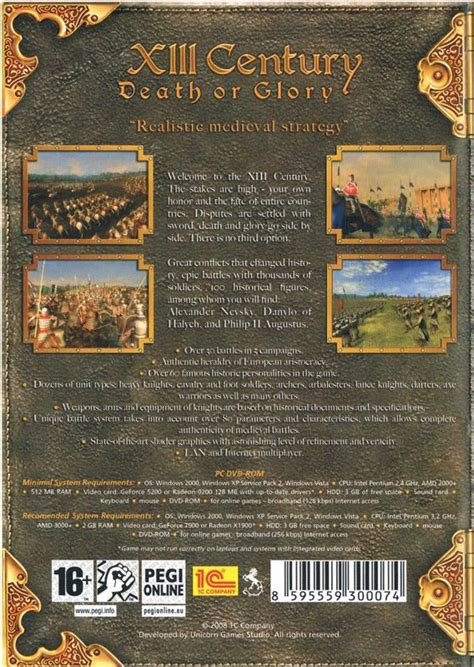
XIII Century: Smrt, nebo vítězství (Limitovaná Sběratelská Edice) is a historical real-time strategy game set in the tumultuous 13th century, immersing players in medieval Europe’s epic conflicts. Players lead iconic factions like the French, English, Germans, and Russians through meticulously recreated battles such as Bouvines and Las Navas de Tolosa, featuring thousands of units, realistic terrain, and dynamic weather. The game offers five campaigns, historically accurate scenarios, and diverse unit types, from knights to archers. This collector’s edition enhances the experience with physical extras like a 12cm figurine, postcards, stickers, a map, and a poster.
XIII Century: Smrt, nebo vítězství (Limitovaná Sběratelská Edice) Cracks & Fixes
XIII Century: Smrt, nebo vítězství (Limitovaná Sběratelská Edice) Reviews & Reception
games.tiscali.cz (60/100): Se stejným námětem, ale výrazně odlišným provedením přichází se svou troškou do mlýna i novinka od ukrajinských vývojářů.
zpravy.aktualne.cz : Hra to tedy není špatná, ale patří spíše do průměru.
hry-pro-pc.heureka.cz (80/100): Obrovské epické bitvy, pět rozdílných kampaní, různorodé, národově rozlišené jednotky a nespočet taktických možností.
XIII Century: Smrt, nebo vítězství (Limitovaná Sběratelská Edice): Review
Introduction
In the shadow of giants like Medieval II: Total War, XIII Century: Smrt, nebo vítězství (Limitovaná Sběratelská Edice) emerged in 2008 as a bold but flawed contender in the medieval real-time strategy (RTS) genre. Developed by Unicorn Games Studio and published by 1C Company, this Czech-language collector’s edition sought to immerse players in historically precise battles of the 13th century, bundled with lavish physical extras. Yet, beneath its ambition lay a game hamstrung by technical limitations and design missteps. This review dissects its legacy, mechanics, and place in gaming history, revealing why it remains a curio for collectors rather than a classic.
Developer History & Context
The Studio and Vision
Unicorn Games Studio, a Ukrainian developer under 1C’s umbrella, aimed to create a historically rigorous RTS focused exclusively on battlefield tactics—eschewing the grand strategy layer of contemporaries like Total War. Released in an era dominated by Age of Empires III (2005) and Medieval II: Total War (2006), XIII Century targeted players craving authenticity over empire-building.
Technological Constraints
Built on a proprietary engine, the game prioritized accessibility, running smoothly on modest 2008-era PCs (Pentium 2.4 GHz, 512 MB RAM, GeForce 5200). However, this came at a cost: Unit animations were stiff, terrain textures lacked detail, and the AI struggled with pathfinding. The absence of a strategic campaign map—a hallmark of Total War—further narrowed its scope, reflecting budgetary and technical limitations.
The Gaming Landscape
In 2008, the RTS genre was evolving toward hybrid models (e.g., Dawn of War II’s tactical focus). XIII Century’s rigid adherence to historical accuracy—preset armies, fixed battle conditions—felt out of step, offering little replayability beyond its linear campaigns.
Narrative & Thematic Deep Dive
Historical Fidelity Over Storytelling
XIII Century dispenses with traditional narrative, framing its five campaigns (England, France, Germany, Russia, Mongol Empire) as reenactments of pivotal battles like Falkirk (1298) and Moravian Field (1278). Each mission opens with an in-game cinematic detailing historical context—weather, terrain, troop composition—mirroring archival records. While educational, this approach sacrifices character development or emotional stakes. The Czech localization (subtitles and manual) adds regional appeal but doesn’t deepen the experience.
Themes of Honor and Chaos
The game’s title—”Death or Glory”—epitomizes its thematic core: the brutal calculus of medieval warfare. Units exhibit distinct national traits (e.g., English longbowmen, Mongol cavalry), and morale systems force players to manage fatigue and panic. Yet, the lack of diplomatic or economic layers reduces warfare to a series of scripted clashes, devoid of political nuance.
Gameplay Mechanics & Systems
Core Loop: Tactical Optimization
Gameplay revolves around pre-battle preparation and real-time execution. Players command preset armies across historically accurate maps, using terrain (hills, rivers, chokepoints) to outmaneuver foes. The “rock-paper-scissors” unit dynamic shines—cavalry crush archers, spearmen repel cavalry—but uneven AI undermines strategy:
– Morale Mechanics: Units flee under arrow volleys or flanking attacks, but morale drains too quickly, turning battles into routs.
– Formation Woes: Custom formations (e.g., wedge, shield wall) promise depth but suffer from clunky controls and desynchronization.
– Scripted AI: Enemies follow predictable patterns, nullifying replay value.
Innovations and Flaws
The game’s sole innovation—a “pause-and-plan” feature—lets players issue commands mid-battle, mitigating micromanagement. However, pathfinding glitches, unresponsive units, and the absence of stealth mechanics (e.g., hiding in forests) frustrate tactical play. The “Freestyle Battle” mode (skirmishes with customizable armies) and multiplayer (2–4 players) offer fleeting diversion but lack balance.
World-Building, Art & Sound
Visuals: Functional but Dated
XIII Century’s graphics were unremarkable even for 2008. Unit models are low-poly and repetitive, with jarringly synced animations. Terrain—while geographically authentic—lacks detail, though maps like Taillebourg’s riverbanks showcase thoughtful design. The collector’s edition’s 12 cm knight figurine and poster evoke medieval grandeur absent in-game.
Sound Design: A Missed Opportunity
A sparse orchestral score loops incessantly, fading into background noise. Battle sounds—clashing steel, cavalry charges—are serviceable but lack impact. The Czech voice acting for narrations adds local flavor but highlights the absence of full dubbing.
Atmosphere: History Textbook, Not Epic
The game’s commitment to realism—down to weather effects—creates an educational tone. However, without dynamic storytelling or visual flair, battles feel clinical, not cinematic.
Reception & Legacy
Launch Reception
Critics panned XIII Century’s shortcomings. Czech outlets like Computerworld (5.5/10) and Games.tiscali.cz (6/10) praised its historical rigor but lambasted AI, repetitive campaigns, and “lifeless” graphics. The StarForce DRM drew ire for compatibility issues. Commercially, it flopped, overshadowed by Total War and Age of Empires.
Enduring Influence
The game’s legacy is niche. Its focus on exact battle replication influenced later titles like Ultimate General: Gettysburg, but its flaws cemented it as a footnote. The collector’s edition—now a rare oddity—appeals solely to medievalists and physical-media enthusiasts.
Conclusion
A Collector’s Item, Not a Classic
XIII Century: Smrt, nebo vítězství (Limitovaná Sběratelská Edice) is a paradoxical artifact. Its physical extras—figurines, maps, postcards—are lovingly crafted, appealing to history buffs. Yet, the game itself is a testament to unrealized ambition: a rigid, technically uneven RTS that prioritizes authenticity over engagement. While it earns points for educational value and Czech localization, it fails to escape the shadow of its genre peers. For €10 bargain bins, it’s a curious diversion; for gaming historians, a cautionary tale of ambition vs. execution.
Final Verdict: A middling strategy title preserved only by its collector’s trappings—5/10 for gameplay, 7/10 as a historical artifact.