
- Release Year: 2011
- Platforms: Windows, Xbox 360
- Publisher: Atari, Inc.
- Developer: Killspace Entertainment
- Genre: Action
- Perspective: Behind view
- Game Mode: Co-op, Single-player
- Gameplay: Arcade, Enemy pickups, Power-ups, Rail shooter, Shooter, Targeting
- Setting: Futuristic, Sci-fi
- Average Score: 57/100
Description
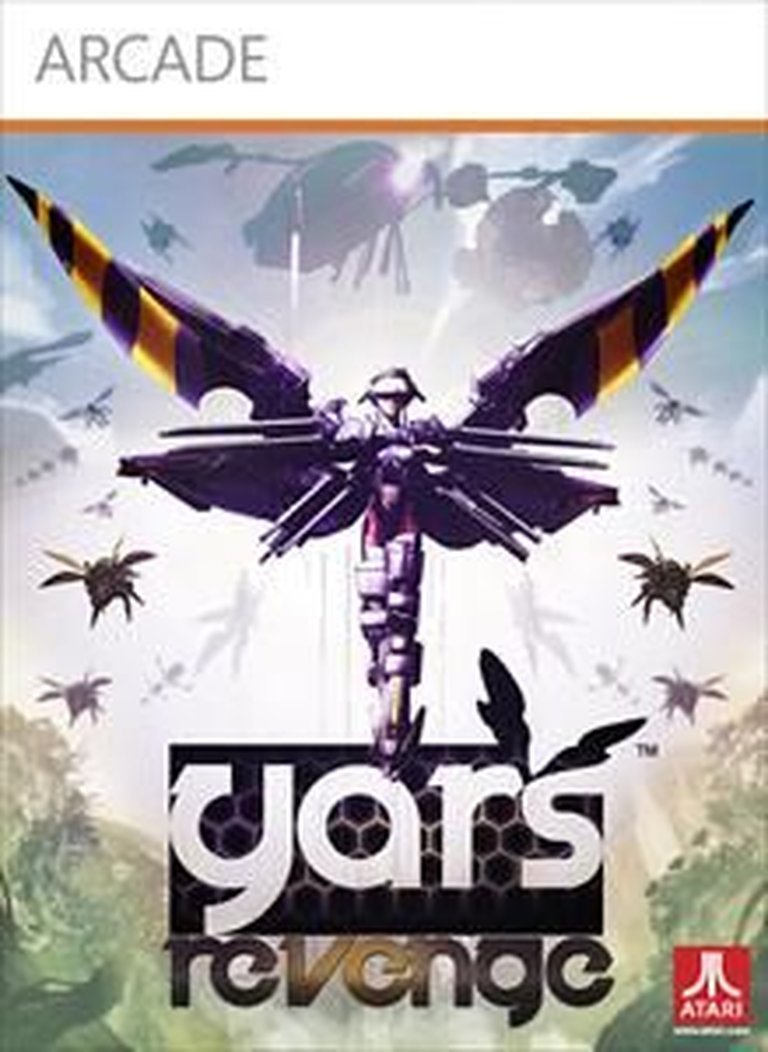
Yar’s Revenge reimagines the classic Atari 2600 game as a third-person rail shooter set in a futuristic sci-fi galaxy. Players control a young female Yar who, after being rescued by an ancient Yar, learns of her people’s enslavement by the evil Qotile and embarks on a quest for revenge. The game features auto-forward movement, aiming mechanics, and combat against waves of enemies with weapons like pulse lasers and railguns, alongside power-ups and a health shield system.
Gameplay Videos
Where to Buy Yar’s Revenge
PC
Yar’s Revenge Reviews & Reception
metacritic.com (55/100): What kicks this game into the frustration bucket more than anything else is that control system.
en.wikipedia.org (55/100): The game received mixed reviews from critics, who praised its graphics, but criticized its gameplay, sound, and lack of voice acting or online multiplayer functionality, calling it difficult to recommend even at its relatively low price point.
newbreview.com : For me, the game suffers from one problem: there’s just not enough.
steambase.io (63/100): Yar’s Revenge has earned a Player Score of 63 / 100. This score is calculated from 82 total reviews which give it a rating of Mixed.
consolemonster.com : Still, the biggest problem with Yar’s Revenge is that it’s plain dull.
Yar’s Revenge: Review
Introduction
In the ever-shifting landscape of video game remakes, few transformations are as radical as the 2011 reimagining of Atari’s 1982 classic, Yar’s Revenge. While the original Yars’ Revenge was a minimalist, abstract shooter on the Atari 2600—praised for its innovative mechanics and haunting simplicity—its 2011 successor is a bombastic, anime-infused rail shooter that bears only the faintest resemblance to its progenitor. This review argues that Yar’s Revenge represents a fascinating but flawed experiment: a visually stunning, thematically ambitious game whose core gameplay and narrative execution ultimately fail to honor its legacy or deliver a satisfying experience. By dissecting its development, design, and reception, we uncover a tale of squandered potential, where artistic ambition clashes with mechanical inadequacy.
Development History & Context
Yar’s Revenge emerged from Killspace Entertainment, a studio founded by veterans of Obsidian Entertainment, Pandemic Studios, and EA Los Angeles. Their portfolio leaned toward sprawling action-adventure games, making their pivot to a rail shooter for Atari a significant departure. Atari, seeking to revitalize the Yars franchise with “something new and exciting,” greenlit Killspace’s vision: a third-person shooter heavily inspired by the anime aesthetic of Hayao Miyazaki and the gameplay of rail shooters like Panzer Dragoon and Sin and Punishment. The team, led by artist Evan Cagle (a self-proclaimed anime fan), aimed for “fast and frenetic” combat, leveraging middleware like Gamebryo and Wwise to realize their sci-fi epic on Xbox 360 and PC platforms.
Released in April 2011, the game arrived during a pivotal moment for digital distribution. Xbox Live Arcade and Steam were maturing, and HD remakes of retro classics were in vogue. Yet, the project’s ambition outstripped its execution. Killspace’s inexperience with rail-shooter mechanics, combined with Atari’s relatively modest budget, resulted in a product that felt technically competent but creatively constrained. The studio dissolved shortly after the game’s launch, leaving Yar’s Revenge as their sole—and final—major project.
Narrative & Thematic Deep Dive
The narrative of Yar’s Revenge is its most audacious departure from the 1982 original. Where the classic offered a cryptic backstory in its manual and comic, the 2011 game adopts a full-blown anime plot: a nameless female Yar is enslaved and brainwashed by the tyrannical Qotile empire. After being shot down and rescued by an ancient Yar sage named Bar Yargler, she undergoes a philosophical awakening, embracing her heritage and embarking on a quest for vengeance to restore peace. This tale of rebellion and redemption is presented through two mediums: breathtaking, hand-drawn cutscenes and on-screen text boxes during gameplay.
Thematically, the game explores freedom versus oppression, cyclical violence, and the cost of retribution. The Qotile represent a faceless imperial force, while the Yar are portrayed as noble, four-armed humanoids, their insectoid origins reimagined as cybernetic armor. However, the narrative falters in execution. Dialogue is stilted and third-person (“The Yar braces herself for the inevitable counterattack“), and the absence of voice acting forces players to read text amidst chaotic combat. As newbreview.com noted, this makes the story “impossible to follow,” reducing themes of liberation to background noise. The potential for a profound allegory about indoctrination is squandered by poor writing, leaving the narrative as a series of disjointed, philosophical musings that feel more pretentious than poignant.
Gameplay Mechanics & Systems
At its core, Yar’s Revenge is a rail shooter, but its mechanics are defined by a fundamental dichotomy: on-rails movement and independent aiming. The player’s Yar automatically progresses along predefined paths, while the right analog controls a targeting reticle for shooting. Primary weapons include a rapid-fire pulse laser (unlimited ammo) and a powerful railgun with a cooldown period, supplemented by homing missiles that can target up to six enemies at once. Power-ups—annihilator (damage boost), seeker (auto-targeting), and defender (projectile shield)—add tactical depth but are undermined by their activation, which pauses reticle movement.
The dual-stick control scheme is the game’s most contentious feature. Critics universally condemned it for making simultaneous aiming and evasion feel “inelegant” (Eurog) and “frustrating” (411mania). Movement and shooting are divorced, forcing players to navigate a minefield of visual clutter: enemies, projectiles, and power-ups often blend into a chaotic “mess of colour” (newbreview), especially in co-op mode. Multiplayer is limited to local split-screen, with two players sharing screen space—a feature that, as Console Monster observed, “makes the game harder” and visually indecipherable. The scoring system, which rewards sustained combat via a multiplier gauge, incentivizes aggression but reveals the game’s repetitive loop: levels are linear, enemy variety is sparse (three major types, per IGN), and boss fights lack grandeur. Ultimately, the gameplay feels more like a tech demo than a cohesive experience, prioritizing visual spectacle over player agency.
World-Building, Art & Sound
Yar’s Revenge’s greatest triumph lies in its world-building and art direction. Environments draw clear inspiration from Miyazaki’s works, featuring lush, bioluminescent landscapes, crumbling futuristic ruins, and sky-high vistas rendered in vibrant cel-shaded graphics. The cutscenes, produced by concept director Evan Cagle, are a standout—animated with the fluidity and expressiveness of Studio Ghibli, they elevate the game’s anime aesthetic to near-cinematic levels. As Polygon noted, the original Yars’ Revenge’s “neutral zone” was a technical marvel; here, its spiritual successor is the game’s entire tapestry of colors and movement.
Sound design, however, is a mixed bag. The techno-infused soundtrack complements the futuristic setting, but its repetitive nature fails to evoke tension or awe. Sound effects—laser blasts, explosions—are functional but unremarkable. The glaring omission is voice acting; text-only dialogue during combat renders the narrative inaccessible, a point repeatedly cited by critics like IGN UK, who argued that “poor voice acting would have been better than none.” This silence underscores a broader disconnect: a game so visually rich yet sonically sparse, its world felt more like a diorama than a living, breathing galaxy.
Reception & Legacy
Upon release, Yar’s Revenge received mixed-to-negative reviews, reflecting its identity as a game of striking highs and jarring lows. On Metacritic, it scored 55/100 (Xbox 360) and 56/100 (PC), with critics praising its art but lambasting its gameplay. GameSpot labeled it a “prime example of squandered potential,” while Eurogamer derided its controls as “inelegant.” Players on Steam echoed these sentiments, awarding a mixed score of 63/100, with complaints about repetition and co-op frustration.
Commercially, the game underperformed, overshadowed by bigger titles and failing to resonate with fans of the original. Its legacy is thus one of cautionary curiosity—a case study in ambitious reboots gone awry. While it did not spawn a sequel (Killspace closed in 2012), it remains a footnote in Atari’s history, occasionally referenced in discussions of “misguided remakes.” Notably, Howard Scott Warshaw, creator of the 1982 original, expressed disappointment, stating the rail-shooter format lacked the original’s freedom of movement—a sentiment that underscores the chasm between the two titles’ philosophies.
Conclusion
Yar’s Revenge is a paradox: a game of breathtaking beauty and profound ambition that collapses under the weight of its own mechanical and narrative flaws. Its anime-inspired art and philosophical themes represent a bold reimagining of Atari’s dormant franchise, yet repetitive gameplay, frustrating controls, and a disjointed story prevent it from transcending mediocrity. As Console Monster aptly summarized, it holds its own visually but “lacks the fundamental elements” that define great rail shooters.
For fans of the 1982 classic, this reboot is a bitter pill—stripped of the minimalist genius that made the original timeless. For modern players, it serves as a reminder that style without substance is fleeting. In the end, Yar’s Revenge is a noble failure: a beautiful, hollow vessel that honors the Yars name in appearance alone. Its place in gaming history is secured not as a classic, but as a cautionary tale of ambition undone.