
- Release Year: 1997
- Platforms: Macintosh, Windows 16-bit, Windows
- Publisher: Berkeley Systems, Inc., Jackbox Games, Inc., Sierra On-Line, Inc.
- Developer: Berkeley Systems, Inc., Jellyvision Games, Inc.
- Genre: Strategy, Tactics
- Perspective: First-person
- Game Mode: Co-op, Single-player
- Gameplay: Fill-in-the-blank, Game show, Multiple Choice, quiz, Time limit, trivia
- Setting: Game show
- Average Score: 84/100
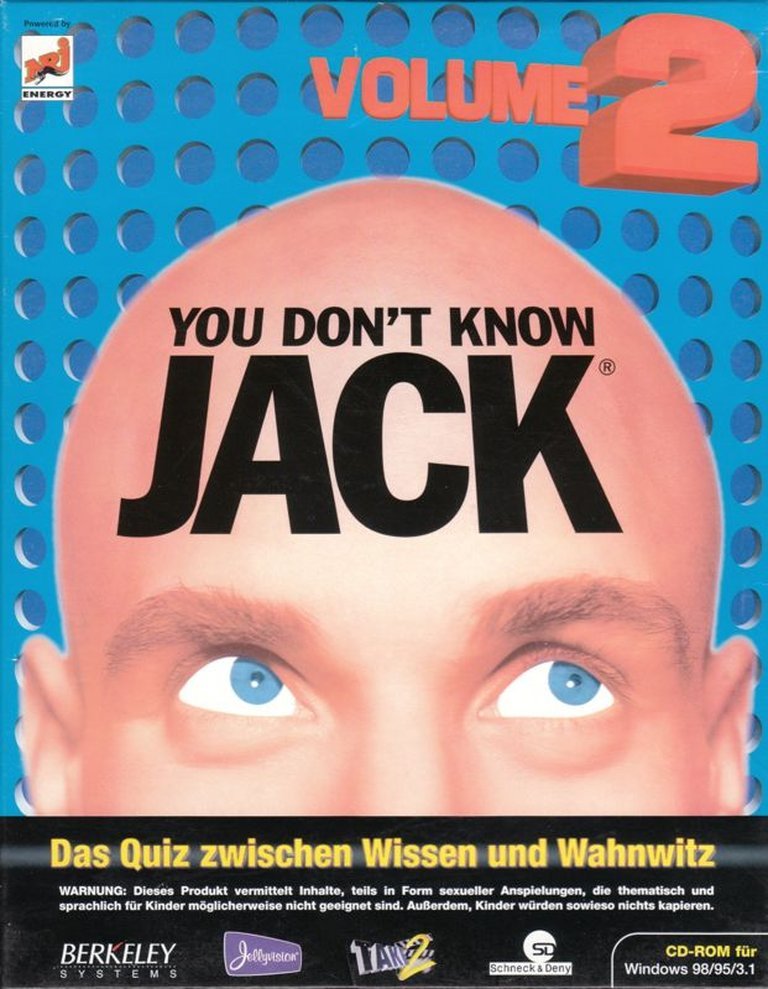
Description
You Don’t Know Jack: Volume 3 is a humorous, sarcasm-laced trivia game for up to three players, parodies the Jeopardy! TV game show format. Players compete in 9 or 21-question games, answering multiple-choice, fill-in-the-blank, rhyming, jumbled word, and audio/visual questions across categories, culminating in the ‘Jack Attack’ matching round. This third installment introduces new categories, questions, and features while maintaining the series’ signature irreverent style and timed gameplay.
Gameplay Videos
Where to Buy You Don’t Know Jack: Volume 3
PC
You Don’t Know Jack: Volume 3 Free Download
You Don’t Know Jack: Volume 3 Cracks & Fixes
You Don’t Know Jack: Volume 3 Guides & Walkthroughs
You Don’t Know Jack: Volume 3 Reviews & Reception
gamefaqs.gamespot.com : You Don’t Know Jack Volume 3 (YDKJ3), for example, is a great quiz show game.
mobygames.com (80/100): A real fun game to play with friends
niklasnotes.com (88/100): Overall, ‘YOU DON’T KNOW JACK Vol. 3’ is celebrated for its nostalgic value, humor, and engaging trivia, making it a fun choice for parties.
You Don’t Know Jack: Volume 3 Cheats & Codes
PC Windows
Enter the text strings shown below either as your name, in response to a gibberish question, or during the high score screen to trigger hidden effects.
| Code | Effect |
|---|---|
| F**k You | When entered as an answer to a gibberish question, the host gets angry, gives a harsher response, and can change the name given to you in the game. |
| f@#k you | Inputting this variation at a gibberish question triggers the host’s punishment routine, resulting in new names and different comments for each time it’s used in a single game. |
| Press B repeatedly at the high‑score screen | While in the high‑score screen, continuously pressing the B button triggers the game’s bloopers sequence during commercial breaks. |
You Don’t Know Jack: Volume 3: Review
Introduction
To step into the digital green room of You Don’t Know Jack: Volume 3 in 1997 was to willingly submit oneself to a uniquely American form of intellectual humiliation and gleeful absurdity. More than just a trivia game, it was a cultural artifact, a satirical distillation of the late-90s quiz show boom filtered through the lens of Gen-X cynicism and razor-sharp wit. As the seventh installment in the series and the third general knowledge volume, Volume 3 arrived not as a radical reinvention, but as a masterful refinement, solidifying the formula that made its predecessors phenomena. Its legacy lies not merely in its sales figures (over 4.5 million units for the entire series by 2008) or awards (including a 1997 Spotlight Award nomination), but in its irrefutable proof that a game could simultaneously challenge intellect, provoke belly laughs, and ruthlessly mock its own players. This review delves deep into the mechanics, humor, and cultural resonance of YDKJ3, arguing it represents a zenith of the interactive quiz format and a timeless template for multiplayer social gaming.
Development History & Context
YDKJ Volume 3 emerged from the fertile, if chaotic, creative crucible of Berkeley Systems and its partner, Jellyvision (later Jackbox Games). Building on the foundation laid by the 1995 original and its 1996 sequel (Volume 2), the third iteration honed the signature “high culture meets pop-culture collision” philosophy. The development, helmed by producers Martin Streicher and Julie Stroud, with technical direction from Craig Sterry and art direction from Liz Newell, faced the technological constraints of the mid-90s CD-ROM era. While allowing for richer multimedia than floppy disks – enabling the inclusion of sound questions (“Super Audio”), picture questions, complex animations (like the “sparkles” for question introductions), and the infamous “dance numbers” – these assets still required careful sequencing to avoid bottlenecks on the hardware of the time (Windows 3.x, Windows 95, Macintosh).
The gaming landscape in 1997 was a fascinating juxtaposition. On one hand, the PC market was saturated with point-and-click adventures, real-time strategy games, and burgeoning 3D titles like Quake and Tomb Raider. On the other, the social, accessible nature of trivia games held significant appeal, amplified by the cultural zeitgeist of quiz shows like Who Wants to Be a Millionaire? (which wouldn’t hit the UK until 1998 but was in development). YDKJ3 positioned itself as the antithesis of mainstream quiz shows: irreverent, sarcastic, and unapologetically difficult. Its development was significantly influenced by its predecessors’ success and the unique “EnElectriGine” engine Jellyvision had developed, which focused heavily on branching dialogue and responsive audio over complex graphics. This engine allowed for the fluid, often unpredictable, banter between host and player that became the series’ hallmark. The release on October 31st, 1997 (Halloween), perhaps unintentionally, added a layer of thematic “spookiness” to the game’s confrontational host and punishing mechanics.
Narrative & Thematic Deep Dive
YDKJ Volume 3 doesn’t feature a traditional narrative plot in the sense of a story with a beginning, middle, and end. Its “narrative” is the constructed, self-contained universe of the eponymous fictional game show, “You Don’t Know Jack.” This universe is meticulously crafted through its structure, characters, and dialogue.
The Host, Cookie Masterson (voiced by Tom Gottlieb), is the centerpiece of this narrative. Unlike the affable Nate Shapiro or the gruff Buzz Lippman of earlier volumes, Cookie embodies a specific persona: the world-weary, sardonic, and frequently exasperated game show veteran who has seen it all and is deeply cynical about the contestants. His dialogue is the engine of the game’s humor. He delivers insults with the precision of a surgeon (“Wrong! You lose money! And your dignity!”), pokes fun at player names (“Oh, that name is original”), reacts with theatrical outrage to blunders (“You buzzed in early! You lose $500 and the respect of your peers!”), and occasionally shows flashes of bizarre enthusiasm (“Oh, I love The Impossible Question! It’s… impossible!”). His interactions create a constant, playful antagonism, framing the player not as a hero, but as a hapless contestant subject to the host’s whims.
The Green Room segment, where players enter their names before the game begins, is the narrative’s pre-show prologue. The sparse graphics – just an “On Air/Stand By” sign – focus the player’s attention entirely on the ambient sounds: producers arguing, singers rehearsing off-key, the bustling energy of a studio floor. This audio immersion immediately establishes the game show setting and Cookie’s position within it. Crucially, the game checks the system clock/date upon launch, triggering unique, often grumpy, commentary on the time of day or holidays (“Wow, up late, aren’t we?”, “Christmas Eve? Don’t you have somewhere better to be?”). This meta-humor reinforces the game’s self-awareness and its attempt to feel like a “live” broadcast.
The Themes are woven into every question and Cookie’s commentary:
1. Intellectual Humiliation & Anti-Elitism: The game relentlessly mocks players for getting answers wrong, regardless of the question’s perceived difficulty or “high culture” subject matter. It simultaneously mocks both the pretensions of deep knowledge and the ignorance of pop culture, creating a level playing field of potential failure. The infamous “Impossible Question,” worth $20,000 but often absurdly obscure (e.g., “What has 4 legs and barks?” with the answer “a dog” under the category “It’s a Dog!”), epitomizes this theme – it’s a mockery of the idea of ultimate trivia knowledge and a sucker’s bet.
2. C Satire & Pop Culture Collision: Questions deliberately blend Shakespearean trivia with 90s sitcom references, classical music with grunge lyrics. This collision isn’t just random; it satirizes cultural boundaries and the often arbitrary nature of what constitutes “important” knowledge. Categories like “What Was That?” (asking for the answer to the previous question) are meta-jabs at quiz show format rigidity.
3. The Spectacle of Failure: The game derives significant humor from the public nature of failure. Buzzing in early results in a comedic punishment (scrambled answers, nonsensical choices). The “Screw Your Neighbor” mechanic forces players to risk humiliation on behalf of others. The “Jack Attack” final round, with its flashing words and tense silence, becomes a crucible of public triumph or crushing defeat, amplified by the lack of visible scores during the round. The “DisOrDat” round, with its 30-second timer, creates frantic, often embarrassing scrambles.
4. Absurdity & Non-Sequitur: Much of the humor stems from complete non-sequiturs in Cookie’s reactions, bizarre fake commercials played before the game begins (selling products like “scented suppositories” or “Momma’s Pride Human Breast Milk”), and the sheer randomness of some question premises (“Can You Remember?” tasks players to guess what Cookie has “forgotten”).
Gameplay Mechanics & Systems
At its core, YDKJ3 is a trivia game, but its genius lies in the presentation and diversification of its question types and the social dynamics it fosters.
Core Loop: Players (1-3) enter names, choose a game length (7 or 21 questions), and then take turns selecting from three category per question. Questions are valued at $1,000, $2,000, or $3,000 in Round 1, doubling in Round 2. Players buzz in to answer multiple-choice questions. Correct answers earn the value; wrong answers lose it. The player with the most money after all questions (including the final round) wins.
Core Mechanics:
* Buzzing & Answering: Speed and accuracy are paramount. Buzzing in too early triggers a penalty.
* Screw Your Neighbor: Each player gets one “screw” per game half. Using it forces an opponent to answer the question. If the opponent is correct, they win the money, and the player who used the screw loses the value. If wrong, both lose money. This adds a crucial layer of strategy, risk, and schadenfreude.
* Game Length: The 7-question “tournament” game is a quick burst, while the 21-question “full” game allows for deeper strategy, more question types, and the potential for massive swings in fortune.
Question Type Evolution (New & Returning):
* DisOrDat ($500 per correct answer): Returning from earlier volumes, this is a solo round for the player who selected the category. Given two categories and 7 items, they must classify them within 30 seconds. It’s fast-paced, tense, and can make or break a lead.
* Gibberish Question ($5,000): A signature returning type. Players hear a nonsensical phrase rhyming with a real answer (e.g., “Pre-empt Tires, Like Crack” -> The Empire Strikes Back). The first to buzz in and type the correct answer wins the decreasing cash value. The famous “fuck you” Easter egg (deducting $50,000 or resetting score, changing the player’s name) originated here.
* Three-Way ($1,000 – always Q10): Exclusive to YDKJ3 and the PS1 port. Players see three related words (e.g., Solid, Liquid, Gas). Clues appear one by one, each matching only one word. Players buzz in when the correct word flashes on screen. Wrong buzzes lose $1,000. This introduced a rapid-paced, pattern-recognition element.
* Impossible Question! ($20,000): Exclusive to YDKJ3 and PS1 port. Worth a fortune but almost always absurdly difficult, obscure, or trick-question based (e.g., “What color eyes does the bald guy on the YDKJ Sports box have?”). It’s a high-risk, high-reward gamble that perfectly encapsulates the game’s anti-elitist humor. The “It’s a Dog!” question (What has 4 legs and barks? Answer: a dog) is legendary for its double-bluff absurdity.
* Super Audio Question: Players listen to a sound clip (e.g., a celebrity laugh, an animal call, a musical snippet) and answer a question about it. Enhanced the multimedia aspect.
* Picture Question: Similar to Super Audio, but based on an image.
* Guest Host Question: Exclusive to YDKJ3 and *The Ride.* A “guest” (often a voice actor playing a caricature) hosts a question, breaking the routine.
* Jack Attack (Final Round – $2,000 per correct match): The climactic word association round. A clue appears (e.g., “Hail to the Chef”). Words/phrases fly across the screen. Players buzz in when a word matches the clue (e.g., “Gordon Ramsay” for the clue). Correct matches earn money; incorrect buzzes lose it every time it happens for that term. The tension is palpable – scores aren’t shown, only ominous music. It’s a frantic, high-stakes test of associative thinking.
UI & Presentation: The UI is deliberately minimalistic during gameplay, focusing attention on the question text, answers, and Cookie’s vocal reactions. The “dance numbers” for each question number, the category animations, and the overall visual style (clean text, simple graphics, the “Jack Head” mascot) are functional but charming, supporting the game show aesthetic rather than overwhelming it. Sound is paramount, with Cookie’s voice, the buzzing sounds, the question timers, and the Jack Attack soundtrack creating the atmosphere.
World-Building, Art & Sound
The “world” of YDKJ3 is the constructed reality of its fictional game show. This world-building is achieved almost entirely through sound and constrained visuals.
- Setting: The primary setting is the abstracted “studio” – the green room at the start, the implied stage during gameplay, and the “post-game” where fake commercials play. It’s intentionally non-specific, allowing it to feel like a universal game show experience rather than a specific physical location.
- Visual Direction: As directed by Liz Newell and Mark Gibson, the art style is functional and iconic. The “Jack Head” – the stylized bald head logo – is omnipresent. Graphics are simple: text-based questions, multiple-choice options, basic animations for category reveals and question transitions, the “dance numbers,” and the flashing words of the Jack Attack. This minimalism focuses the player on the core interaction: listening to Cookie, reading the question, and buzzing in. The Windows 16-bit and Mac versions were well-adapted, ensuring compatibility across the era’s hardware.
- Sound Design: This is where the truly immersive world is built.
- Cookie’s Voice (Tom Gottlieb): The linchpin. Gottlieb’s performance is masterful – exasperated, witty, sarcastic, and energetic. His delivery turns simple trivia questions into comedic set pieces. His reactions are the game’s primary reward (or punishment).
- Ambiance: The green room bustle – producers talking, singers warming up, the low hum of a studio – creates instant immersion before the game even starts.
- Sound Effects: The satisfying thunk of the buzzer, the ticking countdown timers, the “ka-ching” of correct answers, the “dun-dun” of wrong answers, the escalating tension music of the Jack Attack – these are meticulously crafted to provide clear feedback and heighten the drama.
- Music: Rob Warren’s original score is catchy and varied – the upbeat intro, the quirky category jingles, the intense Jack Attack theme. It perfectly complements the game’s shifting tones.
- The Commercials: The fake radio commercials played before each game (“You Don’t Hear Jack”) are a masterclass in absurdist world-building. They sell bizarre products (“Cancer Stick Tobacco Lip Balm,” “Xenora: Queen of Battle” action figures with “overtly erotic” accessories) and deliver faux news reports (“Oxygen: Gas of Life? or Secret Military Death-Vapor?”), cementing the game’s satirical universe and providing endless laughs.
The interaction between these visual and sound elements creates a uniquely potent atmosphere: the feeling of being a contestant on a real, albeit bizarre and hostile, game show, where the host is your equal-opportunity tormentor and the studio audience (implied by the reactions) is always ready to laugh at your expense.
Reception & Legacy
YDKJ Volume 3 was met with widespread critical acclaim upon its release, solidifying the series’ position as a premier party game. Review aggregation sites like MobyGames report an average critic score of 80% based on 11 reviews, with scores ranging from a high of 97% (Electric Games) to a low of 60% (Mac Addict, which felt the formula was “wearing a teensy bit thin”). Key praise centered on its humor (“wall-to-wall sound effects, blistering humor,” “tons of wise cracks and hilarious question categories”), the polished presentation (“top notch product,” “dancing numbers for each question… makes you feel like you are on some wild game show”), and the addictive multiplayer experience (“a real fun game to play with friends,” “hardly better an [sic] an investment”). The new question types, particularly the Three-Way and Impossible Question, were highlighted as fun innovations, though the Three-Way was occasionally criticized as a “complete dud” by GameSpot.
Commercially, it was a significant success, selling alongside its predecessors to contribute to the series’ total sales exceeding 1 million units in the US by early 1998 and 3.5 million by 2001. It was frequently bundled in collections like Huge XXXL and The Irreverent Collection, extending its reach.
Its legacy, however, extends far beyond its initial sales scores:
1. Evolution of the Party Game Formula: YDKJ3 perfected the blend of trivia, humor, social interaction, and light-hearted competition that defined the modern party game. It demonstrated that success wasn’t just about the questions, but about the experience – the banter, the tension, the shared laughter at absurdity and failure. This directly influenced countless party games that followed, from the Jackbox Party Pack series (which the developer, then Jellyvision, evolved into) to titles like Trivial Pursuit digital editions and mobile quiz games.
2. Pioneering Multiplayer Social Dynamics: The “Screw Your Neighbor” mechanic, the inherent competition of buzzing in first, the reliance on shared humor and pop culture knowledge, and the requirement for multiple players to be present to maximize the fun made it a cornerstone of the couch multiplayer experience before the rise of online play. It proved that a game could thrive solely on local interaction.
3. Influence on Host/Player Interaction: The model of a witty, sarcastic, and reactive game show host became a template. Cookie Masterson, developed further in later volumes and games, became one of gaming’s most recognizable and beloved characters, known for his rapid-fire insults and fourth-wall-breaking commentary. This dynamic heavily influenced later games like Buzz! and You’re in the Movies.
4. Cultural Touchstone: It captured a specific moment – the late-90s convergence of quiz show mania and Gen-X irony. Its references and humor, while dated now, were potent then. Its memorable lines (“Wrong! But it’s funny!”), question types, and Easter eggs (like the “fuck you” response) became part of gamer folklore. The fact that it was later adapted for a short-lived ABC TV show (2001) and even a Tiger Electronics tabletop game underscores its cultural penetration.
5. Technical & Design Influence: While EnElectriGine was specific, the focus on branching dialogue trees, responsive audio, and minimal-but-effective graphics to serve the core interaction was influential. The integration of system time for unique greetings was an early example of dynamic content.
6. Enduring Playability: Despite its 90s trappings, the core formula remains engaging. Modern re-releases on Steam (often bundled in the Classic Pack) and its inclusion in the Jackbox Party Pack franchise (as trivia elements in other games) prove its timeless appeal. Its difficulty and humor still hold up in a group setting.
Conclusion
You Don’t Know Jack: Volume 3 stands not merely as a successful sequel, but as a foundational masterpiece of interactive entertainment. It represents the absolute zenith of the CD-ROM quiz game format, a meticulously crafted experience where every element – from Cookie’s withering voice to the frantic Jack Attack, from the absurd Impossible Question to the shared humiliation of a “Screw” – comes together to create something uniquely potent and unforgettable. Its genius lies in its perfect balance: challenging trivia wrapped in razor-sharp satire, demanding competition softened by self-deprecating humor, and a minimalist presentation that maximizes engagement through sound and reactive gameplay.
While its specific 90s pop culture references may date it, the core experience it delivers – the laughter born from shared failure, the tension of high-stakes trivia, the joy of outsmarting the smug host, and the simple pleasure of gathering friends around a keyboard – remains timeless. Volume 3 didn’t just perfect the You Don’t Know Jack formula; it codified the blueprint for the modern multiplayer party game. Its legacy is written in the countless games it inspired and the countless hours of laughter it continues to facilitate. It is, unequivocally, a classic, a game that truly knew its audience and gave them exactly what they wanted: an intellectual beatdown served with a side of uncontrollable giggles. Verdict: An Essential, Timeless Masterpiece.