
- Release Year: 2012
- Platforms: Android, iPad, iPhone, Macintosh, Windows
- Publisher: S.A.D. Software Vertriebs- und Produktions GmbH, Youda Games Holding B.V.
- Developer: Youda Games Holding B.V.
- Genre: Adventure
- Perspective: 1st-person
- Gameplay: Hidden object, Mini-games
- Setting: Detective, Horror, Mystery
Description
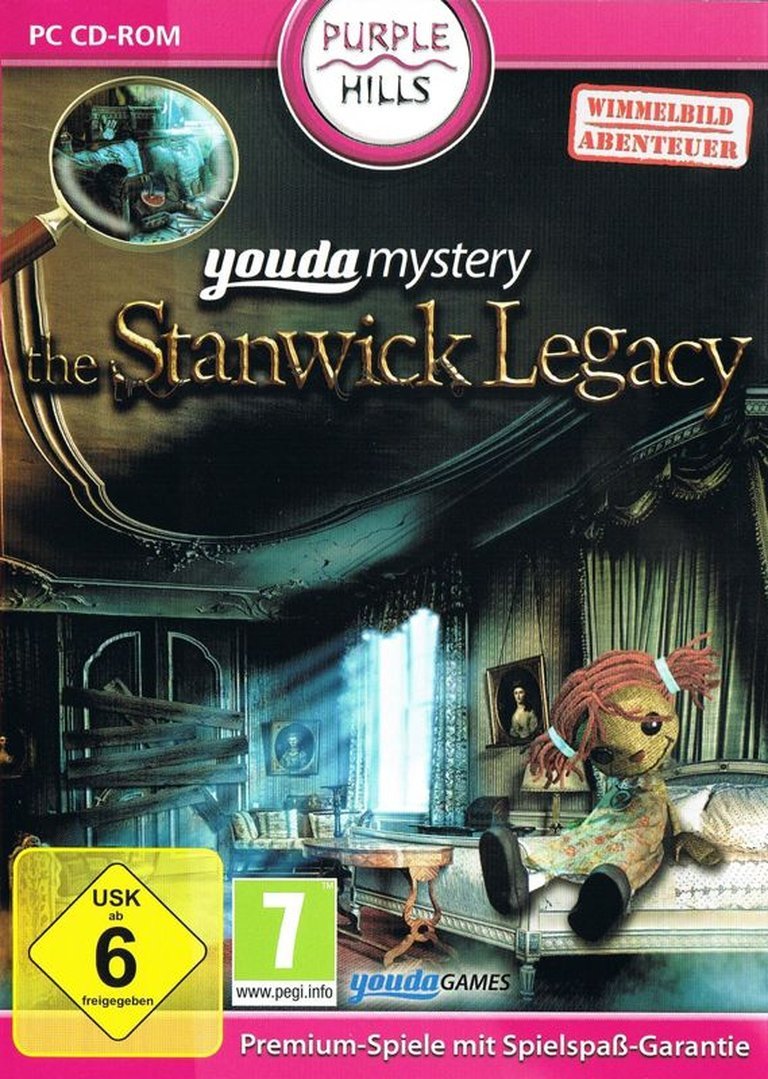
Emma, the last heir of Stanwick Manor, returns to her family’s abandoned estate after her grandfather’s death, exploring its haunting halls through hidden object searches and mini-games across four floors to uncover dark secrets and a mysterious legacy, all while encountering spooky occurrences and using her memories to solve puzzles in this non-linear detective adventure.
Gameplay Videos
Youda Mystery: The Stanwick Legacy Guides & Walkthroughs
Youda Mystery: The Stanwick Legacy Reviews & Reception
gadgetspeak.com : Put together a young woman with an inquisitive mind and an abandoned house, mix in a sprinkling of puzzles and copious amounts of hidden objects and you have all the ingredients for a Hidden Object Adventure game.
gamezebo.com : Youda Mystery: The Stanwick Legacy falls short in almost every aspect of its gameplay.
Youda Mystery: The Stanwick Legacy: A Genre Staple in the Shadows of the Mansion
Introduction: The Allure of the Abandoned Manor
In the sprawling ecosystem of casual gaming circa 2012, few settings were as reliably potent as the decaying, family-occupied manor house. It is the foundational premise for countless hidden object puzzle adventure (HOPA) games, a narrative shorthand that instantly conjures atmosphere, legacy, and latent secrets. Youda Mystery: The Stanwick Legacy, released by Dutch studio Youda Games in March 2012 for Windows (and later ported to Mac, iOS, and Android), is a quintessential embodiment of this premise. It presents itself, through its official ad copy, as “a thrilling story with an unexpected end” set within the atmospheric confines of Stanwick Manor. This review posits that while The Stanwick Legacy is a mechanically competent and atmospherically polished entry within the saturated HOPA genre of its time, it ultimately remains a derivative and somewhat stagnant work. It is a game that proficiently executes a well-established formula without significant innovation, serving more as a symptom of the genre’s creative plateau in the early 2010s than a standout milestone. Its legacy is not one of influence, but of representing the comfortable, repetitive, and commercially viable core of a casual gaming bubble at its peak.
1. Development History & Context: Youda Games and the Casual Crucible
The Studio: Youda Games (operating under Youda Games Holding B.V.) was a prolific Amsterdam-based developer and publisher specializing in a wide array of casual and browser-based titles. Their portfolio from the late 2000s to early 2010s is a masterclass in genre diversification: farming simulations (Youda Farmer series), time management games (Youda Marina), and numerous hidden object/adventure titles (Youda Legend series, Youda Survivor). The Stanwick Legacy fits squarely within their adventure/HOPA sub-line, following titles like Youda Legend: The Curse of the Amsterdam Diamond (2009). The studio operated with a clear, iterative design philosophy: identify a successful casual genre, produce a thematically distinct but mechanically similar title, and distribute it widely across PC download portals, Mac stores, and eventually mobile app stores.
Technological & Market Context: The game’s 2012 release places it in a mature era for the downloadable casual game industry. Big Fish Games, iWin, and other distributors had cemented the “collector’s edition” model with bonus content. The HOPA template was rigidly defined: a first-person, point-and-click investigation of static (or flip-screen) scenes, interleaving hidden object searches with inventory-based puzzles and simple mini-games. The Stanwick Legacy was built for this ecosystem. Its system requirements (Pentium IV 3GHz, 1GB RAM, DirectX 9) were modest even for 2012, targeting the vast installed base of casual gamers on older Windows XP/Vista/7 machines. The move to Mac and mobile (iOS/Android in 2013) was standard franchise extension, though the MacGameStore listing ominously notes a “32bit Incompatibility” and lack of support for macOS 10.15+, hinting at the technical debt and compatibility challenges these ports often faced.
The Creative Vision (or Lack Thereof): There is no evidence of a bold, singular creative vision for Stanwick Legacy. The official description and feature list are pure genre checklist:
* “Over 50 levels with 18 Hidden object levels”
* “29 challenging mini-games to open locks and find clues”
* “Non-linear gameplay”
* “An old house with lots of memories scattered throughout 4 different floors”
* “A spooky attic and a bone-chilling basement”
This reads like a specification document for a “standard premium HOPA.” The shift from the exotic, globe-trotting locations of the Youda Legend series to a single, gothic English manor is not presented as an artistic choice but as a necessary thematic variation. The game exists to fill a catalog slot, leveraging the enduring appeal of “mystery in a haunted house” with polished, if unoriginal, execution.
2. Narrative & Thematic Deep Dive: Tropes in the Attic
Plot Deconstruction: The narrative is a lean framework to justify the gameplay. Emma Stanwick, orphaned as a child after her parents’ “mysterious” deaths, was sent away by her grandfather to boarding school. Upon his recent death, she inherits Stanwick Manor, the family estate she once called home. Her return is prompted by a vague suspicion that her grandfather “didn’t tell the whole story.” The inciting incident is atmospheric: a strange light in the windows and a pervasive, “heartbeat-like” sound upon entry.
The plot unfolds through a series of discoveries: lit fireplaces, strange piping throughout the house, and paintings that move. The “memories” mechanic—where Emma’s recollections trigger solutions to “secret locks”—is the narrative’s only genuine hook, suggesting a psychological or memory-based mystery. However, the available synopses heavily imply a supernatural or sci-fi-esque twist (“Why is the fireplace lit?”, “What makes that heartbeat sound?”), leaning into a low-grade horror aesthetic (PEGI 7 rating means no real scares, just spooky ambience). The promise of an “unexpected end” and a secret she must be “clever enough” to handle suggests a climax where Emma’s choice matters, a rarity in linear HOPAs, but the sources provide no details to confirm this.
Themes & Characters: The themes are on-the-nose: Legacy vs. Truth, Memory vs. History, and The Past’s Grip on the Present. Emma is a classic HOPA protagonist: reactive, intelligent (the “inquisitive mind” noted in reviews), and defined primarily by her relationship to the location (heir, former resident). Her grandfather is the unseen MacGuffin, the “mysterious man” and inventor whose creations (the pipes, moving paintings, secret locks) form the game’s puzzle ecology. The manor itself is the true protagonist—a character defined by its secrets, its four floors, and its atmospheric rooms (spooky attic, bone-chilling basement). The narrative’s weakness is its utter reliance on genre convention. There is no subversion of the “inherited mystery” trope; it is played entirely straight, with the player’s role being to uncover pre-existing secrets rather than grapple with moral ambiguity or deep character study.
Dialogue & Presentation: Narrative delivery is via two methods: animated cut-scenes (skippable) and Emma’s internal monologue, presented as spoken voice-over (likely text-to-speech or limited voice acting, typical for budget HOPAs) and on-screen text (“Emma’s thoughts which are spoken aloud and also appear in print across the top of the screen,” per GadgetSpeak). This is functional but unremarkable, serving only to bridge gameplay segments and provide item/puzzle context.
3. Gameplay Mechanics & Systems: The Relentless Loop
The Stanwick Legacy adheres to the HOPA blueprint with minimal deviation, for better and worse.
Core Loop: The cycle is rigid: explore a scene → find hidden objects → gain inventory items/ clues → use items to solve environmental puzzles → unlock new areas/ reveal new story bits → repeat. The 50+ levels are composed of a mix of:
1. Hidden Object Scenes (HOS): 18 dedicated scenes where players find items from a list against a crowded, illustrated backdrop.
2. Exploration/Puzzle Scenes: The main “rooms” of Stanwick Manor where players navigate, collect items, and interact with puzzles.
3. Mini-Games: 29 distinct puzzles that act as “locks” to progress. These are standard fare: sliding tiles, rotating gears, memory matching, pattern recognition, pipe-rotation, etc. They are skippable after a countdown, a common concession to player frustration.
Systems & UI:
* Inventory: A bottom-screen strip of item icons (photos of found objects). Drag-and-drop interface.
* Journal/Map: A persistent journal in the lower-left corner. Its key feature is an outline map of the manor, showing the player’s location and, crucially, indicating which rooms contain unsolved puzzles. This is a vital navigation tool in the non-linear design.
* Hint System: A pocket watch icon. In HOS, it circles a hidden item after a recharge. In exploration scenes, it only highlights an unsolved puzzle object but provides no clue on how to solve it or where to find the needed item—a consistent point of criticism in the Gamezebo review.
* Progression: Non-linear within the mansion’s layout. Players can revisit any previously unlocked room at any time. Completing puzzles in one room may unlock pathways in another, creating a web of dependencies that requires backtracking.
* “Memory” Mechanic: Emma’s past experiences in the manor are presented as collectible “memories” (likely found objects or triggered events) that, once collected, are referenced in the journal and may be required to solve certain “memory locks,” integrating the narrative directly into the puzzle logic.
Strengths & Critical Flaws:
* Strengths (from promotional material & positive user notes): “Well-drawn scenes,” “atmospheric sound effects,” “non-linear gameplay” offering some freedom, a “thrilling story” (for genre fans), and a “good mix of puzzles and search and find” (MacGameStore user review).
* Flaws (from Gamezebo & Kongregate critiques):
* Opaque Objectives: Lack of clear visual cues beyond the single “sparkle” for HOS zones. The hint system fails to guide progress in exploration scenes.
* Repetitive HOS: Lists often request multiples of the same object type (three stamps, four Tarot cards) across different scenes, leading to tedium.
* Obscure Item Placement: Items hidden behind objects, only partially visible (“a sliver of the item sticking out”), leading to frustrating pixel-hunting.
* Forced Backtracking: While the map helps, the game provides little in-situ direction, making navigation feel like a chore.
* Demo Monetization: A major point of player anger on Kongregate. The game was distributed as a “full version” link that was, in fact, a time-limited demo. Players spent 45 minutes becoming invested before being cut off, leading to accusations of deceptive practices (“it doesn’t say demo in description its evil”). This poisoned the user reception on casual portals.
4. World-Building, Art & Sound: The Gilded Cage
Art Direction: The game markets “breathtaking, original HD artwork.” This is relative. For a 2012 casual title, the pre-rendered 2D backgrounds are detailed, colorful, and professionally illustrative, fitting the “illustrated realism” style noted on Adventure Gamers. The four floors of Stanwick Manor offer visual variety—from ornate parlors to dusty attics to a “bone-chilling” basement—but they adhere to a safe, storybook-gothic aesthetic. There is no bold artistic risk, but the execution is competent and appealing for its target audience. The “non-linear” layout means revisiting scenes, but their static nature can contribute to the feeling of repetition.
Atmosphere & Sound: The atmosphere is built on classic horror-lite tropes: flickering lights, ominous pipes, moving portraits, and that persistent “heartbeat” sound. The sound design, per GadgetSpeak, provides “some atmospheric sound effects” to support this. It is not a audibly rich experience but a functional one, using ambient drones, creaks, and the titular heartbeat to maintain a low-level tension consistent with its PEGI 7 rating. The goal is unease, not terror.
Contribution to Experience: The art and sound successfully create the illusion of a living, mysterious space. Each room feels “lived-in” with scattered objects and personal effects (Emma’s “memories”). However, the very nature of static HOS backgrounds means the world is a collection of beautiful, non-interactive dioramas. The player’s interaction is limited to pointing and clicking, which undermines the sense of place. The world is a puzzle-box to be dismantled, not a place to be immersed in.
5. Reception & Legacy: A Whisper in the Genre
Critical & Commercial Reception:
* Critical: Effectively non-existent. No professional critic reviews are aggregated on Metacritic (for any platform). MobyGames shows no critic reviews and only 1 player collection. This is the most telling stat: Youda Mystery: The Stanwick Legacy was a pure catalog filler. It did not generate enough buzz or sales to register on the radar of mainstream or even niche gaming press. It was consumed silently within the Big Fish Games/iWin ecosystem.
* Commercial: It was commercially released and sold as a CD-ROM and digital download ($9.95 as per MacGameStore and GadgetSpeak). Its presence on Kongregate (as a free-to-play demo with “premium” unlock) and mobile app stores indicates it was part of the standard distribution pipeline for casual games, aiming for volume sales to a non-discerning audience.
* Player Reception: Mixed to negative, dominated by the demo controversy. Kongregate ratings (~2.9/5) are littered with 1-star reviews specifically because the “full version” link was deceptive. The few positive reviews (like the 4-star on MacGameStore calling it “Super” and “challenging”) come from players who purchased the full version and enjoyed the puzzle density. The Gamezebo review (50/100) is a rare professional take, panning its monotony and poor signposting.
Legacy & Influence:
* On Subsequent Games: Zero detectable influence. Youda Games continued its cycle of casual titles (Youda Farmer 3 was also 2011), but Stanwick Legacy did not spawn sequels or a series. It was a one-off storyline within their adventure sub-genre.
* On the Industry: It represents the culmination and stagnation of the classic HOPA model. It took the template perfected by games like Mystery Case Files (2005) and Awakening (2010) and applied it without evolution. By 2012, the genre was already feeling repetitive, and Stanwick Legacy is a prime example of the “more of the same” product that would soon be eclipsed by free-to-play mobile HOGs (like June’s Journey) with social mechanics and live-ops. It stands as a last gasp of the premium, download-to-own casual adventure before the market shifted decisively to mobile and freemium.
Conclusion: The Verdict on Stanwick Manor
Youda Mystery: The Stanwick Legacy is not a bad game in an absolute sense. It is a technically proficient, aesthetically adequate, and mechanically familiar hidden object puzzle adventure that delivers exactly what its feature list promises: 50+ levels, 29 mini-games, and a spooky house to explore. For a player in 2012 with a hunger for exactly that formula, it would have been a perfectly acceptable 5-8 hour diversion.
However, judged by the standards of the medium’s potential—for innovation, narrative depth, and engaging game design—it is a profoundly derivative and unambitious work. Its narrative is a cliché scaffold. Its puzzles are generic. Its UI and hint systems are actively frustrating. Its “non-linear” structure is a paper-thin justification for tedious backtracking. Most damningly, its distribution model on platforms like Kongregate was arguably predatory, hiding its demo status behind “full version” links.
In the grand history of video games, Youda Mystery: The Stanwick Legacy occupies a specific, minor niche: it is a data point in the peak years of the downloadable casual game industry. It exemplifies the “fill-in-the-genre” product—competently made, visually clean, mechanically sound, but utterly devoid of a reason to exist beyond commercial calculus. It did not advance the HOPA genre, nor did it capture significant market share or critical attention. It is a ghost in the machine of gaming history, a game that was played by thousands (likely tens of thousands) in its time but left no footprint, inspired no imitators, and is remembered, if at all, only as one of countless anonymous titles in a Steam library or a forgotten folder on a family computer from 2012. Its true legacy is as a perfect case study in genre complacency—a game that knew the rules of its world perfectly but had nothing new to say within it. It is the Stanwick Manor of video games: impeccably kept, full of familiar objects, and hiding no secrets worth discovering.