
- Release Year: 1999
- Platforms: Windows
- Developer: Matthew Julius Brechner
- Genre: Action
- Perspective: Top-down
- Game Mode: Single-player
- Gameplay: Arcade
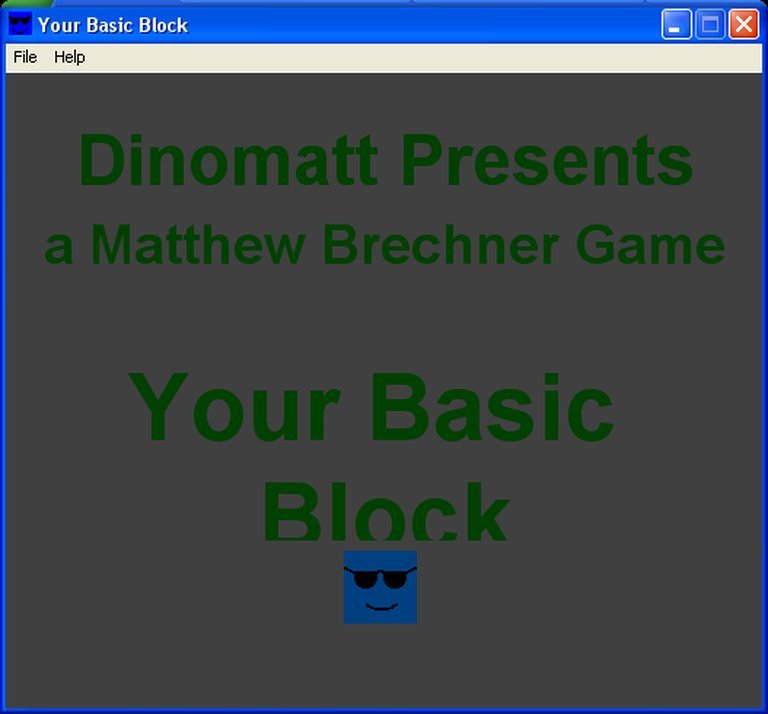
Description
Your Basic Block is a classic arcade-style game released in 1999 where players control a blue block navigating a top-down maze. The objective is to collect all purple blocks while avoiding a red enemy block. Each level features a teleporter to quickly move between corners, adding a strategic element to the gameplay. The game is freeware and designed for single-player action using a keyboard.
Your Basic Block Cheats & Codes
Baldi’s Basics Classic Remastered (PC)
Enter codes into the ‘You Can Think Pad’ during gameplay. Debug Mode (09241993) requires unlocking the NULL style and finding all secret endings prior to use.
| Code | Effect |
|---|---|
| 04281989 | Teleports player to the Music Room with interactive music controls |
| 10181996 | Activates Authentic Mode (1999-style HUD) |
| 11211994 | Activates Chaos Mode (duplicates all characters) |
| 09241993 | Unlocks Debug Mode/cheat menu (accessible via ‘?’ in pause menu) |
Baldi’s Basics Classic (PC)
Enter codes into the ‘You Can Think Pad’. Requires version 1.4.1 or later.
| Code | Effect |
|---|---|
| 31718 | Teleports player to a test room with infinite stamina |
| 53045009 | Flips gameplay upside down (HUD remains normal) |
Your Basic Block: A Study in Minimalist Game Design
Introduction
In an era defined by the rise of 3D graphics, sprawling RPGs, and cinematic storytelling, Your Basic Block (1999) stands as a defiant monument to simplicity. Created by Matthew Julius Brechner and released as freeware for Windows, this top-down arcade game strips the medium down to its barest essentials: colored blocks, reflexive movement, and primal tension. Though unassuming in its execution, Your Basic Block encapsulates a crucial truth about video games—that the purest joy often lies in mechanics, not spectacle. This review explores how a game with no narrative, no characters, and no sound became a quiet triumph of minimalist design.
Development History & Context
The Creator’s Vision
Matthew Julius Brechner, credited with eight other games on MobyGames, envisioned Your Basic Block as a distilled arcade experience. Developed in 1999, the game emerged during a pivotal shift in gaming: the PlayStation had popularized 3D worlds, while titles like Half-Life (1998) and Final Fantasy VIII (1999) emphasized narrative depth. Brechner’s creation rejected these trends, opting for a design closer to early arcade classics like Pong or PAC-MAN.
Technological Constraints
As freeware built for Windows, Your Basic Block required no cutting-edge hardware. Its rudimentary visuals—rendered in flat colors and geometric shapes—were achievable on even the most basic PCs. This accessibility mirrored the ethos of early BASIC-powered games, where creativity flourished within technical limitations.
The 1999 Gaming Landscape
The late ’90s were dominated by franchises like Pokémon, Metal Gear Solid, and The Legend of Zelda. Against this backdrop, Your Basic Block was an outlier. Its release alongside titles such as Quake III Arena and System Shock 2 underscored a stark divide: while the industry raced toward complexity, Brechner’s work served as a reminder that elegance could reside in simplicity.
Narrative & Thematic Deep Dive
The Absence of Story
Your Basic Block has no plot, no dialogue, and no characters—unless one counts the anthropomorphized blue protagonist, the predatory red foe, and the passive purple collectibles. This absence of narrative is its defining feature. The game’s “story” is abstract: a struggle between order (collecting all purple blocks) and chaos (avoiding the red adversary).
Thematic Resonance
Thematically, the game explores tension and inevitability. The red block’s relentless pursuit evokes existential minimalism: the player is both hunter and hunted, tasked with imposing order on a volatile space. The teleporter—a portal that flings the player to the opposite corner—introduces fleeting moments of respite, but the threat of entrapment lingers. In this way, Your Basic Block mirrors life’s Sisyphean struggles, albeit in binary form.
Gameplay Mechanics & Systems
Core Loop
The objective is straightforward:
1. Move the blue block with arrow keys.
2. Collect all purple blocks.
3. Evade the red block, which respawns the level upon contact.
4. Teleport via the bottom-right portal to escape tight corners.
This loop is deceptively deep. The red block’s AI, while primitive, adapts to player movement, creating emergent patterns of chase and evasion. Each level is a microcosm of tension, demanding spatial awareness and quick reflexes.
Character Progression
There is none. The game’s challenge is static, relying on the player’s self-improvement rather than unlocks or power-ups. Mastery comes from memorizing the red block’s behavior and optimizing routes.
UI and Controls
The interface is nonexistent—no health bars, no score counter, no menus beyond level restarts. Control is tactile and immediate, with the keyboard’s arrow keys providing direct agency. This austerity heightens immersion; the player’s focus remains unbroken.
Innovations and Flaws
The teleporter is a clever risk/reward tool, offering escape but potentially cornering the player elsewhere. However, the lack of difficulty scaling or procedural generation limits long-term engagement. Once mastered, the game offers little reason to return.
World-Building, Art & Sound
Visual Design
Your Basic Block’s aesthetic is stark: a black void populated by geometric shapes. The blue and red blocks evoke primal archetypes (ally/enemy), while the purple targets signify objective. This visual minimalism ensures clarity—every element serves a mechanical purpose.
Sound Design
No audio components are documented, suggesting silence as a deliberate choice. The absence of sound amplifies tension, forcing players to rely on visual cues. Modern analogues like Thomas Was Alone (2012) would later prove how minimalist soundscapes elevate block-based narratives, but Brechner’s silence feels intentional—a vacuum where gameplay reigns supreme.
Atmosphere
The game’s atmosphere is clinical yet tense. The void-like backdrop isolates the player, emphasizing the lethality of the red block. It’s a digital gladiatorial arena, stripped of distractions.
Reception & Legacy
Contemporary Reception
No formal reviews exist, but the game’s preservation on platforms like MobyGames hints at cult status. Its exclusion from mainstream discourse speaks to its niche appeal—a curiosity for enthusiasts of minimalist or retro design.
Enduring Influence
While not a commercial titan, Your Basic Block’s DNA surfaces in indie hits like Super Hexagon (2012) and VVVVVV (2010), which marry simple mechanics with high difficulty. The game also prefigures the “hyper-casual” mobile genre, where immediate gameplay trumps complexity.
Historical Significance
As a freeware artifact, Your Basic Block embodies a DIY ethos increasingly rare in today’s industry. It’s a reminder that games need not be vast or visually ornate to captivate—sometimes, all you need is a block, an enemy, and a goal.
Conclusion
Your Basic Block is neither a masterpiece nor a footnote—it’s a manifesto. In an age of photorealistic graphics and cinematic ambitions, Brechner’s game asserts that the soul of gaming lies in mechanics, tension, and purity of purpose. Its legacy is subtle but undeniable: a proof-of-concept for how constraint breeds creativity. For historians, it’s a relic of gaming’s barebones past; for players, it’s an invitation to revisit the medium’s roots. In the end, Your Basic Block is a silent hymn to the joy of moving a colored square—and a testament to the timeless allure of simplicity.
Final Verdict:
A fascinating artifact for retro enthusiasts and design scholars, Your Basic Block is a masterclass in minimalism. While its austerity limits broad appeal, its brilliance lies in its refusal to be anything but itself.