
- Release Year: 2007
- Platforms: Windows
- Publisher: eGames, Inc.
- Developer: Alawar Entertainment, Inc.
- Genre: Compilation
- Game Mode: Single-player
- Gameplay: Fixed screen, Space shooters
- Average Score: 98/100
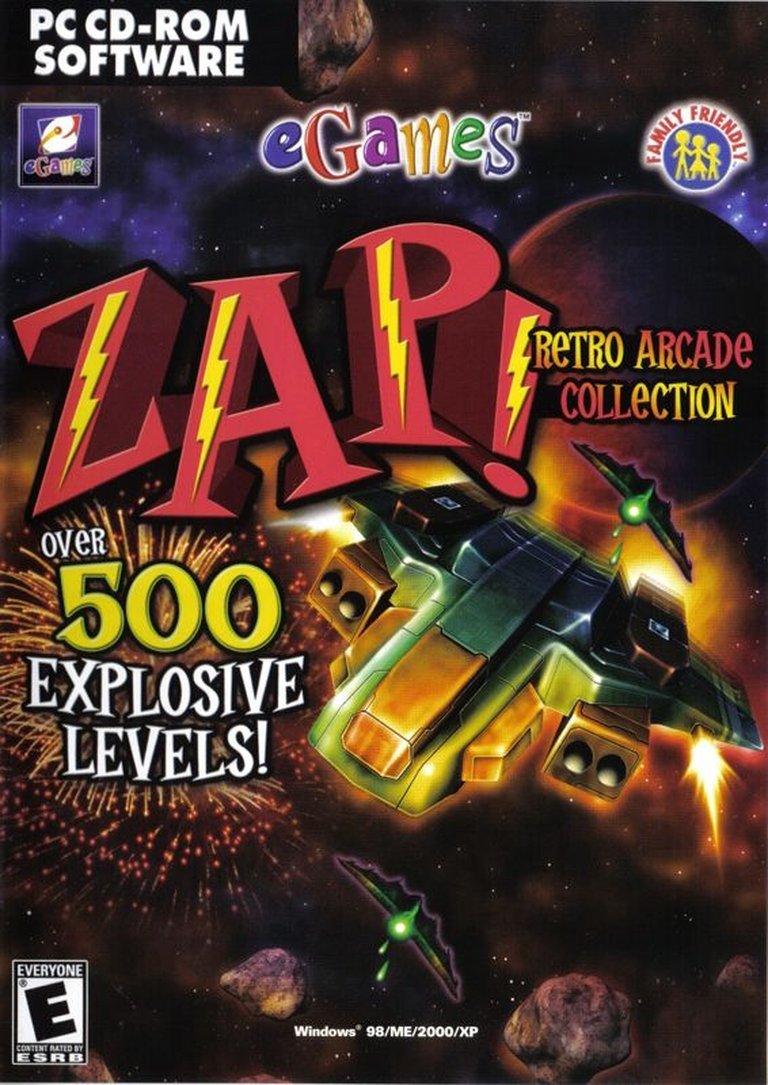
Description
ZAP! is a compilation of eight single-player space shooters in the fixed-screen genre, originally released by Alawar Entertainment and bundled together in 2007. The collection includes titles like Alien Outbreak 2: Invasion, Back to Earth, Crusaders of Space, and Pulsarius, offering retro arcade-style gameplay. Additionally, it features Cubozoid as a bonus game, which deviates from the space shooter theme. The compilation is designed for Windows and caters to fans of classic arcade action.
ZAP! Patches & Updates
ZAP! Reviews & Reception
teacherspayteachers.com (98/100): ZAP has become one of my favorite review games. Thank you for this resource!
highheelsandnumber2pencils.com : ZAP! creates so much excitement and fun for math!
dissonantsymphony.com : The uncertainty is thrilling!
ZAP! (2007): A Retrospective on a Forgotten Compilation of Arcade Nostalgia
Introduction: The Curious Case of ZAP!
In the vast, ever-expanding universe of video game compilations, ZAP! (2007) stands as a peculiar artifact—a digital time capsule of early 2000s indie arcade shooters, bundled together under a title that evokes the golden age of gaming. Yet, unlike the legendary Atari 2600 or the revolutionary Space Invaders, ZAP! has faded into obscurity, remembered by few and analyzed by even fewer. This review seeks to resurrect its legacy, dissecting its components, context, and the broader cultural currents that shaped its existence.
At its core, ZAP! is a compilation of eight fixed-screen space shooters, all previously released by Alawar Entertainment, a Russian developer known for casual and arcade-style games. The collection includes titles like Alien Outbreak 2: Invasion, Back to Earth, Crusaders of Space, and Pulsarius, alongside a bonus game, Cubozoid, which deviates from the shooter genre. On the surface, it appears to be a budget-friendly package aimed at nostalgia-seeking gamers or those craving simple, pick-up-and-play action. But beneath this unassuming facade lies a fascinating intersection of gaming history, indie development, and the evolving landscape of digital distribution in the mid-2000s.
This review will explore ZAP! through multiple lenses: its development history, the thematic and narrative elements (or lack thereof) in its constituent games, its gameplay mechanics, its audiovisual presentation, its critical reception, and its lasting impact—or lack thereof—on the gaming industry. By the end, we will determine whether ZAP! is a forgotten gem, a relic of its time, or merely a footnote in the annals of video game history.
Development History & Context: The Rise of Indie Compilations
The Studio Behind the Game: Alawar Entertainment
Alawar Entertainment, the Russian studio responsible for the games in ZAP!, was founded in 1999 and quickly carved a niche in the casual gaming market. Specializing in arcade shooters, match-three puzzles, and time-management games, Alawar catered to the burgeoning digital distribution scene, where players could download games directly to their PCs. Their titles were often simple, colorful, and designed for short bursts of gameplay—perfect for the early 2000s audience that was transitioning from physical media to digital downloads.
The games in ZAP! were not originally designed as a cohesive collection. Instead, they were standalone releases, each with its own development cycle and audience. Crusaders of Space, for instance, was part of a series that began in the early 2000s, while Back to Earth and its sequel offered a more grounded (pun intended) take on the shooter genre. The decision to bundle these games under the ZAP! banner was likely a marketing strategy by eGames, Inc., the publisher, to capitalize on the growing demand for retro-inspired compilations.
The Gaming Landscape in 2007: Digital Distribution and Nostalgia
The mid-2000s were a transitional period for the gaming industry. The rise of digital distribution platforms like Steam (launched in 2003) and Direct2Drive (2004) was changing how games were sold and consumed. Physical media was still dominant, but the convenience of downloading games directly to one’s PC was gaining traction. Compilations like ZAP! benefited from this shift, as they could be sold as budget-friendly packages without the overhead of physical production.
At the same time, nostalgia for classic arcade games was experiencing a resurgence. Titles like Geometry Wars: Retro Evolved (2005) and Pac-Man Championship Edition (2007) proved that there was still a market for simple, high-score-chasing gameplay. ZAP! tapped into this trend by offering a collection of games that emulated the fixed-screen shooters of the 1980s, albeit with modernized graphics and mechanics.
Technological Constraints and Design Philosophy
The games in ZAP! were developed with the technological limitations of the early 2000s in mind. While they featured more vibrant graphics and smoother animations than their 8-bit predecessors, they were still constrained by the hardware of the time. The fixed-screen design—a hallmark of classic arcade shooters like Galaga and Space Invaders—was a deliberate choice, allowing for tight, focused gameplay loops that were easy to pick up but difficult to master.
The inclusion of Cubozoid, a puzzle game, as a bonus title suggests that the developers were aware of the need for variety. However, its presence also highlights the compilation’s lack of a unifying theme. Unlike Namco Museum or Midway Arcade Treasures, which curated games from a single publisher’s golden age, ZAP! was a hodgepodge of titles from a single developer’s catalog, united more by convenience than by design.
Narrative & Thematic Deep Dive: The Absence of Story
The Plot (or Lack Thereof)
One of the most striking aspects of ZAP! is its near-total absence of narrative. The games within the compilation are, by and large, pure arcade experiences—no cutscenes, no dialogue, and no overarching story. Alien Outbreak 2: Invasion and Back to Earth hint at a sci-fi premise (aliens invading, humanity fighting back), but these themes are conveyed through gameplay rather than exposition. Crusaders of Space and its sequels are even more abstract, tasking players with surviving waves of enemies in a void-like environment.
This lack of narrative is not necessarily a flaw. Classic arcade games thrived on their simplicity, and ZAP! embraces this philosophy wholeheartedly. The focus is on gameplay, high scores, and quick sessions—elements that defined the golden age of arcades. However, in an era where even casual games like Plants vs. Zombies (2009) were beginning to incorporate humor and storytelling, ZAP!’s minimalism feels almost anachronistic.
Themes: Survival, Repetition, and the Arcade Ethos
If ZAP! has any overarching themes, they are the same ones that have defined arcade shooters since their inception:
– Survival: Each game is a test of endurance, challenging players to last as long as possible against increasingly difficult odds.
– Repetition: The fixed-screen design encourages players to refine their strategies, memorize enemy patterns, and strive for perfection.
– High Score Chasing: The ultimate goal is not to “beat” the game but to achieve the highest possible score, a callback to the competitive nature of arcades.
These themes are universal in the shooter genre, but ZAP! does little to innovate upon them. There are no meta-narratives about the futility of war, no environmental storytelling, and no character development. The games are mechanical, almost clinical, in their execution.
Characters and Dialogue: The Silent Protagonists
The protagonists of ZAP!’s games are, for the most part, faceless ships or abstract entities. El Airplane is the sole exception, featuring a more whimsical, cartoonish aesthetic, but even here, the focus is on gameplay rather than personality. There is no dialogue, no voice acting, and no attempt to humanize the player’s avatar. This is not a criticism—many classic arcade games followed the same approach—but it does reinforce ZAP!’s identity as a pure gameplay experience.
Gameplay Mechanics & Systems: The Core of the Experience
The Fixed-Screen Shooter Formula
At its heart, ZAP! is a celebration of the fixed-screen shooter, a subgenre that has its roots in Space Invaders (1978) and Galaxian (1979). The formula is simple:
1. The player controls a ship at the bottom of the screen.
2. Enemies descend from the top, firing projectiles or attempting to collide with the player.
3. The player must dodge, shoot, and survive for as long as possible.
Each game in the compilation iterates on this formula in subtle ways:
– Alien Outbreak 2: Invasion introduces power-ups and varied enemy types.
– Back to Earth grounds the action on a planetary surface, adding terrain obstacles.
– Crusaders of Space emphasizes wave-based survival with boss encounters.
– Pulsarius incorporates a more abstract, geometric visual style.
Combat and Progression
Combat in ZAP! is straightforward but satisfying. Players have a primary weapon (usually a rapid-fire laser) and, in some games, secondary abilities like bombs or shields. The difficulty ramps up quickly, with later waves introducing faster, more aggressive enemies and complex attack patterns.
Progression is tied to the player’s score, which increases with each enemy defeated. There are no RPG-like upgrades or persistent unlocks—each session is a self-contained challenge. This design choice reinforces the arcade ethos but may feel limiting to players accustomed to modern progression systems.
UI and Controls
The user interface is functional but unremarkable. Scores are displayed prominently, and health/shield meters are easy to read. The controls are responsive, with keyboard and mouse support, though some games would have benefited from gamepad compatibility.
One notable flaw is the lack of customization options. Players cannot remap controls, adjust difficulty settings, or tweak visual effects. This rigidity, while authentic to the arcade experience, may frustrate modern audiences.
Innovations and Flaws
ZAP!’s greatest innovation is its variety. By bundling multiple shooters with distinct mechanics, it offers more replayability than a single standalone title. However, this variety is also its greatest flaw—none of the games stand out as exceptional. They are competent but unmemorable, lacking the polish or creativity of contemporaries like Ikaruga (2001) or Geometry Wars.
The bonus game, Cubozoid, is a puzzler that feels out of place. While it provides a change of pace, its inclusion underscores the compilation’s lack of a cohesive identity.
World-Building, Art & Sound: Aesthetic Choices
Visual Design: Retro Meets Modern
The games in ZAP! straddle the line between retro aesthetics and early 2000s digital art. The sprites are colorful and detailed, with smooth animations that would have been impossible on 8-bit hardware. Backgrounds are often static or minimally animated, keeping the focus on the action.
El Airplane stands out for its cartoonish, almost R-Type-inspired design, while Pulsarius opts for a more abstract, vector-like appearance. The visuals are functional but not groundbreaking—serviceable for the era but not particularly distinctive.
Sound Design and Music
The audio design is similarly functional. The sound effects—laser blasts, explosions, and enemy chatter—are clear and punchy, though they lack the iconic memorability of Space Invaders’ descending pitch or Pac-Man’s waka-waka.
The music is generic synth-based fare, designed to fade into the background rather than command attention. There are no standout tracks, and the loops grow repetitive during extended play sessions.
Atmosphere and Immersion
ZAP! does not aim for immersion. There are no cinematic moments, no environmental storytelling, and no attempts to draw players into a fictional world. The atmosphere is purely mechanical, emphasizing gameplay over ambiance. This is not a flaw—it is a deliberate choice—but it does mean that ZAP! lacks the emotional resonance of more narrative-driven shooters like Gradius or R-Type.
Reception & Legacy: The Forgotten Compilation
Critical Reception at Launch
ZAP! received little critical attention upon its release in 2007. It was not reviewed by major gaming outlets, and there are no Metascores or aggregated reviews available. The few player impressions that exist (such as those on MobyGames) suggest that it was seen as a competent but unremarkable collection—fun for fans of the genre but not essential.
Commercial Performance
As a budget compilation, ZAP! likely sold modestly well, appealing to casual gamers and nostalgia seekers. However, it did not achieve the cultural impact of more prominent retro collections like Namco Museum or Sega Genesis Collection.
Legacy and Influence
ZAP!’s legacy is negligible. It did not inspire sequels, spiritual successors, or imitators. The games within it have not been re-released on modern platforms, and Alawar Entertainment has since shifted its focus to mobile and free-to-play titles.
In the grand tapestry of video game history, ZAP! is a footnote—a minor compilation from a transitional era. It is neither a masterpiece nor a disaster but a curious artifact of a time when digital distribution was still finding its footing.
Conclusion: A Time Capsule of Arcade Nostalgia
ZAP! is a game that defies easy categorization. It is not a bad compilation, but it is not a great one either. It is a product of its time—a budget-friendly package of simple, competent shooters designed for an audience that craved nostalgia without demanding innovation.
For modern players, ZAP! offers a glimpse into the early 2000s indie scene, when digital distribution was still in its infancy and arcade shooters were experiencing a minor renaissance. It is a time capsule, preserving a moment when gaming was transitioning from physical media to digital downloads, from pixel art to 3D graphics, and from high-score chasing to narrative-driven experiences.
Final Verdict: 6/10 – A Competent but Forgotten Relic
ZAP! is worth experiencing for fans of arcade shooters and gaming historians, but it is not essential. It lacks the polish of modern indie shooters, the depth of narrative-driven games, and the cultural impact of true classics. Yet, in its simplicity and sincerity, it captures the spirit of an era—a time when games were made for the sheer joy of playing them.
In the end, ZAP! is not a game that will be remembered alongside Space Invaders or Galaga, but it is a worthy footnote in the history of a genre that continues to thrive. For those who seek it out, it offers a brief, nostalgic diversion—a reminder of when gaming was simpler, faster, and, in its own way, purer.