
- Release Year: 1998
- Platforms: Windows
- Publisher: Cryo Interactive Entertainment, Cryo UK Ltd, R&P Electronic Media
- Developer: Cryo Interactive Entertainment, Microfolie’s Editions
- Genre: Adventure
- Perspective: 1st-person
- Game Mode: Single-player
- Gameplay: Puzzle elements
- Setting: Cyberpunk, dark sci-fi, Futuristic, Sci-fi
- Average Score: 92/100
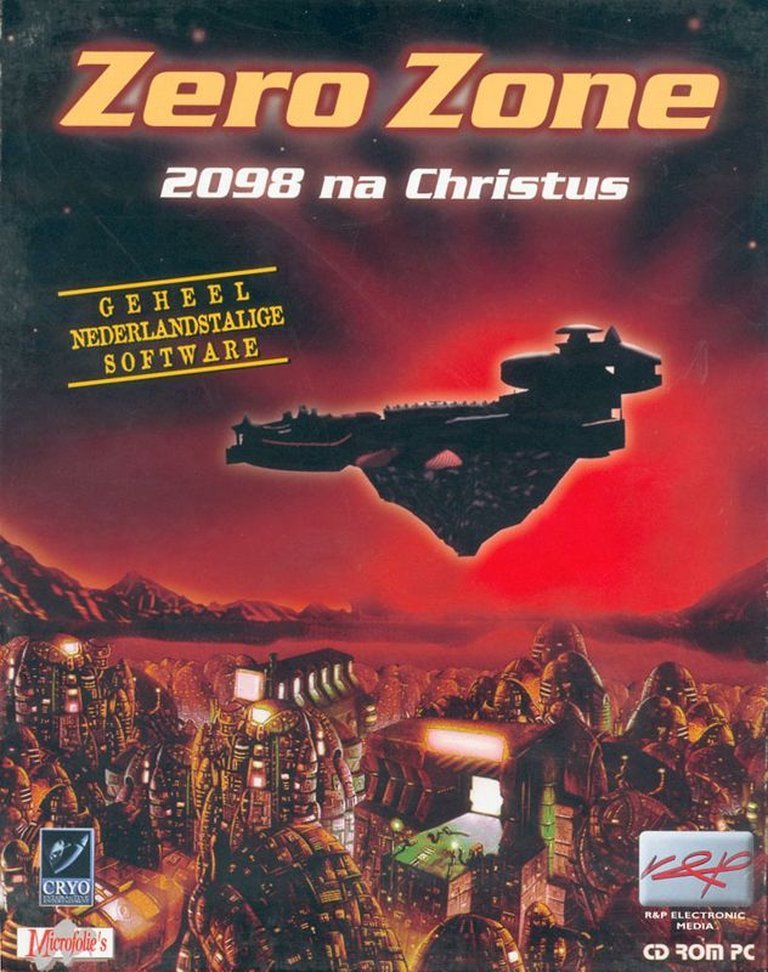
Description
Zero Zone is a cyberpunk adventure game set in the year 2098 in Megatown, a dystopian city where Bios enslave Cybers. The protagonist, Stan Gonzo, inherits his father’s fortune and leadership of Kanary, a major Cyber technology company, only to uncover a murder mystery tied to his father’s death. As Stan investigates, he uncovers secrets that could reshape the power dynamics between Bios and Cybers. The game features first-person point-and-click gameplay with pre-rendered backgrounds, puzzle-solving, and a dark sci-fi narrative.
Where to Buy Zero Zone
PC
Zero Zone Free Download
PC
Zero Zone Reviews & Reception
mobygames.com (87/100): A puzzle-solving adventure with pre-rendered backgrounds representing locations.
en.wikipedia.org : When the game was released, it was criticised for having low quality graphics. Yet some say the plot and music created the right setting for enjoyment.
collectionchamber.blogspot.com : ZeroZone stands out as one of Cryo’s stronger efforts, a stylish and atmospheric cyberpunk adventure that, while certainly not perfect, delivers a pretty enjoyable experience for fans of the genre.
myabandonware.com (97.6/100): Dudes and duddettes, this here is an amazing game. yes, its visuals might be a bit crappy, but the storyline, music and overall interaction experience is something else!
Zero Zone: A Cyberpunk Odyssey Lost in Time
Introduction: The Forgotten Gem of Cryo Interactive
In the late 1990s, the adventure game genre was in a state of flux. The golden age of point-and-click classics like Myst and The 7th Guest was waning, and developers were scrambling to innovate or risk obsolescence. Amid this turbulent landscape, French studio Cryo Interactive—a company known for its ambitious yet uneven output—released Zero Zone (1998), a cyberpunk adventure that dared to blend intricate storytelling, survival mechanics, and a dystopian narrative into a single, sprawling experience. While not a commercial juggernaut, Zero Zone stands as a fascinating artifact of its era: a game that pushed boundaries in world-building and thematic depth, even as it stumbled over technical limitations and design quirks.
This review aims to dissect Zero Zone in exhaustive detail, exploring its development history, narrative ambitions, gameplay mechanics, and lasting legacy. Was it a misunderstood masterpiece, or a flawed experiment that failed to live up to its potential? By examining its strengths and weaknesses, we can better understand its place in the pantheon of cyberpunk gaming and the broader adventure genre.
Development History & Context: Cryo’s Cyberpunk Gamble
The Studio Behind the Game
Cryo Interactive, founded by Philippe Ulrich and Jean-Martial Lefranc, was a French developer with a reputation for producing visually striking but mechanically uneven adventure games. Known for titles like Dune (1992), Atlantis: The Lost Tales (1997), and Egypt 1156 B.C. (1997), Cryo’s games often featured lavish pre-rendered environments, ambitious narratives, and a penchant for blending historical or sci-fi settings with puzzle-solving. However, the studio was also criticized for repetitive gameplay loops, clunky interfaces, and occasional technical instability.
Zero Zone was developed in collaboration with Microfolie’s Editions and published by Cryo Interactive Entertainment, R&P Electronic Media, and Cryo UK Ltd. The game’s development coincided with a period of transition in the adventure genre. The mid-to-late ’90s saw the rise of 3D acceleration and real-time rendering, yet Zero Zone clung to the pre-rendered, node-based navigation popularized by Myst. This choice was likely a pragmatic one—Cryo’s in-house Omni3D engine, while capable of 360-degree panoramic views, was not equipped for fully 3D environments. The result was a game that felt simultaneously cutting-edge and outdated upon release.
Technological Constraints and Design Choices
Zero Zone was built using the Omni3D engine, a proprietary tool that allowed for 360-degree panoramic navigation within static, pre-rendered scenes. This technology was a double-edged sword:
– Pros: It enabled richly detailed environments with a strong sense of immersion, particularly in its cyberpunk cityscapes and corporate interiors.
– Cons: Movement was restricted to “jumping” between fixed nodes, which could feel jarring compared to the smoother navigation of contemporaries like Riven (1997) or Grim Fandango (1998).
The game’s CD-ROM format also imposed limitations. With a single disc containing voice acting, full-motion video (FMV), and hundreds of pre-rendered scenes, compression artifacts and lower-resolution textures were inevitable. The game’s 640×480 resolution—while standard for the time—paled in comparison to the 800×600 resolution of its in-game encyclopedia, GalaxyNet, highlighting a disconnect in visual fidelity.
The Gaming Landscape of 1998
1998 was a pivotal year for adventure games. The genre was fragmenting:
– Traditional point-and-click adventures (Grim Fandango, The Longest Journey) were embracing 3D and cinematic storytelling.
– Survival horror (Resident Evil 2) was blending adventure mechanics with action.
– First-person shooters (Half-Life) were siphoning attention away from slower-paced experiences.
Zero Zone arrived in this crowded field as a cyberpunk puzzle-adventure, a subgenre that had seen limited exploration outside of Blade Runner (1997) and System Shock (1994). Its focus on narrative depth and environmental storytelling was ambitious, but its adherence to older design conventions may have alienated players seeking more dynamic experiences.
Narrative & Thematic Deep Dive: A Cyberpunk Mystery with Heart
Plot Summary
Zero Zone is set in Megatown, 2098, a dystopian metropolis where humanity (the Bios) rules over a subservient class of humanoid machines (the Cybers). The game opens with Stan Gonzo, a young man who has never known his father, inheriting control of Kanary Corporation, the city’s most powerful cyber-technology conglomerate. His father’s death, however, is no accident—it’s murder. Partnering with Agent Ripley, a police investigator, Stan must unravel the conspiracy behind his father’s assassination while navigating the treacherous politics of Megatown.
The narrative unfolds through:
– Environmental storytelling: Exploring Kanary’s corporate offices, Stan’s father’s luxurious apartment, and the city’s underbelly.
– Dialogue and exposition: Conversations with NPCs, emails, and the GalaxyNet database provide lore and clues.
– Puzzle-solving: Deciphering codes, hacking terminals, and manipulating characters to progress.
Themes: Slavery, Identity, and Rebellion
Zero Zone tackles weighty themes with surprising nuance for its era:
1. Oppression and Exploitation: The relationship between Bios and Cybers mirrors historical systems of slavery and class struggle. Cybers are denied autonomy, forced into labor or servitude, and treated as property.
2. Identity and Inheritance: Stan’s journey is as much about discovering his father’s legacy as it is about defining his own role in Megatown’s hierarchy.
3. Technological Dependence: The game critiques humanity’s reliance on machines, questioning whether the Bios’ dominance is sustainable or ethical.
4. Corporate Power: Kanary Corporation embodies the dystopian megacorp trope, wielding influence over both technology and society.
Characters and Dialogue
The game’s cast is small but memorable:
– Stan Gonzo: A reluctant hero, thrust into power and forced to confront his father’s secrets.
– Agent Ripley: The archetypal “cop with a conscience,” serving as Stan’s guide and ally.
– Cyber NPCs: From servile droids to rebellious machines, their interactions highlight the game’s central conflict.
Dialogue is delivered via voice acting (in multiple languages, depending on the region) and text subtitles. While the performances are serviceable, the writing occasionally veers into exposition-heavy monologues, a common pitfall of adventure games. The game’s most innovative communication method, however, is its emoji-like pictogram system for interacting with machines—a quirky but immersive touch that reinforces the cyberpunk aesthetic.
The GalaxyNet: A Cyberpunk Encyclopedia
One of Zero Zone’s most ambitious features is the GalaxyNet, an in-game database accessible via terminals. This separate program functions as:
– A lore dump, providing backstory on Megatown, Kanary Corporation, and the Bios/Cyber conflict.
– A puzzle-solving tool, offering clues and codes.
– A world-building device, fleshing out the game’s dystopian setting.
While the GalaxyNet is a clever addition, its clunky interface and dense text walls can feel overwhelming. Players must sift through paragraphs of dry exposition to find relevant information, a design choice that may frustrate those seeking a more streamlined experience.
Gameplay Mechanics & Systems: Puzzles, Survival, and Shooter Segments
Core Gameplay Loop
Zero Zone is a first-person point-and-click adventure with the following mechanics:
1. Navigation: Players move by clicking on “hotspots” in pre-rendered panoramas, with the ability to rotate the camera 360 degrees.
2. Inventory Management: Stan’s inventory is expansive, allowing players to carry numerous items. Right-clicking or pressing Ctrl accesses the inventory, which also houses the pocket computer (a precursor to modern smart devices).
3. Puzzle-Solving: The game’s challenges range from logic-based puzzles (e.g., deciphering codes) to inventory-based tasks (e.g., feeding a robot dog).
4. Dialogue and Interaction: Conversations with NPCs are one-sided but provide critical clues.
Innovative (and Flawed) Systems
-
Survival Mechanics:
- Stan has health, hunger, and thirst meters, requiring players to feed him pizza, coffee, or cake.
- While immersive, these mechanics feel underdeveloped—there’s little consequence for neglecting them beyond minor inconveniences.
-
Shooter Segments:
- Occasionally, Stan must fend off hostile robots in first-person shooter sequences.
- These segments are clunky and unnecessary, disrupting the game’s pacing and offering little depth.
-
Pocket Computer and Pictograms:
- The pocket computer communicates with machines via emoji-like symbols, a creative but sometimes confusing system.
- Example: A vending machine might display “machine + man drinking = 1 coin,” indicating the cost of a drink.
-
GalaxyNet Integration:
- While rich in lore, the GalaxyNet’s separate executable and dense text make it cumbersome to use.
Puzzle Design: Clever but Obtuse
Zero Zone’s puzzles are a mixed bag:
– Strengths:
– Some puzzles are logical and satisfying, such as hacking terminals or manipulating NPCs.
– The game rewards exploration and observation, with clues often hidden in environmental details.
– Weaknesses:
– Obscure solutions: Some puzzles rely on trial-and-error (e.g., a 5×5 number grid with no clear pattern).
– Lack of feedback: Failed attempts rarely provide hints, leaving players stuck.
– Underutilized mechanics: The survival elements and shooter segments feel tacked-on rather than integrated.
UI and Controls
The game’s mouse-driven interface is functional but dated:
– The cursor changes shape to indicate actions (e.g., pointing finger for movement, hand for interaction).
– Inventory management is straightforward but can become cluttered.
– Saving and loading is manual, with no autosave feature—a frustrating oversight.
World-Building, Art & Sound: A Cyberpunk Feast for the Senses
Setting and Atmosphere
Zero Zone’s Megatown is a cyberpunk masterpiece, blending:
– Neon-lit corporate towers (Kanary’s headquarters).
– Gritty urban underbellies (alleys, slums).
– Luxurious private spaces (Stan’s father’s penthouse).
The game’s pre-rendered backgrounds are detailed and immersive, though the low resolution (640×480) and compression artifacts detract from their impact. The 360-degree panoramas enhance immersion, allowing players to soak in the environment.
Art Direction
- Character Models: The 3D-rendered characters are stiff and poorly animated, with robotic lip-syncing that breaks immersion.
- Cyberpunk Aesthetic: The game nails the high-tech, low-life vibe, with glowing terminals, holograms, and dystopian architecture.
- Lighting and Color: Moody blues and neons dominate, reinforcing the cyberpunk tone.
Sound Design and Music
- Voice Acting: Serviceable but uneven, with some performances feeling wooden.
- Ambient Sound: The hum of machinery, distant chatter, and electronic beeps create a convincing cyberpunk atmosphere.
- Music: The synth-heavy soundtrack complements the setting but is unmemorable compared to contemporaries like Blade Runner’s Vangelis-inspired score.
Reception & Legacy: A Cult Classic in the Making?
Critical Reception
Zero Zone received mixed reviews upon release:
– Praised for:
– Its ambitious narrative and cyberpunk world-building.
– The depth of its lore (via GalaxyNet).
– Its atmospheric visuals and immersive setting.
– Criticized for:
– Technical issues (bugs, crashes).
– Outdated graphics (low resolution, stiff animations).
– Clunky gameplay (survival mechanics, shooter segments).
PC Jeux (France) gave it an 87%, calling it “a beautiful, adult, well-crafted adventure” that was “perfectly in tune with the times.” However, player reviews on MobyGames average a 2.4/5, suggesting a divide between critics and audiences.
Commercial Performance
Zero Zone was not a commercial success, likely due to:
– Competition: Released alongside Grim Fandango and Half-Life, it struggled to stand out.
– Technical Limitations: Its pre-rendered design felt dated compared to 3D-accelerated games.
– Niche Appeal: Cyberpunk was not yet the mainstream phenomenon it is today.
Legacy and Influence
Despite its flaws, Zero Zone has developed a cult following among:
– Cyberpunk enthusiasts who appreciate its dystopian world-building.
– Adventure game fans who enjoy its puzzle-heavy design.
– Retro gamers who revel in its late-’90s aesthetic.
Its influence can be seen in later cyberpunk games like:
– Deus Ex (2000): Shared themes of corporate power and human-machine conflict.
– Observer (2017): Similar dystopian settings and detective narratives.
– Cyberpunk 2077 (2020): While more action-oriented, it shares Zero Zone’s focus on class struggle in a tech-dominated world.
Modern Playability
Playing Zero Zone today is challenging due to:
– Compatibility issues with modern Windows versions.
– Lack of official support (no remasters or re-releases).
– Emulation requirements: Fans recommend PCem or DOSBox for the best experience.
Conclusion: A Flawed Masterpiece Worth Rediscovering
Zero Zone is a game of contradictions:
– Ambitious in narrative, yet clunky in execution.
– Rich in world-building, yet hampered by technical limitations.
– Innovative in mechanics, yet burdened by outdated design choices.
It is not a perfect game, but it is a fascinating one—a cyberpunk odyssey that dared to blend survival mechanics, corporate intrigue, and dystopian themes into a single, sprawling adventure. While it may not have achieved the acclaim of Blade Runner or the polish of Grim Fandango, it stands as a testament to Cryo Interactive’s creativity and a hidden gem of the late-’90s adventure genre.
Final Verdict: 7.5/10 – A flawed but compelling cyberpunk adventure that deserves a place in the annals of gaming history. Recommended for patient retro gamers, cyberpunk fans, and those willing to overlook its rough edges for its ambitious storytelling.
For modern players, Zero Zone is best experienced via emulation (PCem or DOSBox) with a walkthrough on hand—its puzzles can be brutal, but its world is worth exploring. In an era where cyberpunk is dominating gaming once again, Zero Zone serves as a reminder of the genre’s roots and the bold experiments of the past.
Have you played Zero Zone? Share your thoughts in the comments below! And if you’re a fan of retro cyberpunk, check out our other deep dives into forgotten classics like Blade Runner (1997) and System Shock (1994).