
- Release Year: 2005
- Platforms: Windows
- Publisher: 1C Company
- Developer: Gaijin Entertainment Corporation
- Genre: Action
- Perspective: Diagonal-down, Top-down
- Game Mode: Single-player
- Gameplay: Arcade, Mission-based, Perk system, Shooter, Weapon collection
- Setting: 1990s, Contemporary, Europe, Russia
Description
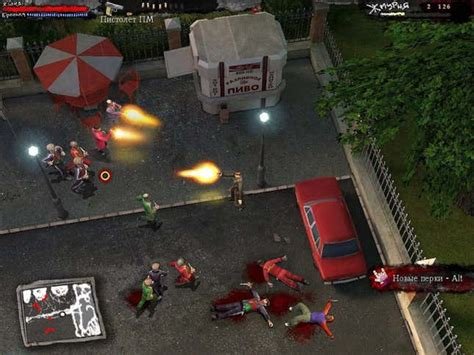
Zhmurki is an isometric action shooter set in 1990s Russia, based on the 2005 film that parodies the country’s chaotic transition to a free-market economy. Players take on roles as small-time gangsters working for a criminal boss, completing 35 missions across historically accurate environments with arcade-style gameplay, including combat, weapon pickups, perk selection, and objectives like exterminating enemies or destroying objects, all amidst a licensed soundtrack.
Zhmurki Patches & Updates
Zhmurki Reviews & Reception
stopgame.ru : Да только не всегда наши мечты сбываются.
jgoodwin.net : the casual brutality and racism the object lesson of the classroom
Zhmurki: A Brutal, Bug-ridden Artifact of Post-Soviet Gaming
Introduction: From Cult Film to Forgotten Game
In the mid-2000s, as Russia’s cinematic landscape revisited the chaotic “dashing 90s” with a mix of nostalgia and brutal satire, Aleksei Balabanov’s Zhmurki (Dead Man’s Bluff) emerged as a landmark. Its 2005 video game adaptation, developed by Gaijin Entertainment and published by 1C Company, sought to transform that anarchic, black-comedic underworld into an interactive experience. The result is not merely a failed translation but a fascinating, flawed time capsule—a game that embodies the technological constraints, commercial pressures, and raw creative ambition of its era. This review argues that Zhmurki the game is a critical failure in almost every traditional metric—gameplay, technical polish, narrative coherence—yet remains an invaluable historical document. It captures a specific moment when Russian game development, flush with licensed film properties but lacking robust engineering, attempted to grapple with its own nation’s recent, traumatic history through the language of the Western arcade shooter. It is a game that is technically “bad” by contemporary standards but is culturally significant as a deliberate, if clumsy, artifact of post-Soviet interactive expression.
Development History & Context: Gaijin’s Halting First Step
Studio & Vision: Gaijin Entertainment, later famous for the meticulously crafted War Thunder and Enlisted, was in 2005 a studio finding its footing. Known for the energetic but simplistic racing game Adrenaline Show, Gaijin’s portfolio showed a knack for accessible arcade action but not for complex narrative design or robust systemic games. The license for Zhmurki came from STV Cinema Company, Balabanov’s production house, representing a bid to capitalize on the film’s strong domestic performance (it grossed ~120 million rubles on a $1-2 million budget, seen by over 914,000 viewers). The vision, as per MobyGames’ description, was explicitly to create an “arcade shooter similar to Crimsonland and, perhaps, GTA”—a hybrid of top-down arena combat and open-world-ish mission structure. This ambition would outpace the studio’s technical execution.
Technological Constraints: The game was built for Windows, distributed on CD-ROM/DVD-ROM, and notoriously protected by the invasive StarForce 3 DRM. This DRM, as noted by preservation sites like MyAbandonware, was infamous for causing system instability, particularly on Windows Vista and newer, often resulting in Blue Screens of Death. This technical anchor alone crippled the game’s longevity and player goodwill. Furthermore, the game’s engine struggled with basic isometric rendering, leading to the “тормознутость движка” (stuttering engine) described in the StopGame review—excessively long level loads and inconsistent frame rates. The “ubiquitous” crashes at level transitions point to deeply unstable memory management.
Gaming Landscape: 2005 was a transformative year for PC and console gaming. Crimsonland (2003) had defined the horde-shooter-with-perks genre; GTA: San Andreas (2004) had raised the bar for open-world crime sagas. Against these polished, influential titles, Zhmurki felt technically regressive. The Russian PC market was robust but fragmented, dominated by publishers like 1C (who handled distribution) and a thriving piracy scene that the StarForce DRM sought, and failed, to curb. Gaijin was attempting to create a “local” product for a global genre, a challenge that would reveal the growing pains of the Russian industry.
Narrative & Thematic Deep Dive: A Blunted Satire
The film Zhmurki is a masterclass in satirical deconstruction. Its framing device—a 2005 professor lecturing on “primitive accumulation of capital” using the 1990s as a case study—immediately sets a critical, analytical tone. The plot follows inept gangsters Sergei and Simon through a spiraling chain of betrayals over a heroin suitcase. Its themes are razor-sharp: the information asymmetry of “blind man’s bluff” as a metaphor for lawless markets; the absurdity of hyper-masculine posturing in a moral vacuum; the transition from state control to criminal anarchy; and the ironic evolution from bandit to bourgeois (the ending where the heroes become Duma deputies). The film uses extreme, Tarantino-esque violence not as glorification but as a farcical mirror held up to a society where “the only real liberty was the freedom to kill.”
The game, by necessity, trims this nuanced satire down to its plot bones. Players control either Simon or Sergei through 35 missions that loosely follow the film’s sequence: intimidating a drug lab, the suitcase exchange, the ambush, the violent interrogations, and the bloody apartment showdown. Yet the narrative weight is completely lost. There is no framing lecture. There is no ironic 2005 coda. The game is presented as a straightforward, context-free series of kill-all-enemies missions. The profound economic and sociological commentary—the core of Balabanov’s work—is absent. Characters are reduced to sprite models; the philosophical weight of the “Zhmurki” game within the film (the literal Russian Roulette) is just another mission objective: “Kill Koron and Bala.”
The game’s failure to engage with theme is its greatest narrative sin. Where the film asks why this violence erupted and what it says about society, the game only asks how many goons are left to kill. The licensed elements—the soundtrack and character designs—provide a superficial veneer of the 1990s aesthetic (punk mohawks, track suits, specific weapons like the AK), but without the contextual framework, they become empty signifiers, a “lubok” (folk print) style without the folk wisdom.
Gameplay Mechanics & Systems: Repetitive, Broken, Uninspired
Core Loop: The gameplay is a direct lift of the Crimsonland formula: an isometric arena where waves of enemies spawn, the player must clear them, pick up weapon and perk drops, and survive. Missions layer on simple variants (“Kill all enemies,” “Destroy the car,” “Assassinate the boss”). The progression system involves an “authority” (experience) meter that fills with kills, allowing a choice between two perks (e.g., faster reload, more health) at discrete intervals.
Flaws & Failures:
1. Crippling Repetition: As the StopGame review acidly notes, the majority of playtime is spent in “банальный поиск оставшихся в живых врагов” (banal search for surviving enemies). Missions lack dynamic triggers; clearing a zone simply means hunting down the last few stragglers, who often hide in distant corners. This turns frantic action into tedious sweeping.
2. Botched “GTA” Ambition: The promise of “historically accurate environments” and diverse objectives is largely unfulledged. Levels are flat, empty maps of generic residential blocks and parking lots. The “open” feel is nonexistent; it’s purely arena-based. Vehicles are present but minimally interactive, failing to capture any sense of a living, lawless city.
3. Weapon & Enemy “Variety” is Skin-Deep: MobyGames claims “15 types of weapon” and “70 different enemies.” In practice, weapon differences are minimal (AK-47 versus a shotgun), and the 70 “enemy types” are primarily cosmetic reskins with identical AI and health pools. The review’s observation that “от силы наберется с десяток уникальных противников” (at best, a dozen unique opponents) is accurate. Tactical diversity is absent.
4. Janky Combat & Controls: “Spring-loaded guns” from the film are not implemented. The direct-control interface is functional but unresponsive by modern standards. Hit detection is inconsistent. The “bullet-time” feature is mentioned as a positive by some, but its implementation is likely a simple time-dilation effect with no strategic depth.
5. Absence of Multiplayer: The review correctly identifies the lack of multiplayer as a fatal flaw for an arena shooter. This genre thrives on competitive and cooperative modes; Zhmurki offers only a derivative single-player campaign.
Innovation? There is none. The game is a拼接 (patchwork) of existing ideas, executed with less finesse than its inspirations. Its only potential innovation—a direct, unironic translation of a specific, culturally dense film into game mechanics—was never attempted.
World-Building, Art & Sound: Surface-Level Authenticity
Visuals & Setting: The isometric perspective and “lubok” style art, as noted in the StopGame review (“Обрисованные до пуговиц… модели диво как хороши”), is the game’s most successful element. Character models for Simon, Sergei, Mikhalych, and the various gangsters are detailed, capturing the exaggerated fashion of 1990s “new Russians”: tracksuits, gold chains, specific hairstyles (mohawks, Soviet-era cuts). Environments—concrete apartment blocks, a McDonald’s, a morgue—are simplistic but recognizable, evoking provincial Nizhny Novgorod’s decay. However, the “gloomy view from above” and “总体 приземленность” (overall groundedness) create a visually dull and claustrophobic world, missing the film’s grim, atmospheric cinematography (Evgeny Privin’s work).
Sound & Music: This is the game’s unequivocal triumph. It features the licensed soundtrack from the film, composed by Vyacheslav Butusov (of Nautilus Pompilius fame). The inclusion of “ставропольской ‘Крестной семьи’” (Stavropol’s “Krestnaya Semya”) and Volodya “Bobasa” Suyazov’s tracks directly imports the film’s sonic landscape of Russian punk, rap, and gritty rock. This provides an authentic, period-specific audio backdrop that the visuals alone cannot achieve. Voice acting, where present, is serviceable but limited.
Contribution to Experience: The soundtrack creates a powerful, ephemeral link to the film’s world. Every time the aggressive, “тягучий, как майский мед” (thick as May honey) Russian rap kicks in, it evokes the film’s tone for those who know it. For those who don’t, it’s just a cool, aggressive soundtrack. The art provides the “look,” but the sound provides the “feel”—a feel utterly disconnected from the repetitive, broken gameplay. It’s like having a perfect mixtape for a road trip where the car constantly breaks down.
Reception & Legacy: A Niche Failure
Launch & Critical Reception: The game was commercially released in Russia on December 9, 2005, but appears to have been a non-entity internationally. Critical reception, where it exists, is uniformly negative. The StopGame review is a template of its failures: “no coherent plot,” “repetitive gameplay,” “technical bugs,” “failure to capture the film’s atmosphere.” On MobyGames, it has a “Collected By” count of only 3 players as of 2023, and no critic reviews are listed—a stark indicator of its obscurity. Its reputation has not evolved; it remains a footnote, a cautionary tale about licensed game development.
Influence on the Industry: Zhmurki the game had zero measurable influence on the Russian or global game industry. Gaijin Entertainment pivoted successfully to highly technical, online-focused games (War Thunder, Crossout), seemingly disowning this early misstep. 1C Company continued to publish a wide range of titles, but Zhmurki is not cited as a learning point. In the broader context of “games based on Russian films,” it sits alongside other forgotten adaptations like Бой с тенью (Boi s ten’yu), sharing the fate of being a rushed product for a domestic audience that often preferred piracy or just to rewatch the film.
Cult Status? Unlike the film, which holds a 7.2/10 on IMDb and is considered a cult classic and a key text in post-Soviet cinema studies, the game has no cult following. Its only claim to fame today is among preservationists and abandonware sites, where it is downloaded not for joy, but for historical curiosity—and with strong warnings about the StarForce DRM and bugs.
Conclusion: A Flawed Relic, Not a Lost Classic
Zhmurki (2005) is a profoundly bad video game by any standard of design, technical execution, or engaging play. It is repetitive, bug-ridden, mechanically shallow, and themically vacant compared to its source material. Its brief moments of aesthetic and auditory success are drowned out by the tedious, unstable core experience. Yet, to dismiss it entirely is to miss its historical value. It is a perfect artifact of a specific developmental moment: a Russian studio, armed with a license to a culturally significant film but lacking the tools or perhaps the vision to do it justice, applying a generic Western arcade shooter template to a subject matter it did not understand how to simulate.
It proves that a powerful, specific setting—the anarchic 1990s Russian underworld—cannot be translated into a good game simply through art assets and a soundtrack. The systemic meaning of that setting (the “blind man’s bluff” of economic chaos) requires game mechanics that can simulate information scarcity, trust, and emergent violence. Zhmurki provides none of this; it provides only the surface-level violence. In the canon of video game history, it belongs not in the “classic” section, but in a museum of “interesting failures”—a digital relic that speaks volumes about the ambitions and limitations of its time, aeurically echoing the film’s satire by becoming, itself, a kind of accidental farce. It is the game that plays like a bad dream version of the film’s world, where the only liberty is the freedom to reload after a crash.