
- Release Year: 2007
- Platforms: Windows
- Publisher: Ska Studios, LLC
- Developer: Ska Studios, LLC
- Genre: Simulation
- Perspective: Behind view
- Game Mode: Single-player
- Gameplay: Business simulation, Managerial
- Setting: Fantasy, Futuristic, Sci-fi
- Average Score: 88/100
Description
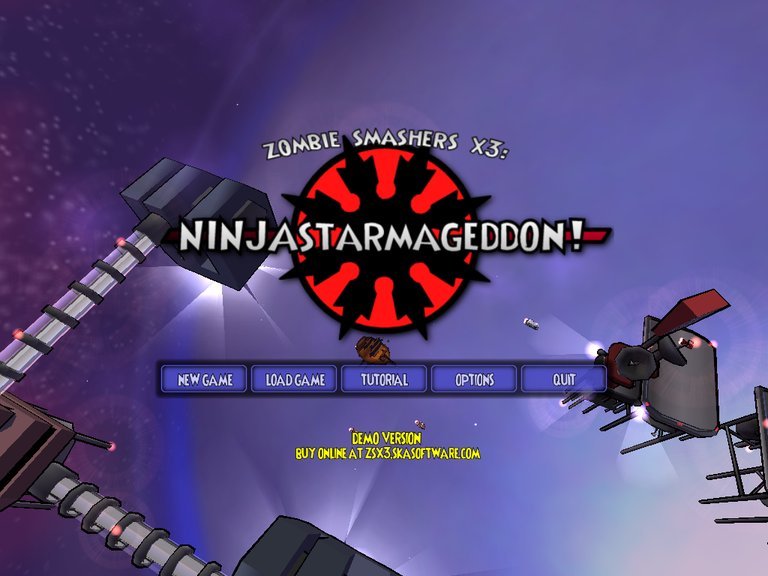
Set in a galaxy where ancient ninja-zombie enmity, space pirates, and cyborgs collide under the rule of the Pterodactyl Government, Zombie Smashers X3: Ninjastarmageddon is a 3rd person space trading game where players choose a spacecraft, character, and co-pilot to trade goods, engage in combat, and explore star systems with services like supermarkets and shipyards, all while managing cargo and navigating cel-shaded chaos with a humorous twist.
Zombie Smashers X3: Ninjastarmageddon Patches & Updates
Zombie Smashers X3: Ninjastarmageddon Reviews & Reception
myabandonware.com : was an above-average ninja title in its time.
Zombie Smashers X3: Ninjastarmageddon: Review
Introduction
In the constellation of cult PC gaming obscurities, few stars shine with the bewildering brilliance of Zombie Smashers X3: Ninjastarmageddon! (ZSX3). Released on January 1, 2007, by Ska Studios, LLC, this third-person space-trading simulator is a glorious anomaly—a genre-defying cocktail of Elite-style commerce, Freelancer-esque combat, and absurdist humor fueled by ninjas, zombies, pterodactyls, and cyborgs. As the third entry in the Zombie Smashers X series following Punx and Skins (2005), ZSX3 emerged from the indie renaissance of digital distribution, a testament to James Silva’s audacious vision. Yet, despite its critical acclaim (a robust 88% average score) and devoted fanbase, it remains a footnote in mainstream gaming history. This review dissects ZSX3’s legacy, dissecting its mechanics, narrative, and impact as a flawed yet indispensable gem of mid-2000s PC gaming.
Development History & Context
The Ska Studios Genesis
ZSX3 was crafted by Ska Studios—a fledgling outfit founded by James Silva—who served as designer, programmer, and composer alongside collaborator “Roger.” The project was a labor of passion, with a lean team of 21 contributors (including playtesters like Steven Bergstrom “Stevemata” and Vyacheslav Yampolsky). Technologically constrained by its Windows-exclusive shareware model (41 MB download), ZSX3 leveraged DirectX for cel-shaded visuals and DirectInput for controls, eschewing AAA ambitions in favor of indie ingenuity.
Vision in a Vacuum
Silva’s ambition was to distill the essence of space trading games into an accessible, action-packed experience. Inspired by classics like Elite and Freelancer, he injected irreverent humor and unconventional faction dynamics—ninjas and zombies, forced into proximity by the profit-driven Pterodactyl Government, with pirates and cyborgs as chaotic wildcards. The era’s gaming landscape, dominated by military shooters and sprawling RPGs, left room for ZSX3’s niche: a “loopy, fun” (Bytten) alternative unshackled from realism.
Narrative & Thematic Deep Dive
The Absurd Galaxy
ZSX3’s premise is a masterstroke of deadpan satire: after centuries of earthbound conflict, ninjas and zombies colonize space separately, only to be reunited by the Pterodactyl Government’s trade policies. This cosmic farce escalates into “Ninjastarmageddon,” pitting players against pirates, assimilation-hungry cyborgs, and the eternal ninja-zombie feud. The narrative unfolds through mission briefs and NPC banter, delivered with B-movie zeal (e.g., zombie grunts: “B-R-A-I-N-S!!”).
Factional Farce
– Ninjas: Swift, stealthy vessels with sleek, dark aesthetics.
– Zombies: Goo-covered ships favoring brute force and cargo plunder.
– Pterodactyls: Corporate overlords controlling trade hubs like the “Ultra-Shopper-Mart.”
– Cyborgs: Metallic marauders seeking forced assimilation.
– Pirates: Chaotic opportunists thriving in lawless nebulae.
Themes of corporate greed (via the Pterodactyls) and futility (e.g., zombie quests for brains) lampoon space opera tropes, while dialogue crackles with anachronistic wit (e.g., Captain Zombinator’s threats). The story’s strength lies in its commitment to chaos—missions range from smuggling gas canisters to escorting ninja emissaries through pirate territory, always underscored by absurdity.
Gameplay Mechanics & Systems
Core Loops: Trade, Combat, Progression
ZSX3’s gameplay revolves around three interwoven systems:
-
Commerce & Logistics:
Players start with a “space-worthy jalopy” or minivan, then traverse “node” star systems via a galactic map. Each node offers facilities: banks (save/load), supermarkets (trade goods like “Kittens” or “Clothes”), shipyards (upgrades), weapon stores, and even “Gas Blaster” stations (fueling cars in space). Trading is simple yet strategic—buy low, sell high—but faction hostility risks cargo losses. -
Combat & Tactics:
Real-time combat emphasizes skill over gear. Players pilot ships with primary weapons (forward-firing lasers) and secondary weapons (e.g., missiles, rockets), controlled via keyboard/mouse. Hostile encounters trigger dogfights, with enemy hit points displayed above ships. Destroyed vessels drop loot, retrievable via tractor beam. The co-pilot system adds depth—players manually deploy secondary weapons while dodging fire. -
Progression & Customization:
Starting small, players upgrade to “galleon” class ships, which trade cargo space for “fighter craft” launch bays (e.g., deploying jeeps as support units). This creates meaningful choices: prioritize firepower or cargo capacity? Ship variety—from nimble jeeps to lumbering minivans—ensures distinct playstyles.
UI & Quirks
The interface is functional but cluttered, with menus for missions, inventory, and shipyards. Direct controls feel responsive, though the tractor beam can be finicky. Shareware limitations (e.g., restricted content) encourage registration, but the core loop remains engaging.
World-Building, Art & Sound
Visual Identity: Cel-Shaded Chaos
ZSX3’s art style is its visual anchor—vibrant, cel-shaded graphics evoke comic-book absurdity. Ship designs are intentionally ridiculous: flying minivans with rocket engines, zombie cruisers dripping goo, and ninja skiffs adorned with shuriken. Environments range from nebula-scarred voids to asteroid-ringed trade hubs, all rendered with crisp textures. Faction silhouettes are distinct, aiding quick identification in combat.
Sound Design: Eclectic Energy
James Silva’s soundtrack is a genre-blending triumph: techno beats chime with chiptune melodies during dogfights, while soma.fm radio cues (per the credits) mimic B-movie broadcasts. Sound effects are exaggerated—explosions “pop” with particle swirls, and weapon impacts satisfy. The audio landscape amplifies the game’s manic tone, making hyperspace jumps feel like joyrides through a lunatic asylum.
Reception & Legacy
Critical Acclaim & Cult Status
At launch, ZSX3 earned praise for its humor and accessibility. Bytten lauded it as “not enslaved to the laws of physics,” awarding 91%, while Gameplay (Benelux) called it a “toegankelijke Privateer-kloon” (accessible Privateer-clone) with 85%. Players scored it 4.2/5, citing its “rad soundtrack” and emergent stories (e.g., tractor-beaming cargo past pirate fleets). Yet, its shareware model and niche appeal limited mainstream visibility.
Historical Footprint
ZSX3 represents a pre-boom indie experiment—digital distribution enabling creativity without publisher constraints. Its influence is subtle: the “quirky faction” trope and arcade-space-flight hybrid echo in titles like Star Traders: Frontiers. However, Ska Studios’ later success (e.g., The Dishwasher: Vampire Smile) overshadowed ZSX3, which now persists as abandonware on sites like MyAbandonware. Redditors recall its “hilarious and strange” charm, while preservationists note its runtime errors (e.g., ActiveX failures) on modern systems.
Conclusion
Zombie Smashers X3: Ninjastarmageddon! is a flawed masterpiece—a testament to indie ambition where audacity outweighs polish. Its space-trading loop, infused with ninja-zombie slapstick and co-pilot combat, remains uniquely compelling. Though UI clutter and technical quirks mar its execution, ZSX3’s irreverent soul endures. As a relic of 2007’s digital frontier, it exemplifies how constraints breed creativity. For players seeking a “loopy” alternative to AAA space epics, ZSX3’s Ninjastarmageddon is not just a game—it’s a time capsule of unbridled, absurd fun.
Verdict: An essential, if overlooked, artifact of indie gaming history. 4.2/5.