
- Release Year: 2004
- Platforms: Windows
- Publisher: Totally Screwed Software
- Developer: Totally Screwed Software
- Genre: Action
- Perspective: Side view
- Game Mode: LAN, Online PVP, Single-player
- Gameplay: Arcade, Shooter
- Setting: Dinosaurs, Zombies
Description
Zombies and Pterodactyls 2005 is a freeware multiplayer side-scrolling shooter with a bizarre premise: a pterodactyl equips zombies with weapons, prompting humans to receive guns and engage in a chaotic war, all organized by pterodactyls as a twisted game. The game features 16 character skins, 5 maps (including capture-the-flag and deathmatch modes), and special variants like Crazy Weapons and Kill the Ghost for online, LAN, or bot play, offering fast-paced, humorous combat in a surreal setting.
Zombies and Pterodactyls 2005 Reviews & Reception
myabandonware.com : Can’t run some imported classes inside the project are not registered in win 10… This is sad 🙁
Zombies and Pterodactyls 2005: A Freeware Frenzy Forged in Absurdity
Introduction: The Unlikeliest of Multiplayer Mayhem
In the vast, uncatalogued archives of PC gaming history, certain titles exist not as industry touchstones or commercial juggernauts, but as pure, unadulterated expressions of a specific time, place, and psyche. Zombies and Pterodactyls 2005 (often abbreviated ZP2K5) is one such title. Released in late 2004 into an online multiplayer landscape dominated by the serious militarism of Counter-Strike and the sci-fi grandeur of Halo: Combat Evolved, this freeware side-scroller from the self-deprecatingly named Totally Screwed Software arrived like a pie in the face of convention. Its thesis is a masterclass in ludicrous simplicity: a pterodactyl arms zombies, humans get guns from pterodactyls, and a three-way war erupts overseen by dinosaur spectators. This review will argue that Zombies and Pterodactyls 2005 is a significant, if niche, artifact of the early 2000s indie scene—a game whose true legacy lies not in its polish or sales, but in its unwavering commitment to chaotic, accessible fun and its prescient embrace of modular, rule-bending game design long before “game modes” became standardized publisher checklist items. It is a forgotten pioneer of the “anything goes” party shooter, a title that prioritizes the spontaneous narrative of a match over any grand narrative of its own.
Development History & Context: The “Totally Screwed” DIY Ethos
To understand ZP2K5, one must first understand its creator, James Silva, and the studio he operated under: Totally Screwed Software. The MobyGames credits paint a picture of an ultra-micro-team. Silva single-handedly handled Code, Graphics, Maps, and Models—a testament to the jack-of-all-trades ethos required of indie developers in the early 2000s, before robust asset stores and accessible game engines like Unity or Godot. His sole collaborators were Joel Snavely, credited for Sounds “whether he likes it or not” (a wonderfully telling detail about the informal, likely friendship-based nature of the project), and Vyacheslav Yampolsky (Slava), who contributed something “can’t remember,” and Monique, who provided “The Idea for the Fireworks Dedicated Servering.”
This context is crucial. ZP2K5 was not forged in a corporate R&D lab but in the quiet, uncompromising space of a hobbyist’s bedroom. The technological constraints were those of the early-mid 2000s PC: DirectX 7/8 era 2D sprite rendering, software or basic hardware acceleration, and the limited networking stacks of the day for its Internet and LAN multiplayer. The business model—pure freeware/public domain—was a direct rejection of the retail-dominated market. This was a “passion project” in its purest form, intended for distribution via sites like MyAbandonware and word-of-mouth, its value measured in downloaded megabytes and played matches, not dollars.
The gaming landscape of its release (November 2004) was one of transition. Consoles were entering the HD era, but PC multiplayer was still largely defined by the mod scene (Counter-Strike, Day of Defeat) and a wave of arena shooters (Unreal Tournament 2004). ZP2K5’s choice of a 2D side-scroller was both a technical shortcut (easier to code and asset-create for one person) and a deliberate stylistic homage to classics like Contra or Metal Slug, but stripped of linear progression for pure, repeatable multiplayer chaos. Its existence speaks to a persistent undercurrent of DIY game development that thrived on absurdist humor and focused gameplay loops, a lineage traceable through Silva’s own subsequent series, “Zombie Smashers X,” and other oddities of the era like Liero or Soldat.
Narrative & Thematic Deep Dive: Absurdism as a Design Philosophy
Zombies and Pterodactyls 2005 possesses a narrative, but it is one entirely subservient to gameplay and tone. The game’s description—the official, canonical story—is a brief, hilarious paragraph of escalating, causeless absurdity. It begins with agency: “One day a pterodactyl decides…” This isn’t a catastrophe or a scientific experiment; it’s a whimsical, malicious whim. The pterodactyl’s motivation is pure, unstructured fun. The subsequent actions are a cascade of irrational, reactive logic: humans try to kill pterodactyls, pterodactyls respond by giving them guns (a solution that pleases the humans), humans then decide to kill zombies, and the zombies are portrayed as bemused victims of circumstance (“they didn’t really want to kill humans”). The narrative climax is the pterodactyls’ meta-realization: this violent spectacle is a “great new game.” They transition from instigators to bookmakers, “flying in competitors” to stage battles.
This is not a story of survival or heroism; it’s a story of narrative nihilism. Themes are brushed against with a wink:
* The Absurdity of Factional Conflict: The core Human vs. Zombie war is rendered meaningless by its artificial, arbitrary origin. Neither side has a just cause; they are puppets in a pterodactyl’s game. This satirizes the often flimsy lore behind faction-based multiplayer shooters.
* Lack of Agency & Existential Frustration: The zombies’ explicit desire not to fight, and their subsequent being ignored (“No one ever cares what zombies want”), injects a darkly comic, almost Camusian layer. They are the ultimate disaffected group, conscripted into a conflict they despise.
* Meta-Gaming & Spectatorship: The pterodactyls represent the ultimate spectators and gamemakers. They don’tparticipate; they curate, setup, and enjoy the chaos. This reflects the player’s own role in a multiplayer match—creating ephemeral stories within a pre-set system.
The story is delivered not through cutscenes or dialogue, but purely as paratextual premise and environmental storytelling. The character skins (soldiers, zombies, etc.) imply roles, but the true narrative emerges from the interactions on the battlefield: a stalemate at the flag, a rocket-jump to a hidden sniper perch, the sudden panic when “Crazy Weapons” mode turns your trusty shotgun into a pea shooter. The game’s true plot is the one the players write together in each match.
Gameplay Mechanics & Systems: Chaotic Elegance in Simplicity
ZP2K5’s genius lies in its distillation of multiplayer shooter fundamentals into a lean, side-scrolling package with a remarkable array of modular rule-sets. The core loop is immediate: choose a skin (from 16 options), a map, a mode, and engage in 2D platforming gunplay. Movement is weightless and responsive, focused on jumping between platforms and dodging horizontally. Weapons range from hitscan pistols and shotguns to arcing grenades and powerful rocket launchers, all with clear, arcade-style stats.
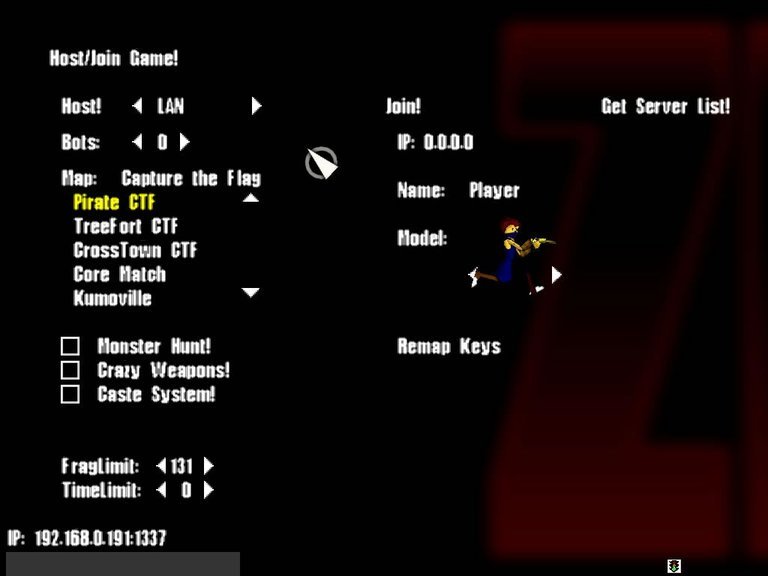
The game’s true depth is revealed in its mode configurations, which apply on top of the five base maps (3 Capture the Flag, 2 Deathmatch, 1 King of the Hill):
- Normal: The pure, unadulterated base experience. A solid, if simple, test of aim and map knowledge.
- Crazy Weapons: A stroke of design brilliance. Every 15 seconds, the attributes (damage, fire rate, projectile speed) of all weapons in the game are randomized. This obliterates any established meta, forces constant adaptation, and turns every match into a hilarious, unpredictable scramble. It’s a systemic joke that keeps gameplay perpetually fresh.
- Caste System: A fascinating inversion of class-based shooters. Here, your chosen character skin determines your starting weapon. A “zombie” skin might start with a shotgun, a “human” with an assault rifle. Crucially, you can still pick up and swap to other weapons from the field, but your spawn loadout is fixed. This creates a unique strategic layer: team composition matters at the spawn screen, and players must decide whether to stick with their caste’s weapon or seek a better one, adding a resource-management tension to the frantic action.
- Kill the Ghost: A brilliant asymmetric mode playable only in Deathmatch and King of the Hill. One player is the “Ghost”: they see the fully lit map, have 100 health, and are the target. All others are “Ghost Hunters”: their vision is limited to their flashlight cone (a dynamic light source in a dark map), they have only 30 health, and must cooperate to find and kill the Ghost. The Killer becomes the new Ghost. This transforms the game into a tense horror/survival experience within its simple engine, leveraging lighting mechanics and paranoia to create something wholly distinct from the core shooter gameplay.
The UI and menus are functional, spartan, and clear—perfectly adequate for the task. Bot support allows for practice, and the networking code (Internet/LAN) is robust enough for its era, focusing on low-latency action. The weapon pick-up system is straightforward, ammo is plentiful, and health is rarely a concern outside of the Ghost Hunters’ 30% max. The design philosophy is clear: remove friction, maximize velocity. There are no complex tech trees, no character progression, no unlocks. The only progression is the player’s skill and the emergent story of the current match.
World-Building, Art & Sound: Maximizing Minimalism
The visual presentation of ZP2K5 is a masterclass in efficient, communicative sprite-based design. Silva’s graphics, while simple by modern standards, are crisp, colorful, and highly readable. The 16 character skins are distinct silhouettes and color palettes, a necessity in the chaotic side-scrolling bloodbath. A zombie in tattered clothes is instantly recognizable against a soldier in camo, even at a glance amidst explosions. The map design is equally purposeful. The five arenas use a limited tile set but employ verticality, one-way gates, hidden alcoves, and open kill-zones to create interesting tactical spaces. A CTF map might have a high, risky shortcut or a low, ambush-prone corridor, rewarding map knowledge and aggressive play.
The art direction fully commits to its absurdist tone. Pterodactyls occasionally flap through the background or foreground—a non-interactive but constant reminder of the premise. Explosions are bright and blocky. Muzzle flashes are stark white sprites. There is no attempt at realism; everything is a video game archetype. This consistency makes the game feel cohesive and charming, like a moving, interactive Saturday morning cartoon. The environments, while simple (caves, military bases, generic outdoor areas), are populated with small, humorous details that reinforce the “huge mess” described in the narrative.
Sound design, credited to Joel Snavely, is functional and effective within the game’s scope. We have the expectedpop** of guns, the crump of explosions, and the satisfying splat of a hit. The audio is clean, not overwhelming, and provides essential feedback for a game where visual chaos is constant. Notably, there are no character voice lines or elaborate soundscapes—the world is quiet except for the sounds of conflict, which keeps the focus squarely on the gameplay. The soundtrack, if one exists beyond perhaps a title screen loop, is not documented in the sources, suggesting its absence or extreme minimalism, which fits the pure-arcade ethos.
Reception & Legacy: The Cult of the Obscure
Zombies and Pterodactyls 2005 existed in a state of near-perfect obscurity at release. It received zero professional critic reviews on MobyGames and only two player ratings (averaging 3.2/5) over years of cataloging. It was not a game that graced the cover of PC Gamer or sparked forum flamewars. Its distribution was through the freeware and abandonware channels, places like MyAbandonware, where it garnered a mere 8 votes with a 4/5 average. This is the reception of a true cult object: known only to a handful of players who stumbled upon it in the vast depths of the internet, downloaded its 4 MB package, and had a brief, joyful fling with its chaos.
Its legacy, therefore, is not one of direct industry influence but of proof-of-concept and spirit. It demonstrates that a compelling, replayable multiplayer experience can be built with:
* A single, absurd narrative hook.
* One developer with a clear vision.
* A small set of well-tuned mechanics.
* The clever use of modifier modes to multiply content without creating new assets (Crazy Weapons, Caste System).
The existence of a sequel, ZP2K9 (2009), prove that Silva and possibly others returned to this well of chaotic design. More broadly, ZP2K5 can be seen as a precursor to the thriving modern scene of asymmetric indie multiplayer games (Duck Game, SpeedRunners, Rivals of Aether) and games that build depth through quirky, specific rulesets rather than complexity. Its “Kill the Ghost” mode is a direct ancestor to the kind of innovative, limited-time modes that major publishers now tout in games like Fortnite or Apex Legends, but conceived in a 4 MB freeware package with no monetization. It is a testament to the idea that gameplay innovation is not solely the domain of AAA budgets.
Conclusion: A Tiny Titan of Unfiltered Fun
Zombies and Pterodactyls 2005 is not a game that changed the world. It did not sell millions, redefine graphics, or spawn a genre. Its surface is thin, its production values quaint, and its reach microscopic. Yet, to dismiss it would be to miss its staggering achievement: it is a perfectly formed, functionally complete, and deeply enjoyable multiplayer shooter that delivers exactly on its bizarre promise with zero bloat.
Its historical importance is as a pure artifact of indie design. It shows what can be accomplished with a singular, focused vision, a grasp of core game feel, and the courage to build entire gameplayVariants out of simple rule swaps. It is the antithesis of the bloated modern live-service shooter. Here, there are no battle passes, no microtransactions, no lengthy unlocks. There is only the match: the frantic jump, the perfectly timed grenade, the absurd moment when your weapon randomly becomes a beam of death, the tension of hunting a ghost with a flickering flashlight.
In the canon of video game history, Zombies and Pterodactyls 2005 deserves a footnote not as a classic, but as a curio and a spirit. It represents a moment when the barrier to entry for multiplayer game creation was low enough for a single person to build a complete, weird, and fun experience and set it loose upon the world for free. For historians, it is a vital data point on the evolution of game modes and modular design. For players, it remains a charming, downloadable time capsule—a reminder that sometimes, all you need for a great game is a pterodactyl with a bad idea and a bunch of armed zombies. Verdict: An obscure, brilliant gem of freeware design. Its value is not in what it takes, but in what it gives: pure, unadulterated, absurdist chaos.